





Why Delamination Happens in Flexible Packaging
What Is Delamination in Flexible Packaging?
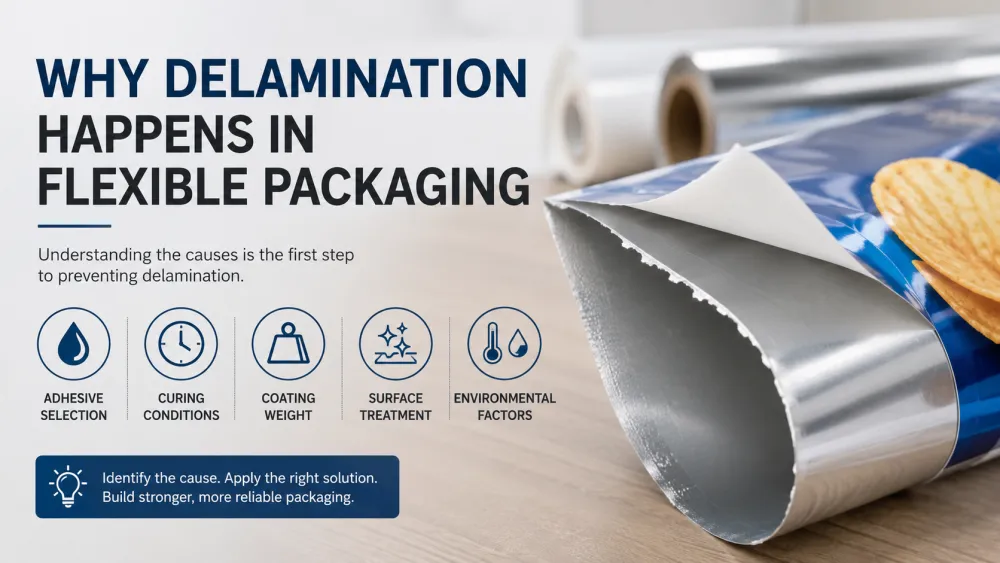
Delamination is one of the most common and costly quality problems in flexible packaging production. It occurs when two or more laminated layers partially or completely separate from each other, reducing the structural integrity and performance of the package.
In a properly laminated structure, the adhesive layer creates a permanent bond between substrates such as PET, PE, CPP, aluminum foil, paper, or nylon films. When this bond fails, the package may lose barrier performance, sealing reliability, appearance quality, and overall product protection.
Delamination can occur immediately after lamination, during curing, during slitting, during pouch conversion, or even after the finished package reaches the customer. Understanding why delamination happens is critical for improving packaging quality and reducing production waste.
Why Delamination Is a Serious Packaging Problem
Many packaging manufacturers initially view delamination as a cosmetic issue. In reality, it can create serious performance and financial consequences.
Common problems caused by delamination include:
- Reduced package strength
- Loss of barrier protection
- Poor sealing performance
- Shorter product shelf life
- Customer complaints and rejected shipments
- Increased production waste
- Downtime for troubleshooting and quality inspection
For high-barrier food packaging, coffee packaging, pharmaceutical packaging, and retort applications, even minor delamination can result in significant product quality issues.
Poor Surface Treatment
One of the most common causes of delamination is insufficient surface treatment of the substrate before lamination.
Most flexible packaging films require corona treatment or similar surface activation processes to increase surface energy and improve adhesive bonding.
If surface tension is too low, the adhesive cannot properly wet the film surface, resulting in weak bond strength.
Common Surface Treatment Problems
- Low dyne level on film surface
- Corona treatment deterioration during storage
- Contamination from dust, oil, or moisture
- Incorrect treatment level for the substrate
How to Prevent Surface Treatment Issues
- Measure dyne levels before production.
- Use fresh materials when possible.
- Store films under suitable conditions.
- Avoid contamination during handling.
- Verify treatment levels according to adhesive supplier recommendations.
Incorrect Adhesive Selection
Even when machine settings are correct, an unsuitable adhesive can lead to poor bond strength and eventual delamination.
Different packaging structures require different adhesive properties. An adhesive suitable for PET/PE packaging may not provide optimal performance for PET/AL/PE or retort pouch structures.
Common adhesive selection mistakes include:
- Using general-purpose adhesive for specialized applications
- Ignoring temperature resistance requirements
- Selecting adhesives incompatible with the substrate
- Overlooking food packaging compliance requirements
- Using adhesives with insufficient final bond strength
Manufacturers should evaluate adhesive performance together with material structure, packaging application, and production process. For a detailed guide, see How to Choose an Adhesive for Flexible Packaging Lamination.
Insufficient Adhesive Coating Weight
Adhesive coating weight directly influences bond strength. If the coating is too low, there may not be enough adhesive to create a reliable bond between substrates.
Insufficient coating weight can occur because of:
- Incorrect coating roller settings
- Adhesive viscosity fluctuations
- Operator adjustment errors
- Coating system wear
- Production speed changes
Although reducing coating weight may lower adhesive consumption, excessive reduction can significantly increase the risk of delamination.
Recommended Actions
- Regularly verify coating weight.
- Monitor adhesive viscosity.
- Inspect coating equipment.
- Maintain stable operating parameters.
Improper Adhesive Mixing Ratio
Many polyurethane adhesive systems require accurate mixing of multiple components before application.
If the mixing ratio is incorrect, the adhesive may not cure properly and final bond strength can be severely affected.
Typical causes include:
- Incorrect mixing equipment calibration
- Operator errors
- Improper adhesive preparation procedures
- Equipment maintenance issues
Even small deviations from the recommended ratio may create long-term bonding problems that are not immediately visible after lamination.
Insufficient Curing Time
Curing is one of the most overlooked causes of delamination.
After lamination, many adhesive systems continue to react chemically and develop bond strength over time. If rolls are slit, converted, or tested too early, the adhesive may not have reached its final performance level.
Common curing-related problems include:
- Premature slitting
- Premature pouch making
- Low curing temperature
- Insufficient curing duration
- Improper storage conditions
Manufacturers should always follow adhesive supplier recommendations regarding curing conditions and bond strength development.
Residual Solvent Problems
Residual solvent can be a major cause of delamination in dry lamination processes.
If the drying tunnel does not completely remove solvent before lamination, the remaining solvent may interfere with adhesive performance and reduce bond strength.
Potential causes include:
- Insufficient drying temperature
- Excessive production speed
- Poor airflow distribution
- High coating weight
- Inadequate drying tunnel design
Dry lamination systems require careful control of drying conditions to minimize residual solvent and ensure proper adhesive performance.
Poor Web Tension Control
Web tension affects nearly every stage of the lamination process.
Unstable tension can create stress within the laminate structure, resulting in bond failure during curing, slitting, or downstream converting.
Typical tension-related issues include:
- Excessive winding tension
- Uneven tension between substrates
- Poor tension control during acceleration and deceleration
- Incorrect tension settings for thin films
Stable tension control is especially important when laminated rolls are later processed by slitting and pouch-making equipment.
Material Compatibility Issues
Not all packaging materials behave the same during lamination. Some structures are naturally easier to laminate than others.
For example, PET/PE and PET/CPP are among the most common flexible packaging structures, but they have different sealing characteristics, thermal behavior, and adhesive requirements.
Material compatibility problems may involve:
- Different thermal expansion rates
- Surface treatment variations
- Film shrinkage differences
- Chemical incompatibility with adhesive systems
Manufacturers should evaluate both substrate performance and adhesive compatibility during material selection. For a structure comparison, see PET/PE vs PET/CPP.
How to Diagnose Delamination Problems
Successful troubleshooting requires a systematic approach rather than changing multiple parameters at once.
When delamination occurs, manufacturers should investigate:
- Material specifications and surface treatment levels
- Adhesive type and mixing ratio
- Coating weight consistency
- Drying performance (for dry lamination)
- Curing conditions
- Web tension settings
- Production records and machine parameters
Documenting production conditions helps identify patterns and reduce future troubleshooting time.
How to Prevent Delamination
Preventing delamination is more effective and less expensive than correcting problems after production.
Best practices include:
- Use suitable substrates for the packaging application.
- Verify surface treatment before lamination.
- Select adhesives according to structure requirements.
- Maintain accurate adhesive mixing ratios.
- Monitor coating weight continuously.
- Ensure proper drying conditions.
- Control web tension throughout production.
- Allow sufficient curing time.
- Train operators on quality control procedures.
- Perform regular bond strength testing.
These preventive measures significantly reduce the risk of bond failure and improve overall packaging quality.
Solventless vs Dry Lamination and Delamination Risk
Both solventless and dry lamination can produce excellent bonding performance when properly controlled. However, each process has different quality control requirements.
In solventless lamination, bond strength depends heavily on adhesive mixing accuracy, coating consistency, curing conditions, and substrate compatibility.
In dry lamination, additional variables such as solvent evaporation, drying tunnel performance, and residual solvent control must also be managed.
Manufacturers evaluating production methods should understand the strengths and limitations of each process. For a complete comparison, see Solventless vs Dry Lamination.
Depending on the packaging structure and production requirements, manufacturers may choose either Solventless Laminating Machines or Dry Laminating Machines.
Conclusion
Delamination is one of the most important quality challenges in flexible packaging lamination. While the visible symptom is separation between layers, the root causes often involve surface treatment, adhesive selection, coating weight, curing conditions, residual solvent, web tension, or material compatibility.
By understanding these factors and implementing systematic process control, manufacturers can significantly improve bond strength, reduce waste, and produce more reliable flexible packaging products.
Successful lamination depends on the combined performance of materials, adhesives, equipment, and process management. Identifying the true cause of delamination is the first step toward building a stable and efficient packaging production operation.
FAQ: Why Delamination Happens in Flexible Packaging
What is delamination in flexible packaging?
Delamination occurs when laminated layers partially or completely separate from each other because the bond strength between substrates is insufficient.
What is the most common cause of delamination?
The most common causes include poor surface treatment, incorrect adhesive selection, insufficient coating weight, improper curing, residual solvent, and unstable web tension.
Can incorrect adhesive selection cause delamination?
Yes. Using an adhesive that is not suitable for the material structure or packaging application can significantly reduce bond strength and increase the risk of delamination.
How does curing affect bond strength?
Many adhesives require curing time to reach their final performance level. Insufficient curing can result in weak bonding and eventual delamination.
Does web tension affect delamination?
Yes. Excessive or unstable web tension can introduce stress into the laminate structure and contribute to bond failure.
Can residual solvent cause delamination?
Yes. In dry lamination processes, residual solvent may interfere with adhesive performance and reduce final bond strength.
How can delamination be prevented?
Delamination can be prevented through proper material selection, surface treatment verification, adhesive control, coating weight management, curing optimization, and stable tension control.
Which lamination process is more prone to delamination?
Both solventless and dry lamination can produce excellent results when properly controlled. Delamination is usually caused by process or material issues rather than the lamination method itself.