





What Is Flexible Packaging Lamination?
What Is Flexible Packaging Lamination?
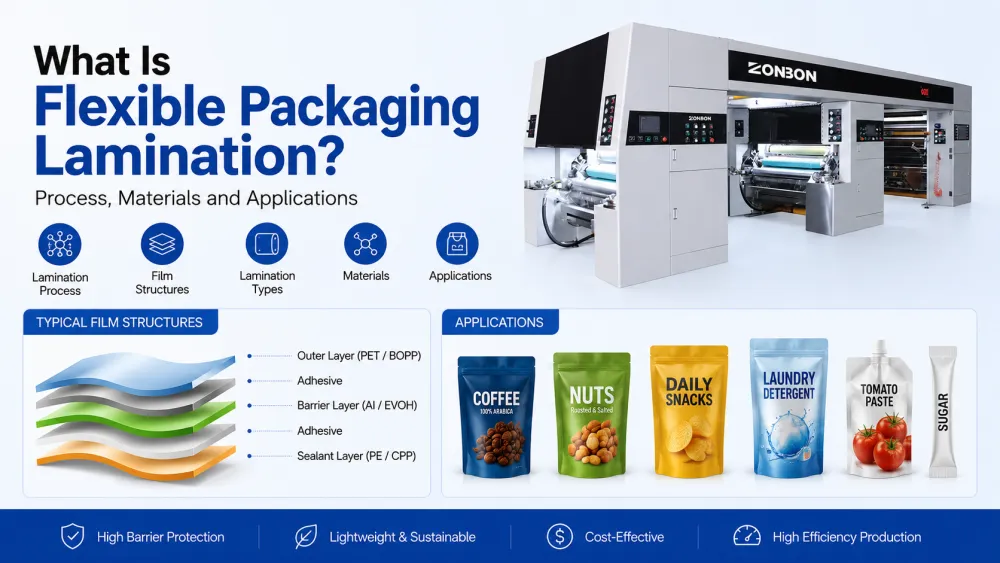
Flexible packaging lamination is the process of bonding two or more layers of film, foil, paper, or other flexible materials together to create a stronger and more functional packaging structure. Instead of relying on a single material, laminated flexible packaging combines different substrates to achieve better barrier protection, sealing performance, print appearance, puncture resistance, and shelf-life stability.
In flexible packaging production, lamination is usually positioned after printing and before slitting or bag making. A printed film may be laminated with PE, CPP, aluminum foil, paper, or another film layer depending on the final packaging requirement. The result is a composite material suitable for products such as food pouches, coffee bags, pet food packaging, frozen food bags, pharmaceutical packaging, liquid packaging, and personal care packaging.
For example, PET provides good printability and dimensional stability, while PE provides heat sealing performance. When PET and PE are laminated together, the structure can offer both attractive printed graphics and reliable sealing performance. This is why laminated structures such as PET/PE, PET/CPP, BOPP/PE, PET/AL/PE, and Paper/PE are widely used in modern packaging production.
Why Is Lamination Important in Flexible Packaging?
Different packaging products require different performance characteristics. A single film often cannot meet all requirements at the same time. Lamination allows packaging manufacturers to combine the advantages of multiple materials into one optimized structure.
Barrier Protection
Many packaged products are sensitive to oxygen, moisture, light, aroma loss, or external contamination. Laminated packaging can improve barrier performance and help protect the product during storage, transportation, and retail display.
Print Protection
In many flexible packaging applications, graphics are printed on the reverse side of an outer film and then protected by another laminated layer. This structure helps prevent ink abrasion, scratching, and direct contact between ink and the packaged product.
Improved Mechanical Strength
Lamination can improve puncture resistance, tear resistance, stiffness, and overall package durability. This is important for heavy products, sharp-edged products, frozen food, pet food, and transportation packaging.
Reliable Heat Sealing
Many laminated structures use PE or CPP as the inner sealing layer. This allows the material to be converted into pouches, bags, sachets, or roll stock with stable sealing performance.
Better Shelf Life
For food, pharmaceutical, and personal care products, proper lamination helps maintain product quality by reducing exposure to air, moisture, and external environmental factors.
How Does the Flexible Packaging Lamination Process Work?
A typical flexible packaging production workflow includes printing, laminating, curing, slitting, and bag making. Lamination connects the printed material with other functional layers to form the final packaging structure.
The general production process can be understood as:
- Printing: graphics are printed on films such as PET, BOPP, or other substrates.
- Lamination: two or more materials are bonded together using adhesive or extrusion coating.
- Curing: some laminated structures need time for adhesive reaction and bond strength development.
- Slitting: large laminated rolls are slit into narrower rolls according to customer requirements.
- Bag making: laminated rolls are converted into finished pouches, bags, or packaging formats.
Before lamination, many packaging manufacturers use Rotogravure Printing Machines or Flexo Printing Machines for printed packaging films. After lamination, finished rolls are commonly processed by Slitting Machines and then converted by Bag Making Machines.
Common Materials Used in Flexible Packaging Lamination
The choice of materials depends on product protection requirements, sealing needs, printing method, shelf-life expectations, and cost targets.
| Material | Main Function | Common Applications |
|---|---|---|
| PET | Printability, strength, dimensional stability | Food packaging, coffee bags, stand-up pouches |
| BOPP | High clarity, gloss, cost efficiency | Snack packaging, dry food packaging |
| PE | Heat sealing, moisture resistance | Inner sealing layer for pouches and bags |
| CPP | Heat sealing, puncture resistance | Retort packaging, food packaging, heavier bags |
| Aluminum Foil | High barrier against oxygen, moisture, and light | Coffee, pharmaceutical, high-barrier food packaging |
| Paper | Natural appearance, print surface, stiffness | Paper-based flexible packaging and sustainable packaging |
Common Flexible Packaging Lamination Structures
Different laminated structures are designed for different packaging needs. Below are common examples used in flexible packaging production.
| Structure | Main Advantage | Typical Use |
|---|---|---|
| PET/PE | Good printing surface and reliable sealing | Food pouches, daily-use packaging |
| PET/CPP | Good strength and heat sealing performance | Snack packaging, retort-related applications |
| BOPP/PE | Cost-effective and clear appearance | Dry food packaging, lightweight packaging |
| PET/AL/PE | Excellent barrier performance | Coffee bags, pharmaceutical packaging, high-barrier food packaging |
| Paper/PE | Paper appearance with sealing layer | Paper-based flexible packaging |
Types of Flexible Packaging Lamination
There are several lamination methods used in flexible packaging production. The correct choice depends on packaging structure, production speed, adhesive system, environmental requirements, and end-use application.
Solventless Lamination
Solventless lamination uses solvent-free adhesives to bond two or more substrates together. It is widely used in modern flexible packaging because it can reduce solvent emissions, lower energy consumption, and improve production efficiency.
This process is suitable for many food packaging, daily-use packaging, and general flexible packaging structures. For manufacturers focused on efficient and cleaner production, Solventless Laminating Machines are often an important equipment choice.
Dry Lamination
Dry lamination uses solvent-based adhesives. The adhesive is applied to the substrate, dried in a drying tunnel, and then laminated with another material. Dry lamination is commonly used for demanding packaging structures that require stable bond strength and high-performance results.
Dry Laminating Machines are often selected for high-barrier structures, foil-containing packaging, and applications where adhesive performance and process control are critical.
Extrusion Lamination
Extrusion lamination uses molten polymer as the bonding layer between substrates. The process can be used to create strong laminated structures and is often applied in packaging that requires special barrier, coating, or structural performance.
Extrusion Laminating Machines are commonly used for packaging structures involving paper, film, foil, and polymer coating combinations.
Solventless Lamination vs Dry Lamination vs Extrusion Lamination
Each lamination method has its own advantages. Instead of choosing only by machine type, packaging manufacturers should evaluate the final packaging application, material structure, adhesive system, production cost, and environmental requirements.
| Lamination Type | Main Feature | Best Suited For |
|---|---|---|
| Solventless Lamination | No solvent drying required, efficient production | Food packaging, general flexible packaging, cost-efficient production |
| Dry Lamination | Uses drying tunnel and solvent-based adhesive | High-barrier structures, foil structures, demanding packaging |
| Extrusion Lamination | Uses molten polymer layer for bonding or coating | Paper-film structures, liquid packaging, special barrier applications |
Applications of Laminated Flexible Packaging
Laminated flexible packaging is used across many industries because it can be customized for different products, shelf-life requirements, and packaging formats.
- Snack food packaging
- Coffee packaging
- Frozen food packaging
- Pet food packaging
- Stand-up pouches
- Spouted pouches
- Pharmaceutical packaging
- Personal care packaging
- Household product packaging
- Liquid packaging
- Paper-based flexible packaging
For example, coffee packaging often requires strong aroma protection and high barrier performance. Frozen food packaging requires durability and sealing stability under low-temperature conditions. Snack packaging often focuses on print appearance, moisture protection, and cost efficiency.
Common Problems in Flexible Packaging Lamination
Although lamination is a mature process, several quality problems may occur when materials, adhesive, machine settings, or curing conditions are not properly controlled.
- Delamination: layers separate due to insufficient bond strength or poor process control.
- Bubbles: air or solvent residue remains between layers.
- Curling: material tension or structure imbalance causes roll deformation.
- Tunneling: localized separation appears between laminated layers.
- Uneven adhesive coating: coating inconsistency affects bonding quality.
- Wrinkles: poor web tension or alignment affects roll quality.
These issues are usually related to adhesive selection, coating weight, drying conditions, web tension, nip pressure, surface treatment, and curing time. A separate troubleshooting article can further explain common lamination defects and how to fix them.
Key Factors That Affect Lamination Quality
High-quality lamination depends on both material selection and machine stability. Packaging manufacturers should pay attention to the following process factors.
Surface Treatment
Film surface tension must be suitable for adhesive bonding. Poor surface treatment can lead to weak bonding and delamination.
Adhesive Selection
Different structures require different adhesive systems. Food packaging, high-barrier packaging, and retort-related structures may require different adhesive performance.
Coating Accuracy
Stable adhesive coating helps ensure consistent bond strength across the web width.
Web Tension Control
Improper tension can cause wrinkles, curling, telescoping, and registration-related quality problems.
Curing Control
For many adhesive systems, proper curing time and temperature are necessary to develop final bond strength.
How Lamination Fits into a Flexible Packaging Production Line
Flexible packaging production is not a single-machine process. It usually requires a coordinated production line from printing to final bag forming.
A typical production flow is:
Film Preparation → Printing → Lamination → Curing → Slitting → Bag Making → Final Packaging
In this workflow, the Laminating Machines section plays a central role because it determines whether the printed material can become a functional packaging structure. If lamination quality is unstable, downstream slitting and bag making may also be affected.
For this reason, packaging manufacturers should evaluate not only the laminating machine itself, but also the compatibility between printing, lamination, slitting, and bag making equipment.
How to Choose the Right Lamination Process
Choosing the right lamination process depends on the packaging application and production priorities. Before selecting equipment or process parameters, manufacturers should clarify several questions:
- What product will be packed?
- What barrier performance is required?
- Is the packaging used for food, liquid, powder, or industrial products?
- Which structure is required: PET/PE, PET/CPP, PET/AL/PE, Paper/PE, or another combination?
- What production speed and roll width are needed?
- Are environmental or solvent emission requirements important?
- Will the laminated roll be used for pouch making, roll stock, or other converting processes?
Solventless lamination is often considered for efficient and cleaner flexible packaging production. Dry lamination is commonly used for more demanding structures and high-barrier packaging. Extrusion lamination is suitable for specific coating and bonding applications involving polymer layers.
Conclusion
Flexible packaging lamination is a key process that transforms individual films, foils, papers, and sealing layers into functional packaging structures. By combining different materials, manufacturers can improve barrier protection, mechanical strength, print durability, sealing performance, and shelf-life stability.
Understanding flexible packaging lamination helps manufacturers select the right material structure, lamination method, and production workflow. Whether the application requires solventless lamination, dry lamination, or extrusion lamination, the final goal is the same: stable production, reliable packaging performance, and consistent product quality.
FAQ: What Is Flexible Packaging Lamination?
What is flexible packaging lamination?
Flexible packaging lamination is the process of bonding two or more flexible materials together to create a composite packaging structure with improved barrier protection, strength, sealing performance, and product durability.
Why is lamination used in flexible packaging?
Lamination is used to combine the advantages of different materials. It can improve moisture resistance, oxygen barrier performance, print protection, mechanical strength, and heat sealing performance.
What are common laminated flexible packaging structures?
Common structures include PET/PE, PET/CPP, BOPP/PE, PET/AL/PE, Paper/PE, and BOPP/CPP. The correct structure depends on the packaged product and performance requirements.
What are the main types of flexible packaging lamination?
The main types are solventless lamination, dry lamination, and extrusion lamination. Each method has different advantages for specific packaging structures and production requirements.
What is the difference between solventless lamination and dry lamination?
Solventless lamination uses solvent-free adhesives and does not require solvent drying, while dry lamination uses solvent-based adhesives and requires a drying tunnel before bonding the materials together.
What products use laminated flexible packaging?
Laminated flexible packaging is widely used for snacks, coffee, frozen food, pet food, pharmaceutical products, personal care products, liquid packaging, and stand-up pouches.
Why does delamination happen?
Delamination may happen because of poor surface treatment, incorrect adhesive selection, insufficient coating weight, improper curing, poor drying, or unstable web tension during production.
Where is lamination positioned in a flexible packaging production line?
Lamination is usually positioned after printing and before slitting or bag making. The common workflow is printing, lamination, curing, slitting, and bag making.