





Flexo vs Rotogravure Printing: Which Is Better for Flexible Packaging?
Why Flexible Packaging Manufacturers Compare Flexo and Rotogravure Printing
When investing in a flexible packaging printing line, one of the most common questions buyers ask is:
Should we choose flexographic printing or rotogravure printing?
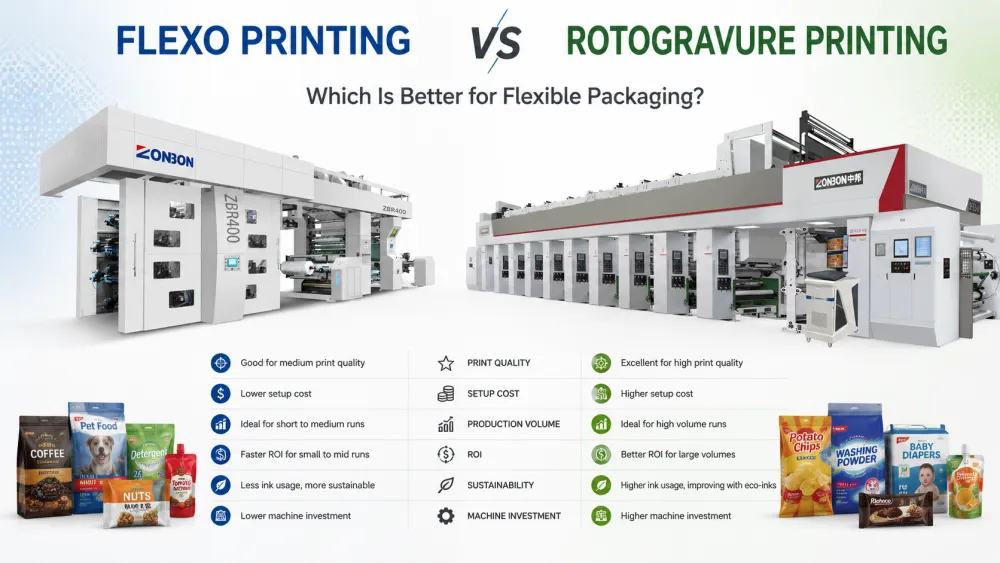
Both technologies are widely used for food packaging, coffee pouches, frozen food bags, personal care packaging, pet food packaging, and many other flexible packaging applications. However, they differ significantly in investment cost, production flexibility, print quality, changeover efficiency, and long-term return on investment.
The right choice depends less on the printing technology itself and more on your order structure, production volume, customer requirements, and future business plans.
What Is Flexographic Printing?
Flexographic printing uses photopolymer printing plates and anilox rollers to transfer ink onto packaging materials.
Modern flexographic presses are widely used for:
- Flexible packaging films.
- Food packaging.
- Frozen food packaging.
- Coffee and tea packaging.
- Courier bags.
- Personal care packaging.
- Medical packaging.
- Paper packaging.
Over the last decade, advances in servo control, plate technology, anilox rollers, and registration systems have significantly improved flexographic print quality.
What Is Rotogravure Printing?
Rotogravure printing uses engraved cylinders to transfer ink directly onto the substrate.
Each cylinder contains thousands of engraved cells that hold and release a precise amount of ink during printing.
Rotogravure printing is commonly used for:
- Large-volume flexible packaging.
- Snack food packaging.
- Tobacco packaging.
- Decorative packaging films.
- Premium consumer packaging.
- Long-run packaging production.
Because engraved cylinders are expensive to manufacture, gravure printing is often more economical when production volumes are very high.
Flexo vs Rotogravure: Key Differences
| Comparison Area | Flexographic Printing | Rotogravure Printing |
|---|---|---|
| Printing Form | Photopolymer Plates | Engraved Cylinders |
| Plate/Cylinder Cost | Lower | Higher |
| Job Changeover | Faster | Slower |
| Short-Run Production | Excellent | Less Economical |
| Medium-Run Production | Excellent | Good |
| Long-Run Production | Good | Excellent |
| SKU Flexibility | High | Lower |
| Initial Investment | Lower | Higher |
| Print Quality | Very High | Extremely High |
| Setup Waste | Lower | Higher |
Which Technology Produces Better Print Quality?
Historically, rotogravure printing has been regarded as the benchmark for premium flexible packaging because engraved cylinders provide highly consistent ink transfer and excellent tonal reproduction.
Rotogravure performs particularly well in:
- Large solid color areas.
- Smooth gradients.
- Premium decorative packaging.
- Ultra-long production runs.
However, the quality gap between flexographic and gravure printing has narrowed significantly.
Modern high-definition flexographic printing can now achieve print quality that meets the requirements of most food packaging, beverage packaging, personal care packaging, and consumer goods packaging applications.
For many packaging buyers, the difference is no longer obvious in everyday commercial packaging products.
Which Technology Is Better for Short and Medium Production Runs?
This is where flexographic printing often has a significant advantage.
Today's packaging market is increasingly driven by:
- More SKUs.
- Frequent design updates.
- Seasonal promotions.
- Private-label packaging.
- Shorter lead times.
- Smaller order quantities.
Because printing plates are less expensive and faster to produce than gravure cylinders, flexographic printing generally provides lower total production costs for short and medium production runs.
This flexibility allows converters to respond more quickly to changing customer demands.
Which Technology Is Better for Large-Volume Packaging Production?
For very large and repetitive packaging orders, rotogravure printing often remains highly competitive.
Although gravure cylinders require higher initial investment, they can deliver excellent consistency over extremely long production runs.
For converters producing the same packaging design repeatedly over many months or years, the cylinder cost can be spread across a large production volume.
This is why rotogravure remains popular in markets where production volumes are extremely high.
Flexo vs Rotogravure: Which Has Better ROI?
The answer depends on your customer base and production model.
Flexographic Printing Often Provides Better ROI When:
- You handle multiple packaging designs.
- You receive frequent repeat changes.
- You serve private-label customers.
- You run short and medium production orders.
- You need faster job changeovers.
Rotogravure Printing Often Provides Better ROI When:
- You produce extremely large order volumes.
- You run the same design repeatedly.
- You can justify cylinder investment over time.
- You focus on long production runs.
Many converters evaluate ROI based on total production cost rather than print quality alone.
Flexo vs Rotogravure for Flexible Packaging Films
Both technologies can print common flexible packaging materials such as:
- BOPP film.
- PET film.
- PE film.
- CPP film.
- Metallized film.
- Laminated packaging structures.
The decision is rarely based on substrate compatibility because both technologies are capable of handling most flexible packaging materials.
Instead, the decision usually comes down to production strategy, order structure, and long-term business goals.
Why Many Flexible Packaging Converters Choose CI Flexo Today
The growth of flexible packaging has increased demand for shorter runs, more SKU variations, and faster delivery times.
As a result, many converters are investing in CI Flexo Printing Machines because they provide:
- Lower plate costs.
- Faster changeovers.
- Excellent registration accuracy.
- Stable film handling.
- Lower startup waste.
- Improved production flexibility.
The central impression structure is particularly suitable for flexible packaging films such as BOPP, PET, PE, CPP, and laminated materials.
When Rotogravure Printing Still Makes Sense
Despite the growth of flexographic printing, rotogravure technology remains an important solution for certain markets.
Converters producing extremely large packaging volumes may continue to invest in Rotogravure Printing Machines because of their consistency and efficiency during long production runs.
Many large packaging groups continue to operate both flexographic and gravure production lines depending on customer requirements.
How to Choose the Right Printing Technology for Your Business
Choose Flexographic Printing If:
- You need faster changeovers.
- You handle many SKUs.
- You focus on short and medium production runs.
- You want lower plate and setup costs.
- You prioritize production flexibility.
Choose Rotogravure Printing If:
- You run very large production volumes.
- You repeat the same packaging designs frequently.
- You can justify higher cylinder investment.
- You focus on long-run production efficiency.
The best solution depends on your production volume, customer structure, budget, and long-term growth strategy.
Related Reading
To better understand gravure technology and how it compares with modern packaging printing systems, you may also find this article useful:
FAQ About Flexo and Rotogravure Printing
Is flexographic printing cheaper than rotogravure printing?
For short and medium production runs, flexographic printing often has lower plate and setup costs than rotogravure printing.
Does rotogravure produce better print quality?
Rotogravure traditionally offers superior image consistency, but modern flexographic printing has significantly narrowed the quality gap.
Can flexographic printing be used for flexible packaging films?
Yes. CI flexo printing machines are widely used for BOPP, PET, PE, CPP, and laminated flexible packaging materials.
Why do packaging converters switch from gravure to flexo?
Many converters seek lower setup costs, faster changeovers, reduced waste, and greater production flexibility.
Which technology is better for large-volume packaging production?
Rotogravure printing often remains highly competitive for extremely large production volumes and long production runs.