





How to Print High-Quality Napkins with Flexo
High-Quality Napkin Printing Starts with the Right Production Setup
Printed napkins are no longer used only as simple disposable tissue products. Restaurants, hotels, catering brands, coffee shops, retail tissue suppliers, and private-label companies increasingly use printed napkins to improve brand presentation and product value.
For napkin manufacturers, the challenge is not only printing a logo or pattern. The real production goal is to keep the tissue soft, control ink transfer, reduce waste, maintain stable color, and deliver consistent quality across large-volume orders.
This article explains the key production factors behind high-quality napkin printing and how manufacturers can choose a suitable flexographic printing solution for different napkin applications.
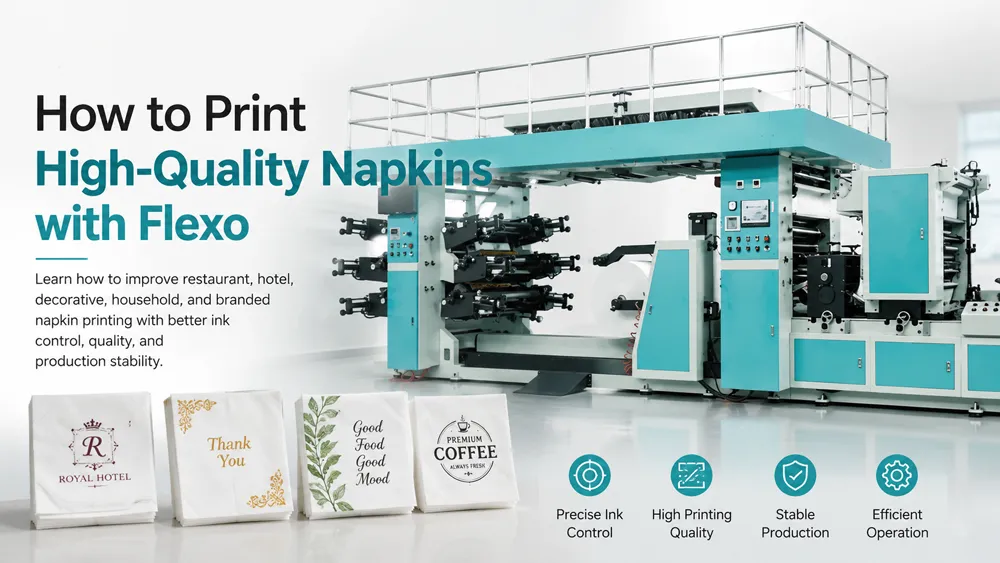
Common Napkin Printing Applications
Different napkin markets require different printing quality, production speed, and machine configuration. Understanding the final application helps manufacturers choose the right printing process and equipment setup.
Restaurant Napkin Printing
Restaurant napkins often include brand logos, simple color designs, slogans, or promotional messages. These products usually require stable repeat printing, clear logo edges, and consistent color across high-volume orders.
For restaurant chains and fast-food brands, consistent printed napkins help strengthen brand recognition while keeping production cost under control.
Hotel and Catering Tissue Products
Hotels, event venues, and catering companies often require napkins with a cleaner visual appearance, better softness, and more premium decorative printing.
In this application, color stability and surface cleanliness are especially important because printed napkins are part of the guest experience.
Decorative Tissue Printing
Decorative tissue products may include floral patterns, seasonal designs, festive graphics, or multi-color patterns. These designs require better registration control and stable ink transfer to avoid blurry patterns or uneven color.
Household Tissue Products
Household napkins sold through retail channels often require decorative printing that looks attractive on shelves and remains consistent from batch to batch.
For this market, manufacturers usually need a balance between production efficiency, print quality, and material cost.
Custom Branded Napkins
Custom branded napkins are widely used by coffee shops, bakeries, restaurants, event companies, airlines, and private-label brands. These jobs may involve smaller batches, frequent design changes, and different color requirements.
A flexible printing setup helps manufacturers respond faster to customer orders without excessive setup waste.
Key Challenges in Napkin Printing Production
Napkin printing is different from printing on packaging film, label stock, or thicker paper. Tissue materials are lightweight, absorbent, and easy to deform during production. These material characteristics create several common production challenges.
Ink Penetration and Blurry Printing
Tissue paper absorbs ink more easily than coated paper or plastic film. If ink transfer is not controlled properly, printed logos and patterns may become blurry, dark, or uneven.
Manufacturers need to choose suitable ink, anilox roller configuration, printing pressure, and drying conditions to maintain clean print edges.
Color Variation Between Batches
For restaurant chains, hotels, and branded napkin buyers, color consistency is important. If the same logo appears different from one batch to another, it can affect brand presentation.
Stable ink supply, controlled printing pressure, and consistent production parameters help reduce color variation.
Tissue Wrinkling or Web Instability
Napkin tissue is soft and thin. Improper tension control may cause wrinkles, web movement, folding issues, or even material breakage during printing.
A stable web handling system is important for reducing interruptions and maintaining continuous production.
Poor Pattern Registration
Decorative napkins and multi-color custom designs require accurate registration. If the material shifts during printing, patterns may become misaligned.
Registration stability is especially important for decorative tissue printing and high-value custom branded napkins.
Excessive Setup Waste
Frequent order changes can increase waste, especially for custom branded napkin production. Reducing setup time and improving adjustment accuracy can help manufacturers control production cost.
How to Improve Napkin Printing Quality
High-quality napkin printing depends on more than the printing machine itself. It requires a balanced setup involving material selection, ink control, tension management, drying performance, and operator experience.
Choose the Right Tissue Material
Different tissue materials behave differently during printing. Virgin tissue, recycled tissue, embossed napkin paper, colored tissue, and multi-ply materials all require different production settings.
Before mass production, manufacturers should test tissue absorbency, surface strength, softness, and thickness to avoid printing defects.
Control Ink Transfer Carefully
Ink volume must be suitable for tissue material. Too much ink may cause bleeding, while too little ink may result in weak color or incomplete graphics.
Proper anilox selection, ink viscosity control, and stable doctor blade performance are important for clean and repeatable printing.
Maintain Stable Web Tension
Stable tension control helps reduce wrinkling, web shifting, and material breakage. This is especially important when printing thin or soft napkin tissue at higher speeds.
Match Drying Performance to Ink and Material
Drying must be strong enough to prevent smearing, but not so aggressive that it affects tissue softness or causes unnecessary energy consumption.
For tissue napkin printing, drying balance is important for both print quality and product feel.
Reduce Setup Time for Custom Orders
Custom branded napkin production often requires frequent design changes. Faster adjustment and repeatable machine settings help reduce waste and improve delivery speed.
How to Choose a Printing Solution for Napkin Production
When selecting equipment for napkin printing, manufacturers should focus on actual production requirements instead of only comparing machine price.
Application Type
Restaurant napkins, hotel napkins, decorative napkins, household napkins, and custom branded napkins may require different color configurations and production speeds.
Number of Printing Colors
Simple logo printing may only need one or two colors, while decorative tissue products may require more color stations for complex patterns.
Material Range
The machine should match the tissue material used in production, including tissue thickness, ply structure, embossing condition, and roll width.
Production Capacity
Factories serving restaurant chains, hotels, or retail tissue markets often need stable continuous production capacity to meet delivery schedules.
Changeover Requirements
If your factory handles many custom branded napkin orders, faster setup and easier adjustment can reduce downtime and improve order flexibility.
Printing Stability
For napkin products, stable ink transfer and web handling are more important than simply choosing the highest machine speed.
For manufacturers evaluating a dedicated napkin printing solution, ZONBON Machinery offers the Napkin Flexographic Printing Machine for restaurant napkins, hotel tissue products, decorative tissue printing, household tissue products, and custom branded napkin production.
Buyer Checklist Before Investing in Napkin Printing Equipment
Before purchasing a napkin printing machine, buyers should clarify their production requirements with the supplier. This helps avoid wrong configurations and unnecessary investment.
- What napkin sizes and roll widths need to be printed?
- Will the products be used for restaurants, hotels, retail, or custom branding?
- How many printing colors are required?
- What type of tissue material will be used?
- Is the tissue virgin, recycled, embossed, colored, or multi-ply?
- What production speed is required?
- How often will designs or orders change?
- What print quality level do customers expect?
- Is water-based ink required for hygiene or environmental reasons?
- What after-sales support, installation, and operator training are available?
Why Napkin Manufacturers Need Industry-Specific Printing Support
Napkin printing is not only a machine purchase. It is a production system that must match tissue material, ink behavior, customer order structure, and final product use.
A supplier with experience in napkin and tissue printing can help buyers evaluate material compatibility, printing width, color configuration, drying requirements, and production workflow before the machine is built.
This is especially important for manufacturers producing custom branded napkins, decorative tissue products, and hospitality napkins where print appearance and delivery consistency directly affect customer satisfaction.
FAQ About Napkin Flexographic Printing
What is the best printing method for napkins?
Flexographic printing is widely used for napkin production because it supports high-volume printing, stable ink transfer, and cost-efficient logo or pattern printing on tissue materials.
Can flexographic printing be used for restaurant napkins?
Yes. Flexographic printing is commonly used for restaurant napkins with logos, brand colors, promotional messages, and decorative designs.
What causes blurry printing on napkins?
Blurry printing is often caused by excessive ink transfer, high tissue absorbency, unsuitable anilox selection, or incorrect printing pressure.
Can printed napkins be customized for brands?
Yes. Custom branded napkins are widely used by restaurants, hotels, coffee shops, bakeries, event companies, and private-label tissue suppliers.
What should buyers consider before choosing a napkin printing machine?
Buyers should consider napkin size, tissue material, number of colors, production speed, order change frequency, ink requirements, and supplier support.