





Center Winding vs Surface Winding Slitting Machines: What's the Difference?
Why Rewinding Method Matters in Slitting Machines
Many buyers focus on slitting speed, knife systems, or machine width when selecting a slitter rewinder. However, the rewinding system often has an even greater impact on finished roll quality.
A well-designed rewinding system helps maintain stable roll hardness, prevent wrinkles, reduce telescoping, and improve downstream converting performance. Two of the most common rewinding methods used in slitting machines are center winding and surface winding.
Understanding the differences between these systems helps buyers choose the most suitable machine for their materials and production requirements.
What Is Center Winding?
Center winding refers to a rewinding method where torque is applied directly through the rewind shaft or core. The finished roll is driven from its center during the winding process.
As the roll diameter increases, the machine continuously adjusts torque to maintain proper tension and roll formation.
Main Characteristics of Center Winding
- The roll is driven through the core.
- Torque control plays a critical role.
- Suitable for many film and flexible packaging applications.
- Allows precise tension adjustment during winding.
- Commonly used in high-speed slitter rewinders.
What Is Surface Winding?
Surface winding uses a driven contact roller that applies force to the outer surface of the roll. Instead of driving the roll through the core, the machine drives the roll through surface contact.
The pressure between the winding roll and contact roller helps maintain roll formation throughout production.
Main Characteristics of Surface Winding
- The roll is driven through surface contact.
- Roll hardness can be controlled through contact pressure.
- Often used for paper and certain industrial materials.
- Suitable for larger finished roll diameters.
- Provides stable winding for selected heavy materials.
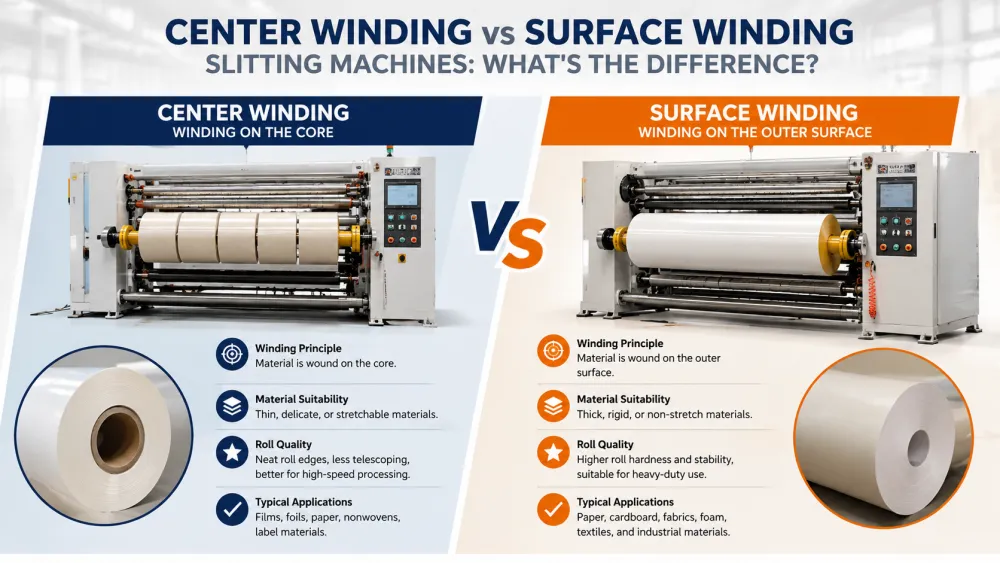
Center Winding vs Surface Winding: Key Differences
| Feature | Center Winding | Surface Winding |
|---|---|---|
| Drive Method | Through the core | Through surface contact |
| Tension Control | High precision | Pressure-based control |
| Suitable Materials | Films, laminates, labels | Paper, heavy materials |
| Roll Diameter Flexibility | Good | Excellent |
| High-Speed Capability | Excellent | Good |
| Roll Hardness Control | Through torque adjustment | Through surface pressure |
When Should You Choose Center Winding?
Center winding is commonly preferred when processing flexible materials that require precise tension control and consistent roll quality.
Typical Applications
- BOPP film
- PET film
- CPP film
- PE film
- Flexible packaging laminates
- Self-adhesive labels
- Release liners
These materials are sensitive to tension variations, making accurate torque control extremely important.
For converters processing flexible packaging materials, center winding often provides better winding consistency and production stability.
When Should You Choose Surface Winding?
Surface winding is often selected for materials that benefit from controlled roll pressure and stable winding of larger roll diameters.
Typical Applications
- Kraft paper
- Packaging paper
- Thermal paper
- Industrial paper rolls
- Selected nonwoven materials
- Heavy specialty materials
For paper converting operations, surface winding may provide improved roll formation and more stable handling characteristics.
How Rewinding Method Affects Roll Quality
Finished roll quality directly affects downstream converting performance.
Poor winding control may cause:
- Telescoping rolls
- Wrinkles
- Loose winding
- Excessively hard rolls
- Material deformation
Choosing the correct winding method helps improve consistency and reduce production waste.
The Role of Tension Control in Both Systems
Regardless of the winding method, proper tension control remains essential.
Even the most advanced rewinding system cannot compensate for unstable web tension.
For thin films, foil laminates, and label materials, tension control often has a greater impact on finished roll quality than machine speed.
Buyers can learn more in our guide to Web Tension Control in Slitter Rewinder Machines.
Common Buyer Mistakes When Comparing Rewinding Systems
Many buyers assume one winding method is universally better than the other. In reality, the correct choice depends on the material and application.
Common mistakes include:
- Selecting based only on machine price.
- Ignoring material characteristics.
- Focusing solely on maximum speed.
- Overlooking roll quality requirements.
- Failing to consider downstream production processes.
The best rewinding system is the one that delivers consistent roll quality for your specific material.
How to Choose the Right Rewinding System
Before selecting a slitting machine, buyers should evaluate:
- Material type
- Material thickness
- Finished roll diameter
- Production speed requirements
- Roll hardness specifications
- Downstream converting processes
A supplier that understands your material characteristics can often recommend the most suitable winding configuration and help avoid long-term production issues.
Buyers comparing different slitting machines should evaluate rewinding performance as carefully as slitting accuracy and machine speed.
FAQ: Center Winding vs Surface Winding Slitting Machines
What is the difference between center winding and surface winding?
Center winding drives the roll through the core using torque control, while surface winding drives the roll through contact with a driven roller.
Which winding method is better for flexible packaging films?
Center winding is often preferred for flexible packaging films because it provides more precise tension control and winding consistency.
Which winding method is commonly used for paper rolls?
Surface winding is frequently used for paper converting because it helps maintain stable roll formation and supports larger roll diameters.
Can tension control affect roll quality?
Yes. Poor tension control can create wrinkles, telescoping rolls, uneven winding, and other quality defects regardless of the winding method used.
How do I choose the right rewinding system?
The best choice depends on material type, thickness, roll diameter requirements, production speed, and downstream converting processes.