





CI Flexo vs Stack Flexo Printing Machine
CI Flexo vs Stack Flexo: What Is the Difference?
When choosing a flexographic printing machine for packaging production, one of the most common questions buyers ask is:
Should I choose a CI flexo printing machine or a stack flexo printing machine?
Both machine types are widely used in packaging printing, but they are designed for different materials, production requirements, and investment priorities.
Choosing the wrong machine can result in registration problems, unstable production, material waste, or unnecessary investment. The right choice depends on your packaging products, substrate type, print quality expectations, and long-term production plans.
This guide explains the key differences between CI flexo and stack flexo printing machines to help packaging manufacturers choose the most suitable solution.
What Is a CI Flexo Printing Machine?
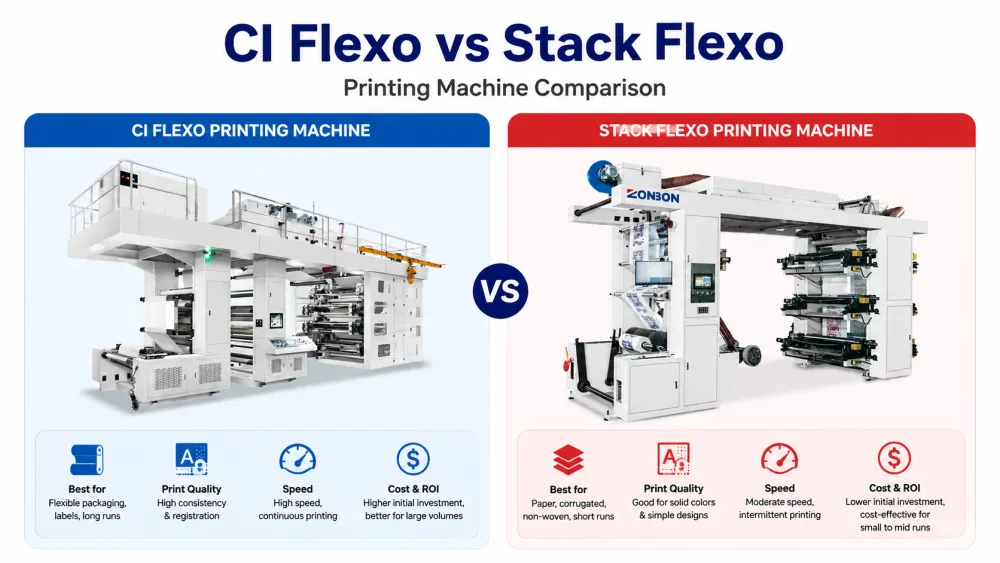
A CI (Central Impression) flexo printing machine uses one large central impression drum to support the substrate while multiple color stations print around it.
Because the web remains supported on one central cylinder, CI flexo systems generally provide more stable registration and better web handling for lightweight and stretchable materials.
CI flexo printing is commonly used for:
- Flexible packaging film.
- Food packaging.
- Coffee pouches.
- Frozen food packaging.
- Medical packaging.
- Hygiene packaging.
- Laminated film structures.
For packaging manufacturers printing on thin films, CI Flexo Printing Machines are widely used because of their stable registration and tension control.
What Is a Stack Flexo Printing Machine?
A stack flexo printing machine uses vertically stacked printing units, where each color station operates independently.
Compared with CI systems, stack flexo machines generally provide more flexibility for handling different substrate thicknesses and are often preferred for paper-based products and certain industrial packaging applications.
Stack flexo printing is commonly used for:
- Paper bags.
- Kraft paper packaging.
- Woven bags.
- Shopping bags.
- Corrugated materials.
- Industrial packaging.
For manufacturers handling paper and thicker packaging materials, Stack Flexo Printing Machines often provide a more practical and cost-effective solution.
CI Flexo vs Stack Flexo Printing Machine: Key Differences
Although both technologies use flexographic printing, their structure and performance are different.
| Comparison Area | CI Flexo | Stack Flexo |
|---|---|---|
| Machine Structure | Central impression drum | Vertical stacked units |
| Best Materials | Flexible films | Paper and thicker materials |
| Registration Accuracy | Higher | Moderate |
| Tension Stability | Better for thin films | More material flexibility |
| High-Speed Production | Better | Moderate |
| Material Compatibility | BOPP, PET, PE, laminated film | Kraft paper, woven bag, paper packaging |
| Initial Investment | Higher | Lower |
| Production Flexibility | Film-focused | Broader material adaptability |
| Typical Packaging Use | Flexible packaging | Paper packaging |
Which Machine Is Better for Flexible Packaging Film?
For flexible packaging film printing, CI flexo printing machines are usually the preferred option.
Flexible materials such as:
- BOPP film.
- PET film.
- PE film.
- CPP film.
- Laminated films.
- Metallized packaging film.
are often lightweight and sensitive to web movement. During high-speed printing, unstable tension can easily create registration problems.
The central impression drum used in CI flexo helps stabilize the web throughout production, improving:
- Registration accuracy.
- Color consistency.
- Film stability.
- Startup waste reduction.
- Multi-color print performance.
For food packaging, coffee packaging, frozen food bags, and premium laminated packaging, CI flexo is generally considered the stronger option.
Which Machine Is Better for Paper, Kraft, and Woven Materials?
For paper packaging and thicker materials, stack flexo printing machines often provide greater flexibility.
Stack flexo is commonly preferred for:
- Kraft paper bags.
- Paper shopping bags.
- Industrial woven bags.
- Corrugated packaging.
- Paper wrapping products.
Because stack systems handle thicker materials more easily, they can be a practical solution for manufacturers focusing on non-film packaging production.
In many cases, stack flexo also provides a lower initial investment for factories entering packaging printing.
CI Flexo vs Stack Flexo: Print Quality and Registration
Print quality depends heavily on registration stability and material handling.
CI flexo systems generally perform better on multi-color flexible packaging because the substrate stays supported on one impression drum throughout printing.
This helps reduce:
- Color shifting.
- Registration errors.
- Film movement.
- Print inconsistency.
Stack flexo systems can still deliver good print quality, especially for paper products and simpler graphics, but may require more adjustment when printing thin flexible films.
CI Flexo vs Stack Flexo: Cost and ROI
Investment cost is one of the biggest considerations for packaging manufacturers.
CI Flexo Investment
CI flexo printing machines generally require higher investment because of their more advanced structure, tension control, and high-speed capability.
However, for flexible packaging production, better registration and lower waste may improve long-term ROI.
Stack Flexo Investment
Stack flexo machines often have lower initial equipment cost and may be more suitable for factories with simpler packaging requirements or limited investment budgets.
For paper packaging applications, stack flexo can still provide strong production efficiency.
How to Choose the Right Flexo Printing Machine for Your Factory
Instead of asking which machine is universally better, manufacturers should ask:
Which machine is better for my production?
Choose CI Flexo If:
- You print flexible packaging films.
- You need higher registration accuracy.
- You produce premium packaging.
- You run multi-color graphics.
- You require high-speed production.
- You want lower film waste.
Choose Stack Flexo If:
- You mainly print paper packaging.
- You produce kraft paper bags or woven bags.
- You need broader substrate flexibility.
- You prefer lower investment cost.
- Your graphics are relatively simple.
The best solution depends on substrate type, packaging application, print quality requirements, and long-term production goals.
Common Buyer Mistakes When Comparing CI and Stack Flexo
- Choosing based only on machine price.
- Ignoring material compatibility.
- Overlooking long-term waste cost.
- Selecting high speed without stable registration.
- Not considering future production expansion.
In packaging production, the cheapest machine is not always the lowest-cost solution over time.
FAQ About CI Flexo and Stack Flexo Printing Machines
What is the difference between CI flexo and stack flexo?
CI flexo uses a central impression drum for better registration on flexible films, while stack flexo uses vertically stacked printing units for broader material handling.
Which flexo machine is better for flexible packaging?
CI flexo printing machines are generally better for flexible packaging film because they provide better registration and tension stability.
Is stack flexo better for paper packaging?
Yes. Stack flexo is often more suitable for kraft paper, woven bags, shopping bags, and thicker packaging materials.
Is CI flexo more expensive than stack flexo?
In many cases, yes. CI flexo machines usually require higher investment but may provide stronger ROI for film packaging production.
How do buyers choose between CI flexo and stack flexo?
Buyers should evaluate substrate type, packaging products, print quality requirements, production speed, budget, and long-term business goals.