





Decorative Material Rotogravure Printing Machine Guide
Decorative material printing has become an important application of rotogravure technology beyond traditional flexible packaging. Today, gravure printing is widely used to produce high-quality surface designs for interior decoration, furniture materials, wall coverings, and laminated decorative films.
These applications require precise color reproduction, realistic texture effects such as wood grain or marble patterns, and stable long-run production performance. Rotogravure printing is particularly suitable for this field due to its excellent image fidelity and consistency.
What Is Decorative Material Rotogravure Printing?
Decorative material rotogravure printing refers to the use of engraved-cylinder printing technology to produce patterned and textured surfaces on plastic films and composite materials used in interior and furniture decoration.
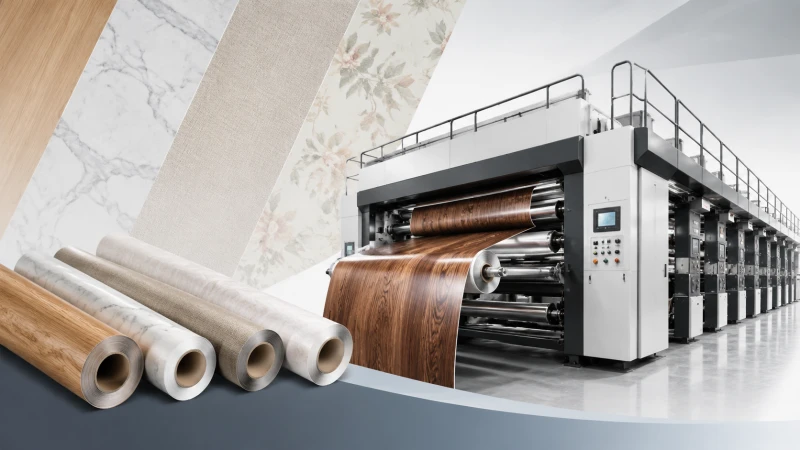
It is commonly used to create visually realistic surface effects such as wood grain, stone texture, leather patterns, and artistic designs on flexible substrates.
Unlike standard packaging printing, decorative printing focuses more on visual aesthetics, texture realism, and surface design consistency.
What Types of Decorative Products Can Be Printed?
Rotogravure printing is widely used in decorative material production for the following applications:
- Wood grain decorative film
- Marble texture film
- PVC decorative sheets
- Wallpaper and wall covering materials
- Furniture surface decorative film
- Laminated interior design films
These products are commonly used in residential, commercial, and industrial interior design applications.
Why Use Rotogravure Printing for Decorative Materials?
Rotogravure printing is preferred in decorative material production because it provides extremely high image precision and stable color reproduction over long production runs.
- High-resolution image reproduction
- Realistic texture simulation
- Stable color consistency
- Excellent repeatability for mass production
- Suitable for continuous roll-to-roll processing
These advantages make gravure printing ideal for producing premium decorative surfaces that require both aesthetic quality and industrial-scale efficiency.
Common Materials Used in Decorative Printing
Decorative gravure printing is typically applied to flexible roll materials designed for lamination and surface finishing.
| Material Type | Application |
|---|---|
| PVC Film | Wallpaper and interior wall coverings |
| PET Film | High-strength decorative surfaces |
| BOPP Film | Laminated decorative layers |
| Composite Films | Furniture and flooring decoration |
| Laminated Materials | Multi-layer decorative applications |
Each material requires different drying conditions, tension control, and ink formulation to achieve optimal decorative results.
How Decorative Printing Differs from Packaging Printing
Although both applications use rotogravure technology, decorative printing and packaging printing have different priorities.
Packaging printing focuses on functionality, readability, and compliance, while decorative printing focuses on visual appearance and texture realism.
- Decorative printing emphasizes aesthetics and surface design
- Packaging printing emphasizes information clarity and functionality
- Decorative materials often require higher color accuracy for pattern realism
- Production runs are typically long and design-driven
Key Machine Requirements for Decorative Printing
High-Precision Cylinder Engraving
Accurate engraving is essential for reproducing fine textures such as wood grain and marble patterns.
Stable Color Registration
Multi-color alignment must remain consistent to ensure pattern continuity across long rolls.
Learn more in our guide on How Automatic Registration Improves Gravure Printing Accuracy .
Drying System Stability
Proper drying ensures ink adhesion and prevents smudging or pattern distortion during high-speed production.
You can explore more in How Drying Systems Affect Rotogravure Printing Efficiency .
Web Tension Control
Stable tension is critical for maintaining pattern alignment and preventing stretching or deformation of decorative films.
Market Applications of Decorative Gravure Printing
Decorative gravure printing is widely used in several fast-growing industries:
- Interior decoration industry
- Furniture manufacturing
- Flooring and wall covering production
- Commercial interior design materials
- Architectural surface finishing
As demand for customized interior design increases globally, decorative film printing continues to expand as a high-value industrial segment.
How to Choose a Suitable Rotogravure Printing Machine
When selecting a machine for decorative material production, buyers should focus on production stability, pattern accuracy, and long-run consistency rather than only speed.
Key selection factors include:
- Material compatibility
- Color registration accuracy
- Cylinder engraving precision
- Drying system efficiency
- Tension control stability
Modern Rotogravure Printing Machines are designed to support both packaging and decorative applications with high efficiency and consistent output quality.
Conclusion
Decorative material rotogravure printing is an important extension of gravure technology into the interior design and surface decoration industry.
Its ability to produce realistic textures, stable colors, and high-quality surface patterns makes it a key technology for modern decorative material manufacturing.
As demand for customized interior design continues to grow, gravure printing remains a reliable and scalable solution for producing premium decorative films and surfaces.
Looking for a Decorative Printing Solution?
Share your material type, pattern requirements, and production goals. Our engineering team can help recommend a suitable gravure printing solution for decorative applications.
Talk to Our EngineersFAQ: Decorative Material Rotogravure Printing Machine Guide
What is decorative material rotogravure printing used for?
It is used to produce decorative surfaces such as wood grain film, marble texture film, wallpaper, and PVC interior design materials.
Why is rotogravure printing used for decorative materials?
Because it provides high-resolution image reproduction, stable color consistency, and excellent long-run production performance for complex surface designs.
What materials are used in decorative gravure printing?
Common materials include PVC film, PET film, BOPP film, composite films, and laminated decorative surfaces.
What is the difference between decorative printing and packaging printing?
Decorative printing focuses on visual aesthetics and texture realism, while packaging printing focuses on functionality, information clarity, and compliance.
What industries use decorative gravure printing?
It is widely used in interior decoration, furniture manufacturing, wall covering production, and architectural surface finishing industries.
What machine features are important for decorative printing?
Key features include high-precision cylinder engraving, stable registration control, efficient drying systems, and strong web tension stability.
Can one machine be used for both packaging and decorative printing?
Yes, modern rotogravure printing machines can be configured to handle both applications depending on material and production requirements.