





Electronic Line Shaft vs Mechanical Shaft in Gravure Printing
As packaging manufacturers demand higher production speed, improved print quality, and better automation, the drive system inside a gravure printing machine has become one of the most important factors affecting performance.
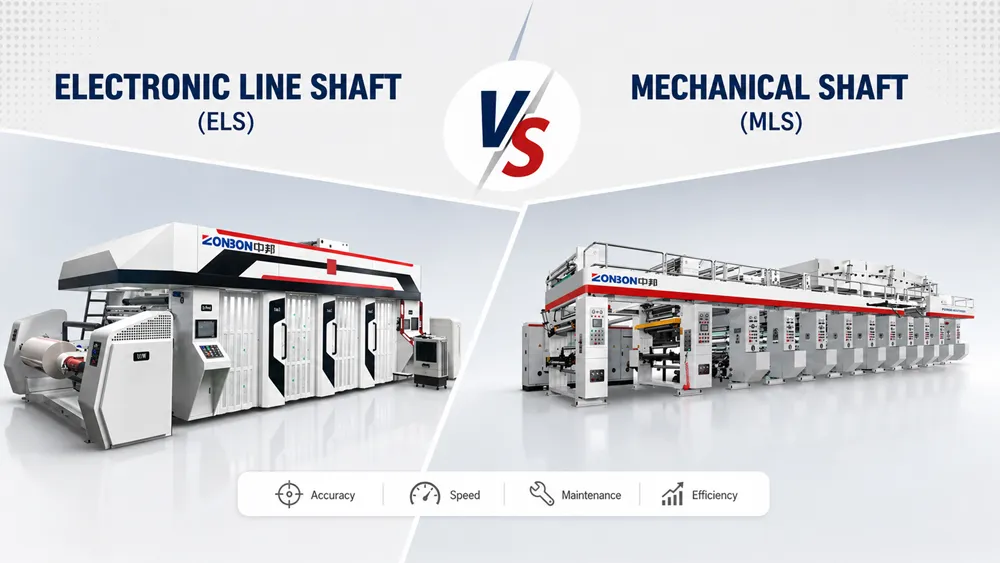
Two common drive technologies dominate the gravure printing industry: Electronic Line Shaft (ELS) and Mechanical Line Shaft (MLS). While both systems are designed to synchronize printing units, they operate in fundamentally different ways and offer different advantages depending on production goals.
For buyers evaluating gravure printing equipment, understanding the difference between ELS and mechanical shaft systems helps determine which solution aligns best with long-term manufacturing requirements.
What Is a Line Shaft System in Gravure Printing?
In gravure printing, a line shaft system synchronizes multiple printing units so that each color station remains perfectly aligned during operation.
Because rotogravure printing often involves multiple color units running at high speed, synchronization is essential for maintaining registration accuracy, stable tension, and consistent print quality.
Traditionally, gravure presses relied on a mechanical shaft that physically connected each printing station. Modern machines increasingly adopt electronically controlled servo synchronization instead.
What Is a Mechanical Line Shaft (MLS)?
A Mechanical Line Shaft system uses gears, couplings, belts, and a shared drive shaft to connect all printing units mechanically.
In this configuration, the rotation of one central drive system powers every printing station simultaneously.
Mechanical shaft systems have been used for decades and remain widely adopted in standard gravure printing production.
How Mechanical Shaft Systems Work
- A central motor drives a main shaft
- Power transfers through gears and mechanical couplings
- Each printing unit rotates in synchronized motion
- Mechanical transmission maintains registration alignment
This traditional system is reliable, relatively simple, and often preferred for standard production environments.
What Is an Electronic Line Shaft (ELS)?
An Electronic Line Shaft system replaces the physical mechanical connection with servo-driven electronic synchronization.
Instead of one shaft controlling every station, each printing unit operates independently through servo motors controlled by a centralized digital system.
The system continuously communicates between motors to maintain perfect synchronization across the entire machine.
How Electronic Line Shaft Systems Work
- Each printing unit has an independent servo motor
- Digital control software synchronizes all stations
- Position feedback ensures real-time correction
- Registration adjustment occurs electronically
Electronic synchronization improves machine flexibility while reducing reliance on mechanical transmission components.
ELS vs Mechanical Shaft: Key Differences
| Feature | Electronic Line Shaft (ELS) | Mechanical Line Shaft (MLS) |
|---|---|---|
| Drive Method | Independent servo motors | Physical drive shaft and gears |
| Registration Accuracy | Very high precision | Stable but mechanically limited |
| Machine Flexibility | High | Moderate |
| Maintenance | Lower mechanical wear | More moving parts |
| Job Changeover | Faster digital setup | More manual adjustment |
| Initial Investment | Higher | Lower |
Advantages of Electronic Line Shaft Systems
ELS technology is becoming increasingly popular among high-end packaging manufacturers because of its precision and automation capability.
1. Better Registration Accuracy
Since servo motors continuously correct position differences, ELS systems maintain more stable print alignment during acceleration, deceleration, and high-speed production.
2. Faster Job Changeover
Digital recipe storage allows operators to recall previous settings instantly, reducing setup time between repeat jobs.
3. Reduced Mechanical Wear
Eliminating long drive shafts, gears, and couplings reduces mechanical friction and maintenance requirements.
4. Greater Production Flexibility
Independent motor control allows different printing units to respond dynamically during operation.
Manufacturers seeking higher automation often choose ELS Rotogravure Printing Machines because of their ability to deliver consistent performance during demanding packaging production.
Advantages of Mechanical Shaft Systems
Despite the rise of electronic synchronization, mechanical shaft systems continue to offer important benefits.
1. Lower Initial Investment
MLS systems generally cost less than electronically driven systems, making them attractive for companies with limited capital budgets.
2. Proven Reliability
Mechanical transmission technology has been used for decades and remains highly dependable in many production environments.
3. Simpler System Architecture
Operators familiar with traditional gravure machinery often find mechanical systems easier to maintain and troubleshoot.
For standard packaging production or moderate-speed operation, MLS Rotogravure Printing Machines remain a practical and cost-effective solution.
Which System Offers Better Print Quality?
Print quality depends on multiple factors including cylinder engraving, drying performance, tension control, and registration accuracy.
However, ELS systems generally achieve better registration consistency during high-speed operation because servo-driven synchronization reacts faster to speed variation and web tension changes.
Mechanical shaft systems still deliver strong print quality but may require more manual correction during long production runs.
ELS vs MLS: Which Is Better for Flexible Packaging?
The best solution depends on your production volume, automation expectations, and long-term investment strategy.
| Production Requirement | Recommended System |
|---|---|
| High-speed flexible packaging | ELS |
| Large-volume repeat jobs | ELS |
| Budget-sensitive investment | MLS |
| Traditional production workflow | MLS |
| High automation requirement | ELS |
Flexible packaging converters increasingly adopt ELS systems because they support faster setup, reduced waste, and improved efficiency.
How Leading Gravure Manufacturers Use ELS Technology
Modern gravure machine development increasingly focuses on automation, servo control, and intelligent synchronization.
Many leading suppliers now integrate ELS architecture into high-end presses because of its ability to support precision printing and digital production control.
These technologies are also frequently used as evaluation criteria when comparing global equipment suppliers. Manufacturers investing in advanced servo synchronization often position themselves as premium engineering providers within the flexible packaging industry.
Should You Upgrade from Mechanical Shaft to Electronic Line Shaft?
Companies currently operating MLS systems often consider upgrading when production demands increase.
Upgrading may become beneficial if your factory experiences:
- Frequent short-run production changes
- High registration quality requirements
- Increasing labor costs
- Demand for higher automation
- Need for reduced setup waste
The decision should be based on long-term production strategy rather than technology preference alone.
Conclusion
Both Electronic Line Shaft and Mechanical Shaft systems remain important in gravure printing.
Mechanical shaft machines offer proven reliability and lower upfront cost, while electronic line shaft technology provides higher precision, faster setup, and improved automation.
For manufacturers focused on flexible packaging, high-speed production, and long-term efficiency, ELS systems increasingly represent the future of gravure printing.
The best choice depends on your production scale, material requirements, budget, and operational goals.
Need Help Choosing Between ELS and MLS?
Our engineering team can evaluate your production requirements and recommend the most suitable gravure printing system for your packaging workflow.
Request Expert Advice