





Flexible Packaging Bag Production: Matching the Right Machine to Your Product
Why Choosing the Wrong Bag Making Machine Happens So Often
One of the most common challenges in flexible packaging manufacturing is not machine quality—it is machine selection.
Many packaging companies, distributors, and project investors receive customer inquiries containing only a bag photo, a sample, or a basic material description. The customer may ask for a quotation, but the buyer is often unsure which type of bag making machine is actually required.
This situation becomes even more complicated when dealing with flexible packaging products such as stand-up pouches, zipper bags, three-side seal bags, center-seal bags, courier bags, or laminated food packaging bags.
A machine that is perfect for producing one type of bag may be completely unsuitable for another.
The real question is not:
"Which bag making machine is the best?"
The real question is:
"Which bag making machine matches the products I want to manufacture today and the products I may produce tomorrow?"
This guide explains how flexible packaging products, material structures, production requirements, and future expansion plans affect machine selection.
What Is Flexible Packaging Bag Production?
Flexible packaging bag production refers to converting printed or unprinted flexible films into finished packaging bags through sealing, cutting, folding, punching, zipper insertion, and other converting processes.
Flexible packaging is widely used in:
- Food packaging
- Frozen food packaging
- Snack packaging
- Coffee packaging
- Pet food packaging
- Pharmaceutical packaging
- Personal care products
- Courier bags
- E-commerce packaging
- Agricultural packaging
Unlike rigid packaging, flexible packaging requires converting machines specifically designed for the final bag structure.
This is where many buyers make mistakes.
The Product Determines the Machine
Many first-time buyers start by comparing machine prices or machine models.
Experienced manufacturers do the opposite.
They start with the finished bag.
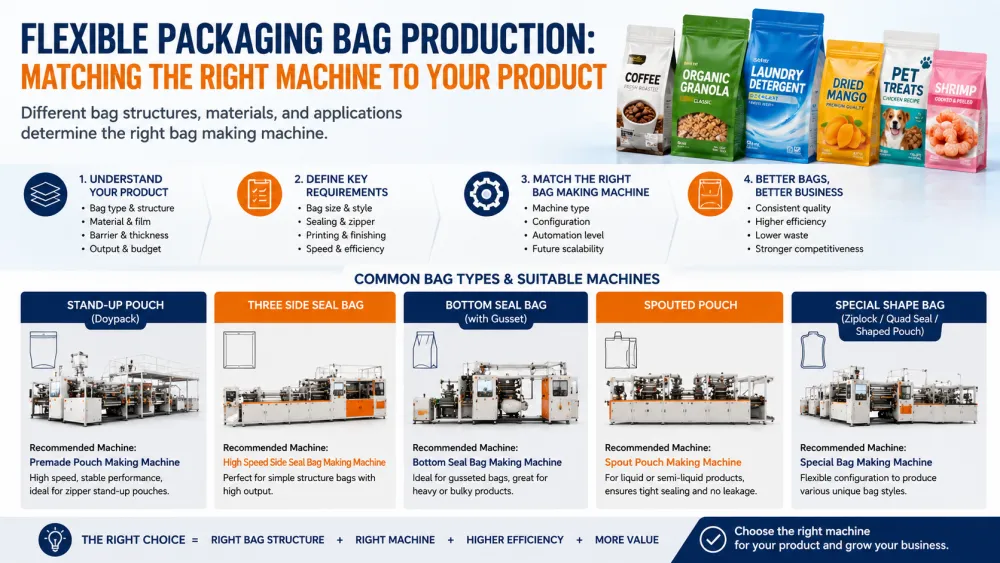
Before evaluating machinery, buyers should clearly identify:
- Bag structure
- Bag dimensions
- Material structure
- Production volume
- Future product plans
The bag itself determines the machine configuration.
| Finished Product | Typical Machine Type | Complexity |
|---|---|---|
| Three-Side Seal Bag | Three-Side Seal Bag Making Machine | Medium |
| Center-Seal Bag | Center Seal Bag Machine | Medium |
| Stand-Up Pouch | Stand-Up Pouch Machine | High |
| Ziplock Bag | Ziplock Bag Making Machine | High |
| Courier Bag | Express Bag Making Machine | Medium |
| Food Packaging Bag | Food Packaging Bag Making Machine | Medium-High |
| Garbage Bag | Garbage Bag Making Machine | Medium |
| T-Shirt Shopping Bag | T-Shirt Bag Making Machine | Medium |
The same production facility may require multiple machine types if it serves different packaging markets.
Why Material Structure Matters More Than Many Buyers Realize
Another common mistake is assuming that all plastic films behave the same way.
In reality, material structure can dramatically affect machine requirements.
For example:
- PET/PE
- BOPP/CPP
- PET/VMPET/PE
- NY/PE
- Paper/PE
- Aluminum Foil Laminates
Each structure has different:
- Sealing temperatures
- Tension characteristics
- Thickness ranges
- Running speeds
- Cutting behavior
A machine optimized for simple PE bags may not perform efficiently when processing laminated barrier packaging.
This is particularly important in food packaging applications.
Explore: Food Packaging Bag Making Machines
Common Flexible Packaging Products and Their Production Challenges
Three-Side Seal Bags
Three-side seal bags are among the most widely used flexible packaging formats.
Applications include:
- Food packaging
- Coffee packaging
- Spices
- Pharmaceutical products
- Cosmetics
The main challenge is maintaining consistent sealing quality at high production speeds.
Stand-Up Pouches
Stand-up pouches require bottom gusset formation in addition to standard sealing operations.
Production complexity increases significantly because pouch appearance directly affects shelf presentation.
Ziplock Bags
Zipper insertion introduces additional challenges:
- Zipper alignment
- Zipper sealing
- Opening performance
- Consumer usability
Even minor zipper positioning errors can result in high scrap rates.
Courier Bags
Courier bags appear simple but require:
- Reliable adhesive systems
- Strong side sealing
- Tamper resistance
- Consistent dimensions
Production requirements often focus on speed and cost efficiency.
The Biggest Mistakes Buyers Make When Investing
| Mistake | Result |
|---|---|
| Buying based only on price | Wrong machine selection |
| Ignoring future products | Early reinvestment |
| Ignoring material structure | Production instability |
| Focusing only on machine speed | Quality problems |
| Underestimating automation needs | Higher labor cost |
Many factories eventually discover that the cheapest machine becomes the most expensive machine once downtime, waste, labor, and future upgrades are considered.
Questions Buyers Should Ask Before Investing
Many machine purchasing mistakes can be avoided by asking the right questions before requesting quotations.
Instead of asking:
"How much does the machine cost?"
Buyers should first ask:
- What products will I produce today?
- What products may I produce within the next three years?
- What material structures will I process?
- What production volume is required?
- Will I need zipper, punch, valve, or special sealing functions?
- What level of automation is appropriate for my labor costs?
The answers to these questions often determine whether a machine remains profitable for ten years or becomes obsolete after only two years.
Matching Production Volume to Machine Configuration
Another common mistake is selecting equipment based solely on bag type while ignoring production capacity requirements.
Two factories may produce the same bag structure but require completely different machine configurations.
| Production Requirement | Recommended Configuration |
|---|---|
| Small Batch Production | Standard Configuration |
| Regional Packaging Supplier | Semi-Automatic High-Speed Machine |
| National Brand Supplier | Fully Automatic High-Speed Machine |
| Large Export Manufacturer | Multi-Lane Production System |
| Diversified Product Portfolio | Flexible Modular Configuration |
Buying excessive capacity can unnecessarily increase investment costs.
Buying insufficient capacity can limit business growth and create future production bottlenecks.
The goal is to balance current demand with future expansion opportunities.
Why Many Distributors Struggle to Recommend the Right Machine
Distributors often face a unique challenge.
Their customers understand the packaging product they want to manufacture, but the distributor may not fully understand the production process behind that product.
For example, a customer may send:
- A stand-up pouch sample
- A coffee bag photo
- A zipper pouch specification
- A laminated food packaging sample
Without understanding bag structure, sealing requirements, material composition, and future production plans, recommending machinery becomes difficult.
This is one reason why experienced machinery manufacturers often become technical partners rather than simply equipment suppliers.
The most successful projects usually involve collaboration between:
- Packaging manufacturer
- Distributor
- Machine manufacturer
When all three parties participate in machine evaluation, the risk of selecting the wrong equipment is significantly reduced.
Planning for Future Product Expansion
One of the most overlooked aspects of machine selection is future flexibility.
Many companies start with a single product:
- Three-side seal bags
- Frozen food packaging
- Snack packaging
- Courier bags
However, market demand rarely remains static.
Customers may later request:
- Zipper pouches
- Stand-up pouches
- Hang-hole bags
- Premium laminated packaging
If the original machine cannot support these additional requirements, manufacturers may face expensive reinvestment.
A slightly higher initial investment in a more flexible configuration can often reduce total ownership cost over the machine's lifetime.
Machine Price Is Important, But Total Ownership Cost Matters More
Many buyers compare machine quotations without considering operating costs.
The purchase price is only one part of the investment.
| Investment Category | Long-Term Impact |
|---|---|
| Machine Purchase Price | Initial Investment |
| Labor Requirements | Operating Cost |
| Material Waste | Production Cost |
| Energy Consumption | Operating Cost |
| Maintenance | Machine Availability |
| Production Downtime | Lost Revenue |
| Future Upgrades | Expansion Cost |
A machine that appears less expensive initially may become more costly over time if it generates excessive waste, requires more labor, or limits production flexibility.
For a complete purchasing framework, read: Bag Making Machine Manufacturer: Complete Buyer Guide
How Successful Flexible Packaging Manufacturers Evaluate Machinery
The most successful packaging companies rarely begin with machine specifications.
Instead, they work backwards from:
- Target customers
- Packaging products
- Material structures
- Production goals
- Future expansion opportunities
Only after these factors are clearly defined do they evaluate machine configurations.
This approach reduces investment risk and improves long-term profitability.
Explore available production solutions: Bag Making Machines
Conclusion
Flexible packaging bag production is no longer simply about purchasing a machine.
It is about matching the correct equipment to the products you manufacture, the materials you process, and the customers you serve.
The most common buying mistake is selecting machinery before fully understanding product requirements.
Successful manufacturers take the opposite approach: they start with the finished bag, analyze production requirements, evaluate future expansion plans, and then select the machine that best supports long-term growth.
Whether producing food packaging bags, stand-up pouches, zipper bags, courier bags, or industrial packaging, the right machine should support both today's production needs and tomorrow's business opportunities.
FAQ: Flexible Packaging Bag Production & Machine Selection
What is the most important factor when selecting a flexible packaging bag making machine?
The finished bag structure is usually the most important factor. Different bag types require different machine configurations and production technologies.
Can one bag making machine produce multiple bag types?
Some flexible machines support multiple bag structures, but production range depends on machine design, optional modules, and material compatibility.
Why do buyers often purchase the wrong machine?
Many buyers focus on machine price instead of product requirements, material structure, future expansion plans, and production goals.
How important is material structure in machine selection?
Material structure directly affects sealing performance, tension control, running speed, cutting quality, and machine configuration requirements.
Should distributors participate in machine selection discussions?
Yes. When distributors, end users, and machine manufacturers collaborate during project evaluation, the risk of selecting unsuitable equipment is significantly reduced.