





Why CI Flexo Printing Machines Are Needed for BOPP & PET Film
Why BOPP and PET Films Are More Challenging Than Other Materials
BOPP and PET films are thin, lightweight, and flexible, which makes them ideal for high-quality flexible packaging but also introduces printing challenges not seen with paper, kraft, or woven substrates.
Compared with thicker or more rigid materials:
- These films are highly sensitive to tension fluctuations, which can cause stretching, wrinkling, or registration drift.
- Their non-porous surfaces require careful ink selection and surface treatment for proper adhesion.
- High-speed production amplifies any minor misalignment or web instability.
- Multi-color graphics are more prone to color misregistration due to material stretch and drift.
Why Stack Flexo Printing Machines Cannot Print BOPP and PET Films Effectively
Stack flexo presses, with their vertically stacked independent color units, are ideal for thicker substrates like paper, kraft, and woven bags. However, they face limitations when printing thin, flexible films such as BOPP and PET:
- In stack presses, the web is unsupported between color stations, causing lightweight films to stretch or drift, especially at high speeds.
- Registration accuracy suffers because each unit has independent drive and mechanical tolerances, making fine multi-color alignment difficult.
- Thin films are prone to wrinkling when tension varies between stacked units, leading to uneven printing.
- Stack presses typically cannot provide the stable web handling and tension control needed for BOPP and PET films.
Why CI and Gearless CI Flexo Machines Are Ideal for BOPP & PET
Central Impression (CI) and Gearless CI flexo machines are designed to support the substrate around a central drum, stabilizing thin and flexible films throughout the printing process.
- The central drum reduces web movement between color stations, improving registration accuracy for multi-color graphics.
- Advanced tension control systems prevent stretching and wrinkling of lightweight films.
- Servo-driven gearless CI systems allow fast setup adjustments, reducing startup waste and improving multi-color registration consistency.
- These machines handle high-speed production without sacrificing print quality on delicate substrates like BOPP and PET.
For manufacturers seeking stable, high-quality printing on flexible packaging films, CI Flexo Printing Machines and Gearless CI Flexo Printing Machines are the most reliable solutions.
Key Considerations for Printing BOPP and PET Films
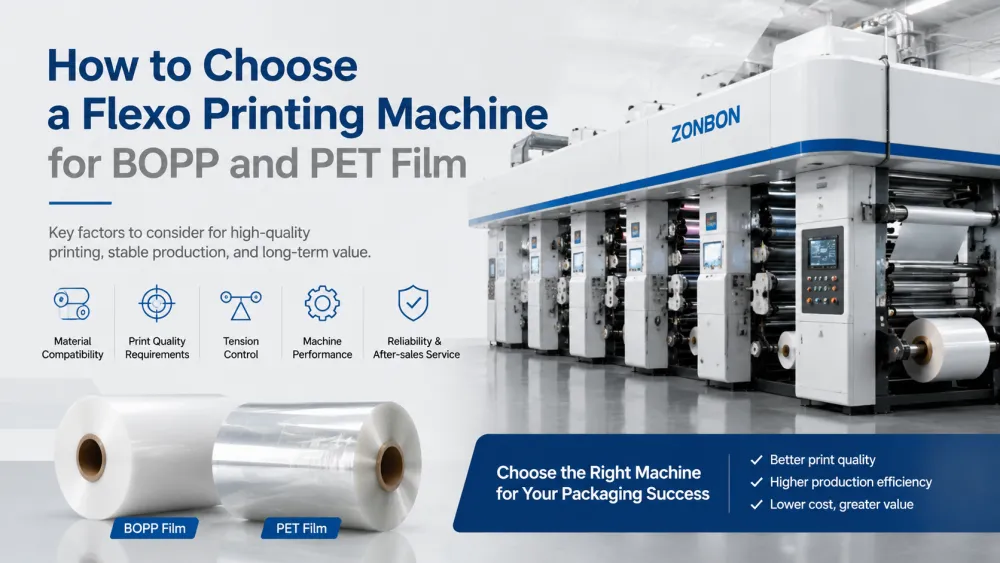
- Use appropriate ink for non-porous films (solvent-based or treated water-based).
- Ensure web tension is stable throughout the printing process.
- Monitor drying systems to prevent dimensional changes.
- Maintain precise registration systems for multi-color graphics.
- Regularly inspect plates, anilox rollers, and servo systems for consistent ink transfer.
Conclusion
BOPP and PET films present unique challenges that require stable substrate handling, precise tension control, and accurate registration. Stack flexo presses cannot provide the support and control needed for these delicate materials, making CI and Gearless CI flexo machines the ideal choice for high-quality flexible packaging production.
FAQ About Printing BOPP and PET Films
Why are BOPP and PET films harder to print than paper?
Because they are thin, stretchable, and non-porous, requiring more precise tension control and surface treatment.
Can stack flexo presses print BOPP or PET films?
No. Stack presses do not provide sufficient substrate support between color stations, leading to registration drift and wrinkling.
Why is a CI flexo machine better for thin films?
CI machines stabilize the web on a central drum, reduce web movement, and maintain registration accuracy for multi-color printing.
What is the advantage of a gearless CI flexo press?
Gearless CI presses use servo control for tighter registration, faster setup, and reduced startup waste, especially for thin and stretchable films.