





Understanding Gravure Printing Cylinder Engraving
In gravure printing, even the most advanced machine cannot deliver premium print quality without properly engineered printing cylinders. One of the most important yet often misunderstood factors behind stable gravure performance is cylinder engraving.
Cylinder engraving directly influences ink transfer, color consistency, image sharpness, and long-run production stability. For flexible packaging manufacturers, understanding how gravure cylinders are engraved helps explain why some printing systems achieve better results than others.
Whether you are evaluating print quality problems, researching gravure technology, or planning a new packaging production line, understanding cylinder engraving is essential.
What Is Gravure Printing Cylinder Engraving?
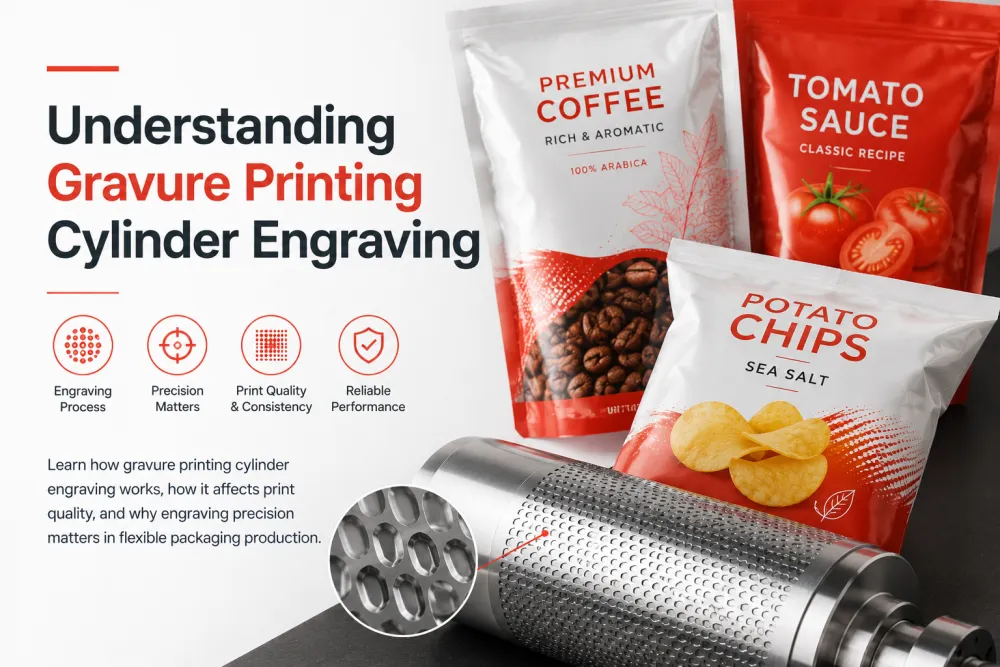
Gravure printing cylinder engraving is the process of creating thousands of microscopic recessed cells on the surface of a printing cylinder.
These engraved cells hold ink during printing and transfer it onto the substrate under pressure.
Unlike surface printing technologies, gravure printing belongs to the intaglio printing process, meaning the image is engraved below the cylinder surface rather than raised above it.
During production:
- Ink fills the engraved cells
- A doctor blade removes excess ink from the cylinder surface
- The remaining ink transfers to film, foil, or paper
The shape, depth, and consistency of these cells directly affect final print quality.
Why Cylinder Engraving Matters in Gravure Printing
Cylinder engraving plays a central role in gravure printing performance because it controls how much ink transfers to the material.
Even small engraving inconsistencies can affect:
- Color density
- Ink uniformity
- Gradient smoothness
- Fine text clarity
- Image sharpness
- Long-run print consistency
In flexible packaging production, where visual appearance strongly influences brand perception, engraving precision becomes especially important.
Premium packaging often requires stable color reproduction across millions of printed meters. This level of repeatability depends heavily on cylinder quality.
How Gravure Printing Cylinders Are Made
Gravure cylinders are manufactured through a highly controlled engineering process.
While methods may vary slightly between suppliers, the process generally includes the following steps:
1. Base Cylinder Preparation
A steel cylinder forms the structural foundation.
This core provides:
- Mechanical strength
- Rotational stability
- Dimensional consistency
2. Copper Plating
The cylinder surface is coated with copper because copper is easier to engrave precisely.
This copper layer becomes the surface where image cells are created.
3. Cylinder Engraving
The image is engraved into the copper surface using specialized technology.
This step determines:
- Cell depth
- Cell shape
- Ink volume capacity
- Print sharpness
4. Chrome Plating
After engraving, a thin chrome layer is applied to improve wear resistance and extend cylinder lifespan.
Since gravure printing often involves long production runs, durability becomes critical for maintaining consistent print quality.
Main Types of Gravure Cylinder Engraving
Different engraving technologies influence production quality and printing capability.
Electromechanical Engraving
Electromechanical engraving is one of the most common methods used in gravure printing.
In this process, a diamond stylus mechanically engraves cells into the copper cylinder surface.
Advantages include:
- Stable production consistency
- Proven industrial reliability
- Good repeatability
- Strong suitability for flexible packaging
This method remains widely used in high-volume packaging production.
Laser Engraving
Laser engraving uses high-precision laser technology to create engraved cells.
Compared with traditional mechanical engraving, laser systems may provide:
- Higher detail precision
- More flexible cell geometry
- Improved consistency for complex graphics
However, adoption depends on production requirements, investment level, and application needs.
How Cell Geometry Affects Print Quality
In gravure printing, the engraved cell structure determines how much ink transfers onto the substrate.
Three key factors influence printing performance:
Cell Depth
Deeper cells generally transfer more ink, producing stronger color density.
Shallower cells typically create lighter tones and finer detail.
Cell Shape
Cell geometry affects ink release behavior during printing.
Different shapes influence:
- Ink transfer efficiency
- Image smoothness
- Color consistency
Cell Uniformity
Consistent engraving quality ensures stable ink transfer across long production runs.
Poor consistency may create:
- Uneven color appearance
- Print streaking
- Density variation
- Image inconsistency
Common Cylinder Engraving Problems
Some print quality issues originate directly from engraving inconsistency.
Uneven Ink Transfer
Poorly engraved cells may release ink unevenly, creating unstable color density.
Weak Fine Detail Reproduction
Text or small graphics may lose sharpness if cell precision is insufficient.
Inconsistent Long-Run Quality
Low-quality engraving can create visible print variation during large-volume production.
Premature Cylinder Wear
Inadequate surface treatment may reduce cylinder durability over time.
Why Cylinder Quality Matters When Choosing a Gravure Printing Manufacturer
Even high-speed gravure presses cannot compensate for poor cylinder quality.
In practical production environments, machine performance and cylinder engineering work together to determine final results.
Experienced gravure manufacturers generally understand:
- Ink transfer behavior
- Material compatibility
- Drying interaction
- Registration stability
- Production repeatability
When comparing suppliers, evaluating technical understanding of cylinder performance can provide valuable insight into engineering capability.
If you are researching global suppliers, our guide to the Top 10 Rotogravure Printing Machine Manufacturers explores leading companies shaping modern gravure printing technology and large-scale flexible packaging production.
How Cylinder Engraving Influences Flexible Packaging Production
Flexible packaging often requires:
- Premium graphics quality
- Stable color consistency
- High-speed production
- Long-run repeatability
Cylinder engraving affects all of these production goals.
This is one reason gravure printing continues to dominate packaging applications such as:
- Snack packaging
- Coffee packaging
- Frozen food packaging
- Pet food bags
- Medical foil packaging
High-quality engraving helps manufacturers achieve stable output while reducing waste and maintaining consistent brand appearance.
Conclusion
Gravure printing cylinder engraving is one of the most important factors affecting print quality, color consistency, and production efficiency.
From cell geometry and engraving precision to surface durability and long-run repeatability, cylinder quality directly influences packaging performance.
For packaging manufacturers evaluating gravure printing technology, understanding cylinder engraving provides valuable insight into both machine performance and supplier capability.
Looking for a High-Performance Gravure Printing Solution?
Share your material type, packaging application, and production goals. Our engineering team can help recommend a gravure printing solution designed for stable and efficient production.
FAQ: Understanding Gravure Printing Cylinder Engraving
What is gravure printing cylinder engraving?
Gravure printing cylinder engraving is the process of creating microscopic recessed cells on the cylinder surface. These cells hold and transfer ink during printing, directly affecting color density, image sharpness, and overall print quality.
Why is cylinder engraving important in gravure printing?
Cylinder engraving controls how ink transfers onto film, foil, or paper. Poor engraving quality may result in uneven color, weak fine details, inconsistent gradients, or unstable long-run print performance.
How are gravure printing cylinders engraved?
Most gravure cylinders are engraved after copper plating using either electromechanical engraving or laser engraving technology. After engraving, a chrome layer is usually added to improve wear resistance and extend cylinder life.
What is the difference between electromechanical engraving and laser engraving?
Electromechanical engraving uses a diamond stylus to create cells mechanically and is widely used for flexible packaging production. Laser engraving uses high-precision laser technology and may provide finer detail or more flexible cell geometry depending on the application.
How does cylinder cell depth affect print quality?
Cell depth influences ink volume. Deeper cells generally transfer more ink for stronger color density, while shallower cells are often used for finer details and lighter tones. Proper cell design helps maintain stable print consistency.
Can poor cylinder engraving affect packaging quality?
Yes. Poor engraving may lead to uneven ink transfer, color inconsistency, weak image sharpness, print streaking, or unstable long-run performance. In flexible packaging production, engraving quality strongly affects final package appearance.
How long does a gravure printing cylinder last?
Cylinder lifespan depends on production volume, material type, maintenance, and surface treatment quality. Chrome-plated cylinders used under proper operating conditions can support long production runs before refurbishment becomes necessary.
Do gravure printing machines include cylinders?
Machine supply scope depends on the manufacturer and project configuration. Many Rotogravure Printing Machines are configured to work with customer-specific engraved cylinders based on packaging design, material requirements, and print specifications.
How can I evaluate cylinder quality before purchasing a gravure press?
Buyers should evaluate engraving precision, cylinder consistency, material compatibility, and the manufacturer’s technical understanding of ink transfer and print performance. Reviewing production samples and testing results can also help reduce purchasing risk.