





How to Compare Rotogravure Printing Machine Manufacturers
Selecting a rotogravure printing machine is a long-term investment, but choosing the right manufacturer is equally important. Machines with similar specifications can differ significantly in production stability, print quality, operating costs, technical support, and future upgrade potential.
Many buyers focus primarily on price, printing speed, or the number of color stations. However, experienced converters know that a reliable manufacturing partner often delivers greater long-term value than the lowest initial quotation.
This guide explains how global buyers, distributors, and packaging manufacturers can compare rotogravure printing machine manufacturers objectively and make more informed purchasing decisions.
Why Comparing Manufacturers Matters
Two gravure presses may appear similar on paper, yet perform very differently after installation. Manufacturing quality, engineering standards, component selection, assembly accuracy, and after-sales support all influence long-term productivity.
Choosing the right manufacturer can help you:
- Reduce production downtime
- Improve print consistency
- Lower maintenance costs
- Increase production efficiency
- Extend equipment service life
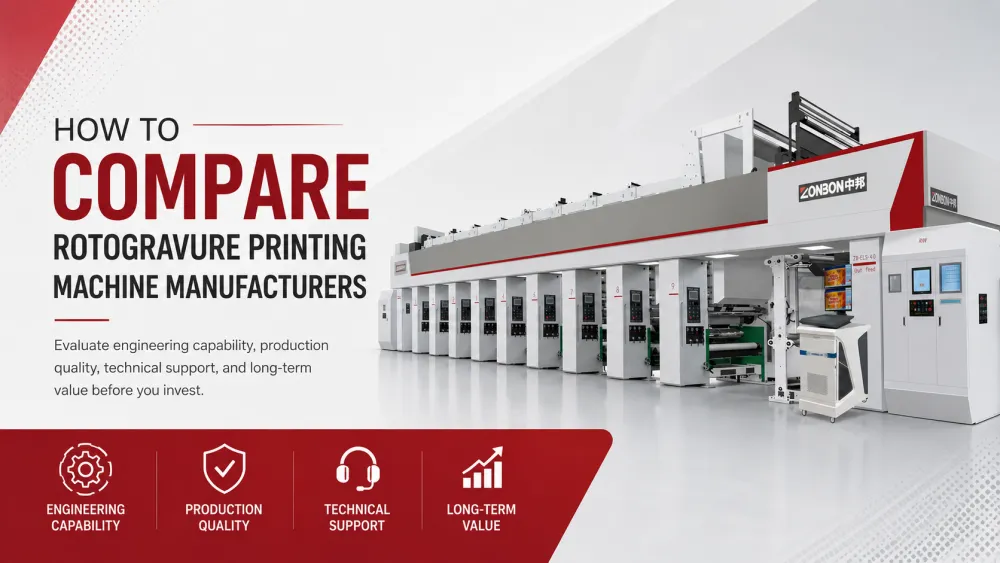
Look Beyond Machine Specifications
Technical specifications are only one part of the evaluation process.
Buyers should also understand how the manufacturer designs, assembles, tests, and supports the equipment throughout its operating life.
| Evaluation Area | Why It Matters |
|---|---|
| Engineering Design | Improves stability and production accuracy |
| Manufacturing Quality | Influences long-term reliability |
| Automation Level | Reduces setup time and operator workload |
| Technical Support | Helps solve production issues quickly |
| Future Upgrade Capability | Supports business expansion |
Evaluate Industry Experience
Manufacturers often specialize in different applications. Some focus on flexible packaging, while others have experience in pharmaceutical packaging, decorative materials, aluminum foil, or industrial films.
Ask suppliers to provide examples of projects similar to yours instead of only showing general machine photos.
Review Engineering Capability
A capable manufacturer should explain why a particular configuration is recommended rather than simply offering a standard model.
Engineering discussions should include:
- Material compatibility
- Production speed targets
- Printing accuracy requirements
- Drying system design
- Registration control
- Future production expansion
Suppliers that understand your production process are usually better equipped to recommend the most suitable solution.
Assess Manufacturing Quality
Machine quality depends not only on purchased components but also on machining precision, assembly standards, quality inspection, and final testing.
Questions worth asking include:
- How are machine frames manufactured?
- How are cylinders and rollers aligned?
- What quality inspection procedures are followed?
- How is machine performance verified before shipment?
Compare Technical Support, Not Just Delivery
Many buyers evaluate only the delivery schedule and purchase price. In reality, technical support after installation often has a greater impact on long-term production performance.
A reliable manufacturer should provide support for:
- Installation guidance
- Operator training
- Process optimization
- Troubleshooting assistance
- Spare parts planning
- Future upgrades
Understand Total Cost of Ownership
The lowest purchase price does not always result in the lowest operating cost.
When comparing manufacturers, evaluate:
- Energy efficiency
- Material waste
- Setup time
- Maintenance frequency
- Spare parts availability
- Expected equipment lifetime
Considering total ownership cost provides a more realistic basis for investment decisions.
Review Customer References and Real Projects
Request examples of completed installations that closely match your production requirements.
Relevant case studies often provide better insight than generic marketing materials because they demonstrate how equipment performs under actual production conditions.
Questions Buyers Should Ask Before Making a Decision
- Which industries does the manufacturer specialize in?
- Can the machine be customized for our application?
- How is print quality verified before shipment?
- What training is included?
- How quickly are spare parts supplied?
- Can the production line be upgraded in the future?
- What after-sales support is available?
Compare Multiple Manufacturers Objectively
Comparing several suppliers allows buyers to understand differences in engineering philosophy, manufacturing capability, automation level, and service support.
If you are researching leading suppliers worldwide, our guide to Top 10 Rotogravure Printing Machine Manufacturers provides an overview of internationally recognized companies and their market positioning. It can serve as a useful starting point before conducting detailed technical evaluations.
Conclusion
Choosing a rotogravure printing machine manufacturer should never be based solely on price or machine specifications. Engineering expertise, manufacturing quality, application experience, technical support, and long-term partnership all contribute to the success of your investment.
By evaluating manufacturers from both technical and business perspectives, buyers can reduce purchasing risk and select equipment that delivers stable performance for many years.
FAQ: How to Compare Rotogravure Printing Machine Manufacturers
What is the most important factor when comparing rotogravure printing machine manufacturers?
Beyond machine specifications, buyers should evaluate engineering capability, manufacturing quality, application experience, technical support, and long-term service.
Should I choose the lowest-priced gravure printing machine?
Not necessarily. A lower purchase price may lead to higher operating costs if the equipment generates more waste, requires frequent maintenance, or lacks technical support.
How can I verify a manufacturer's capabilities?
Ask for customer references, completed project examples, factory testing procedures, quality control documentation, and application cases similar to your production requirements.
Why is after-sales support important?
Professional technical support helps reduce downtime, improve production efficiency, shorten troubleshooting time, and extend equipment service life.
Should I compare manufacturers from different countries?
Yes. Comparing manufacturers globally provides a broader understanding of available technologies, automation levels, and pricing, helping buyers make more objective investment decisions.
What questions should I ask before choosing a supplier?
Discuss application experience, customization capability, testing procedures, installation support, training, spare parts availability, and future upgrade options before making a final decision.