





Differential Shaft in Slitting Machines: Why It Matters
Why Some Finished Rolls Are Tight While Others Are Loose
Many converters invest in high-speed slitting machines, advanced tension control systems, and quality slitting knives, yet still experience problems such as uneven roll hardness, telescoping rolls, loose winding, and inconsistent finished roll quality.
In many cases, the root cause is not the slitting section itself but the rewinding system. When multiple narrow rolls are rewound on a standard shaft, small differences in material thickness, roll diameter, and tension can cause each roll to behave differently during production.
This is where differential shaft technology becomes important. For label converters, flexible packaging manufacturers, foil processors, and thermal paper producers, differential shafts help improve winding consistency and reduce common rewinding defects that affect downstream production.
What Is a Differential Shaft?
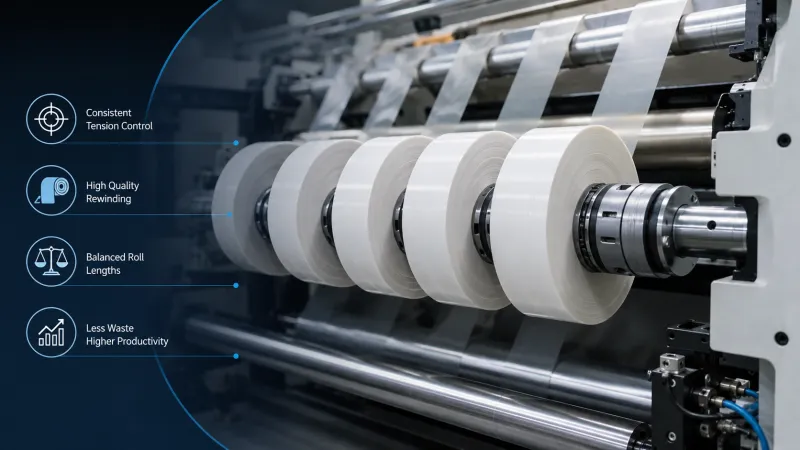
A differential shaft is a specialized rewinding shaft used in slitting machines that allows each rewind core to rotate independently within a controlled torque range.
Unlike a conventional air shaft where all rolls rotate at the same speed, a differential shaft automatically compensates for small differences between individual rolls during winding.
This compensation helps maintain more consistent tension and roll hardness across all rewind positions, even when processing multiple narrow rolls simultaneously.
Why Standard Air Shafts Can Create Rewinding Problems
A standard air shaft works well for many applications, but challenges often appear when converting multiple narrow rolls.
During production, slight differences naturally occur between rolls:
- Material thickness variation
- Coating weight variation
- Different roll diameters
- Small tension fluctuations
- Material stretch characteristics
Because every roll is locked to the same shaft speed, these differences cannot be automatically compensated for.
As a result, some rolls may become:
- Too tight
- Too loose
- Uneven in hardness
- Prone to telescoping
- Difficult to process downstream
These issues often lead to customer complaints, rejected rolls, and unnecessary material waste.
How a Differential Shaft Works
A differential shaft uses friction rings, ball-lock systems, or pneumatic structures that allow controlled slipping between individual rewind cores.
As roll diameters increase during rewinding, each roll can rotate at slightly different speeds while still maintaining controlled torque.
This means the shaft automatically compensates for roll-to-roll differences throughout the winding process.
Instead of forcing every roll to behave identically, the differential shaft allows each roll to achieve more stable winding conditions.
What Problems Can a Differential Shaft Solve?
Uneven Roll Hardness
One of the most common customer complaints is inconsistent roll hardness.
Some rolls may be tightly wound while others are noticeably softer. This inconsistency often causes difficulties during printing, laminating, die-cutting, and packaging operations.
Differential shafts help balance winding tension across all rewind positions and improve roll consistency.
Telescoping Rolls
Telescoping occurs when rolls shift sideways during winding, storage, or transportation.
This problem is especially common in narrow-width converting applications where tension differences between rolls become more noticeable.
By maintaining more uniform winding conditions, differential shafts help reduce telescoping risks.
Loose Winding
Loose rolls often create handling problems and reduce downstream production efficiency.
Differential shaft technology helps maintain more stable winding pressure throughout the production run.
Customer Quality Complaints
Many quality complaints originate from rewinding problems rather than slitting defects.
Improving winding consistency often improves customer satisfaction and reduces rejected shipments.
Which Industries Benefit Most from Differential Shafts?
Not every application requires a differential shaft, but some industries benefit significantly from this technology.
Self-Adhesive Label Converting
Label converters frequently process multiple narrow rolls with tight quality requirements.
Consistent roll hardness is important because finished rolls often move directly into printing, inspection, and die-cutting operations.
Flexible Packaging Film Converting
BOPP, PET, PE, CPP, and laminated films are highly sensitive to tension variations.
Differential shafts help improve rewinding consistency and reduce roll-to-roll variation.
Aluminum Foil Processing
Foil materials are particularly sensitive to winding defects because they have limited elasticity.
Stable rewinding helps reduce wrinkles, edge damage, and roll deformation.
Thermal Paper Production
Receipt rolls and ticket rolls require consistent winding quality to perform reliably in automatic printing equipment.
Differential Shaft vs Standard Air Shaft
| Feature | Differential Shaft | Standard Air Shaft |
|---|---|---|
| Individual Roll Compensation | Yes | No |
| Multiple Narrow Rolls | Excellent | Limited |
| Roll Hardness Consistency | High | Moderate |
| Telescoping Prevention | Better | Basic |
| Rewinding Quality | Superior | Standard |
| Investment Cost | Higher | Lower |
While differential shafts require additional investment, many converters find that improved roll quality and reduced waste provide a strong long-term return.
Why Differential Shafts Are Closely Related to Tension Control
A differential shaft does not replace a tension control system. Instead, it works together with tension control to improve rewinding performance.
Even with advanced automatic tension systems, small differences between rewind rolls still occur during production.
A differential shaft provides an additional layer of compensation that helps maintain more consistent winding conditions.
Buyers interested in improving rewinding performance should also understand web tension control in slitter rewinder machines.
When Is a Differential Shaft Worth the Investment?
Many buyers ask whether a differential shaft is truly necessary.
The answer depends on the material, roll widths, and quality requirements.
A differential shaft is often worth considering when:
- Producing multiple narrow rolls
- Processing flexible packaging films
- Converting self-adhesive labels
- Slitting aluminum foil laminates
- Experiencing telescoping roll problems
- Receiving customer complaints about roll quality
- Seeking to reduce waste and improve consistency
For many converters, the cost of rejected rolls and production downtime can exceed the additional investment required for differential shaft technology.
How Differential Shafts Improve Long-Term Production Efficiency
The biggest benefit of a differential shaft is not simply better rewinding quality. It is the reduction of production variability.
More consistent rolls help improve:
- Printing performance
- Laminating consistency
- Die-cutting accuracy
- Pouch-making efficiency
- Customer satisfaction
- Material utilization
Over time, these improvements often generate greater value than the initial equipment upgrade cost.
Choosing the Right Rewinding Configuration
Differential shafts are one part of a complete rewinding system. Material characteristics, winding method, tension control, roll width, and production speed must all work together to achieve stable production results.
Converters evaluating new slitting machines should assess rewinding technology as carefully as slitting speed, knife systems, and automation features.
For applications where finished roll quality directly affects downstream production, differential shaft technology can become an important competitive advantage.
FAQ: Differential Shaft in Slitting Machines
What is a differential shaft in a slitting machine?
A differential shaft is a rewinding shaft that allows individual rolls to compensate for small speed and tension differences during winding, helping improve roll consistency.
Why do label converters often use differential shafts?
Label converters frequently process multiple narrow rolls that require consistent winding quality for printing, inspection, and die-cutting operations.
Can a differential shaft reduce telescoping rolls?
Yes. By improving tension balance between rolls, differential shafts help reduce telescoping and other rewinding defects.
Is a differential shaft better than a standard air shaft?
For applications involving multiple narrow rolls and high-quality winding requirements, differential shafts generally provide better rewinding consistency and roll hardness control.
When should I consider upgrading to a differential shaft?
If your production experiences loose rolls, uneven hardness, telescoping, or frequent rewinding quality complaints, a differential shaft may be worth evaluating as part of your machine configuration.