





ELS Rotogravure Printing Machine Guide: Advantages & Top Manufacturers
What Is an ELS Rotogravure Printing Machine?
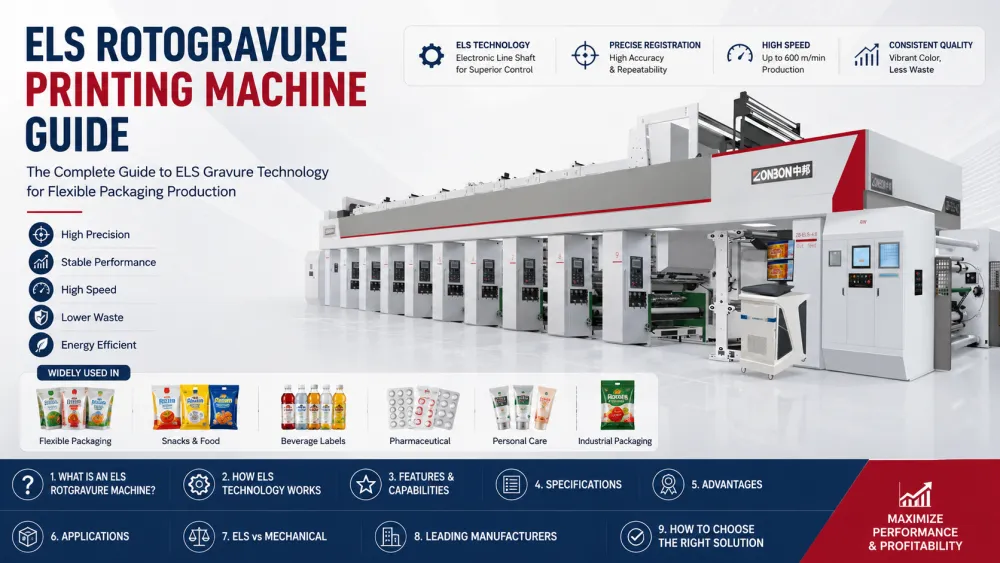
An ELS Rotogravure Printing Machine is a high-speed gravure printing press that uses an Electronic Line Shaft control system instead of a traditional mechanical shaft transmission structure. In a conventional gravure press, printing units are connected by gears, shafts, and mechanical transmission components. In an ELS system, each printing unit is driven by an independent servo motor and synchronized electronically through a digital control system.
This structure allows the machine to achieve more accurate color registration, smoother web tension control, faster job adjustment, and more stable performance during high-speed roll-to-roll printing. It is widely used in flexible packaging, food packaging, pharmaceutical packaging, aluminum foil packaging, laminated films, and premium consumer product packaging.
For packaging manufacturers that require high-speed production, multi-color printing, and long-run stability, ELS technology offers a more advanced solution than traditional mechanical shaft systems.
How Electronic Line Shaft Technology Works
In an ELS gravure press, every printing station is controlled by its own servo motor. These servo motors are electronically synchronized through a central control system, allowing each printing unit to operate independently while remaining precisely coordinated with the whole machine.
Instead of relying on a long mechanical shaft to transfer motion, the machine uses digital signals to control speed, position, tension, and registration. During production, the system continuously monitors web movement, cylinder position, tension changes, and registration accuracy.
When small deviations occur, the servo system can make real-time corrections. This helps reduce color misalignment, material stretching, vibration, and registration errors during high-speed printing.
Main Features & Technical Capabilities
Independent Servo Drive System
Each printing unit is equipped with an independent servo motor. This improves synchronization accuracy, reduces mechanical transmission errors, and gives operators more flexible control over machine operation.
High-Speed Printing Performance
ELS gravure machines are designed for large-scale flexible packaging production. Depending on the model and configuration, typical production speeds may range from 250 m/min to 400 m/min or higher.
Accurate Color Registration
Electronic synchronization helps maintain stable color-to-color registration during acceleration, deceleration, and continuous high-speed running. This is especially important for multi-color packaging designs, fine graphics, and premium printed materials.
Automatic Tension Control
Stable web tension is essential when printing thin films and laminated materials. ELS systems usually work with automatic closed-loop tension control to reduce film stretching, wrinkles, web deviation, and registration problems.
Automatic Register Control
Many modern ELS gravure presses include automatic register control systems. These systems help shorten setup time, reduce startup waste, and improve print consistency during long production runs.
PLC and Touch Screen Operation
Most machines are equipped with PLC control, touch screen operation, recipe storage, fault alarms, and production data monitoring. These functions make operation easier and help factories improve production management.
Typical Technical Specifications
| Parameter | Typical Range |
|---|---|
| Printing Colors | 6 colors, 8 colors, 10 colors, 12 colors |
| Printing Width | 800 mm to 1300 mm or customized |
| Mechanical Speed | 300 m/min to 450 m/min |
| Printing Speed | 250 m/min to 400 m/min |
| Registration Accuracy | Typically around ±0.1 mm depending on material and configuration |
| Applicable Materials | BOPP, PET, PE, CPP, PVC, nylon film, paper, aluminum foil, laminated film |
| Drive System | Independent servo motor with electronic line shaft control |
| Tension Control | Automatic closed-loop tension control |
| Drying System | Electric heating, gas heating, thermal oil, or customized drying system |
| Unwind / Rewind Diameter | 600 mm to 1000 mm or customized |
Key Advantages for Flexible Packaging Production
Better Registration Stability
One of the biggest advantages of ELS technology is improved registration stability. Because each printing unit is electronically synchronized, the system can reduce errors caused by gear backlash, shaft vibration, and mechanical wear.
Higher Production Efficiency
Digital control, servo synchronization, and automatic register adjustment help reduce setup time and improve production efficiency. This is valuable for packaging factories that handle both long-run and medium-run orders.
Lower Material Waste
Automatic registration and stable tension control can reduce startup waste and printing defects. This is especially important when printing expensive substrates such as laminated films, aluminum foil, and specialty packaging materials.
Reduced Mechanical Maintenance
Compared with traditional mechanical shaft systems, ELS machines use fewer long transmission components. This can reduce mechanical wear, lubrication requirements, and maintenance frequency during long-term operation.
More Flexible Job Changeover
Operators can adjust many production parameters through the control system instead of relying heavily on manual mechanical adjustment. This improves flexibility when switching between different printing jobs, materials, and product specifications.
Stronger Long-Term Investment Value
Although an ELS gravure press usually requires a higher initial investment than a traditional machine, it can provide long-term value through better production efficiency, lower waste, improved print quality, and stronger automation capability.
Common Packaging Applications
ELS gravure technology is mainly used in high-quality roll-to-roll printing applications where speed, precision, and consistency are important.
- Food packaging films
- Snack packaging
- Coffee bags and stand-up pouches
- Pharmaceutical packaging
- Aluminum foil packaging
- Detergent and household product packaging
- Cosmetic and personal care packaging
- Tobacco packaging
- Decorative films
- Laminated industrial packaging materials
ELS vs Traditional Mechanical Shaft Systems
When buyers compare modern servo-driven gravure presses with traditional mechanical systems, the main differences are usually found in drive structure, registration control, high-speed stability, maintenance requirements, and automation capability. For a more detailed technical comparison, you can read this guide on Electronic Line Shaft vs Mechanical Shaft.
| Comparison Item | ELS Gravure Press | Mechanical Shaft Gravure Press |
|---|---|---|
| Drive System | Independent servo motors with electronic synchronization | Mechanical shaft and gear transmission |
| Registration Stability | Higher and more stable | More affected by mechanical wear |
| High-Speed Performance | Better for modern high-speed production | Limited by mechanical transmission structure |
| Maintenance Demand | Lower mechanical maintenance demand | More mechanical components require maintenance |
| Job Changeover | Faster digital adjustment | More manual adjustment required |
| Automation Level | Higher | Lower to medium |
Leading Global Gravure Press Manufacturers
BOBST
BOBST is one of the world’s leading manufacturers of packaging and printing equipment. The company is well known for high-end gravure printing systems, advanced automation, and strong global service support. BOBST machines are widely used by large flexible packaging manufacturers that require premium print quality, high productivity, and long-term production stability.
Windmöller & Hölscher
Windmöller & Hölscher, often known as W&H, is a globally recognized manufacturer of flexible packaging machinery. The company provides advanced printing and converting solutions for high-performance packaging production and is respected for automation, process control, and integrated flexible packaging systems.
Cerutti
Cerutti is a respected name in gravure printing technology, especially in Europe and international premium packaging markets. The company has long experience in high-speed rotogravure printing systems for packaging and publication applications. Cerutti is known for engineering quality, stable production performance, and advanced gravure technology.
Uflex Engineering
Uflex Engineering is part of a major global flexible packaging group and provides rotogravure printing machines for packaging manufacturers in many international markets. The company combines packaging production experience with machine manufacturing capability, making it a strong option for buyers looking for practical gravure printing solutions.
ZONBON Machinery
ZONBON Machinery is a growing manufacturer specializing in flexible packaging converting equipment, including ELS rotogravure printing machines for film, paper, and aluminum foil applications.
The company focuses on providing cost-effective high-speed gravure solutions for packaging manufacturers seeking modern servo-driven technology with flexible customization options. Its ZB400-ELS series supports printing speeds up to 380 m/min and includes automatic registration and servo synchronization systems.
Key Strengths
- Manufacturer-direct solutions
- Flexible customization
- Competitive pricing
- Support for flexible packaging production
- Global installation and after-sales support
How to Choose the Right Gravure Printing Solution
Before purchasing a modern gravure press, buyers should evaluate their production requirements carefully. The right machine configuration depends on material type, printing width, color quantity, speed requirements, drying system, automation level, and future production plans.
Important points to consider include:
- What materials will be printed?
- How many printing colors are required?
- What is the target production speed?
- Is automatic register control required?
- What drying method is suitable for the ink and substrate?
- Will the machine need to support future production expansion?
- Does the manufacturer provide installation, training, and after-sales support?
For buyers evaluating different configurations, printing widths, and automation levels, ZONBON Machinery provides various ELS Rotogravure Printing Machines designed for flexible packaging production, laminated films, aluminum foil, and high-speed roll-to-roll printing applications.
Final Thoughts
The ELS Rotogravure Printing Machine is an advanced solution for modern flexible packaging production. By replacing traditional mechanical shaft transmission with electronic servo synchronization, ELS technology helps packaging manufacturers achieve better registration accuracy, higher production speed, lower material waste, easier operation, and improved long-term reliability.
For factories producing food packaging, pharmaceutical packaging, laminated films, aluminum foil packaging, and premium consumer packaging, ELS gravure technology can provide strong value in both production efficiency and print quality. When selecting a machine, buyers should compare not only price, but also technical configuration, material compatibility, service capability, customization support, and long-term production stability.