





Flexo Printing for Food Packaging: Materials, Ink & Machine Guide
Food Packaging Printing Is More Than Choosing a Printing Machine
Many buyers searching for a food packaging printing machine believe the first decision is choosing the equipment. In reality, successful food packaging production starts much earlier—with understanding the packaging application, selecting the right material structure, choosing a suitable ink system, and then matching the most appropriate printing technology.
The same flexographic printing machine may perform very differently depending on whether you are producing snack bags, coffee pouches, frozen food packaging, dairy packaging, or pet food packaging.
For packaging converters, distributors, and factory investors, understanding these relationships helps avoid costly purchasing mistakes and ensures the production line is suitable not only for today's products but also for future business expansion.
Why Food Packaging Has Different Printing Requirements
Unlike general industrial packaging, food packaging must meet higher standards for appearance, safety, consistency, and production efficiency.
Food packaging printing typically requires:
- Excellent print quality for retail shelf appeal.
- Stable color consistency across long production runs.
- Strong ink adhesion after lamination.
- High registration accuracy for multi-color graphics.
- Compatibility with food-safe packaging materials.
- Reliable production at high operating speeds.
These requirements directly influence material selection, ink systems, drying performance, and the type of flexographic printing machine that should be used.
Common Materials Used in Flexible Food Packaging
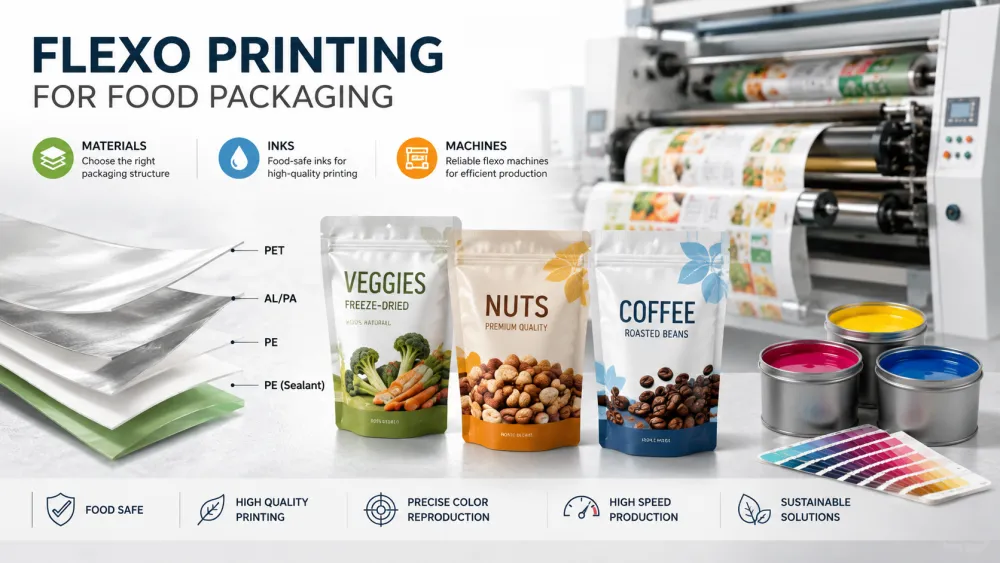
Food packaging rarely uses a single material. Most packages consist of laminated structures designed to balance printability, barrier performance, sealing strength, and cost.
| Packaging Application | Typical Material Structure | Main Purpose |
|---|---|---|
| Snack Packaging | BOPP / CPP | Excellent printability and sealing |
| Coffee Packaging | PET / AL / PE | High barrier protection |
| Frozen Food | PET / PE | Low-temperature resistance |
| Pet Food Packaging | PET / PE | Strength and durability |
| Sauce Packaging | PET / NY / PE | Puncture resistance and sealing |
| Rice & Grain Bags | BOPP / PE | Strength and cost efficiency |
Understanding the packaging structure is one of the first steps in selecting the right printing solution.
Choosing the Right Ink for Food Packaging Printing
Ink selection depends not only on print quality but also on packaging structure, production process, and regulatory requirements.
Water-Based Ink
Water-based inks are widely used for paper packaging and some flexible packaging applications because of their lower VOC emissions and environmental advantages.
Solvent-Based Ink
Solvent-based inks remain common in flexible packaging due to their strong adhesion, fast drying performance, and compatibility with many plastic films.
Low Migration Ink
For sensitive food packaging applications, low migration ink systems may be required to help meet food packaging safety standards and customer specifications.
The appropriate ink system should always be evaluated together with the substrate, drying system, and downstream converting process.
How Food Packaging Applications Influence Machine Selection
Different food packaging products often require different production capabilities.
| Food Packaging Type | Key Production Requirement | Recommended Printing Solution |
|---|---|---|
| Snack Packaging | High-speed multi-color printing | CI Flexo |
| Coffee Packaging | Excellent registration and premium graphics | CI Flexo / Rotogravure |
| Frozen Food Packaging | Stable printing on laminated films | CI Flexo |
| Pet Food Packaging | Strong solid colors and durability | CI Flexo |
| Rice Packaging | Cost-effective large-volume production | CI Flexo |
Selecting the right machine should always begin with the packaging application rather than simply comparing equipment specifications.
Why CI Flexo Printing Machines Are Widely Used for Food Packaging
Food packaging increasingly demands shorter delivery times, more product variations, and higher print quality. These trends have made CI flexographic printing one of the preferred solutions for many flexible packaging manufacturers.
The central impression drum provides stable web handling, helping improve registration accuracy when printing lightweight materials such as BOPP, PET, PE, and laminated film structures.
Many food packaging manufacturers choose CI Flexo Printing Machines because they offer:
- Stable registration during multi-color printing.
- Excellent film handling performance.
- Lower setup waste.
- Fast job changeovers.
- Efficient production for multiple packaging SKUs.
When Is Rotogravure Printing Still a Better Choice?
Although flexographic printing continues to grow rapidly, rotogravure printing remains an excellent choice for certain food packaging applications.
Converters producing extremely large production volumes with consistent packaging designs may continue to benefit from rotogravure technology because of its exceptional long-run consistency and image quality.
For many packaging companies, the decision between flexographic and rotogravure printing depends more on production volume, product variety, and investment strategy than on print quality alone.
Questions Buyers Should Answer Before Investing in a Food Packaging Printing Line
- What food products will be packaged?
- Which packaging materials will be used?
- How many colors are required?
- Will the packaging be laminated after printing?
- What production speed is expected?
- Will future packaging products require additional capabilities?
- How important are fast job changeovers?
- What level of automation is required?
Answering these questions before requesting quotations allows manufacturers to recommend equipment based on actual production requirements rather than simply providing a standard machine configuration.
How ZONBON Machinery Helps Buyers Select the Right Food Packaging Printing Solution
Many distributors and buyers understand the packaging products their customers want to manufacture but are less familiar with the technical differences between machine configurations.
Rather than recommending equipment based only on specifications, ZONBON Machinery works with distributors, converters, and factory owners to understand the complete production process—from packaging application and material structure to printing technology and future expansion plans.
This consultative approach helps bridge the gap between customer requirements and machine selection, reducing investment risk while improving long-term production performance.
Related Reading
If your food packaging products use flexible films, you may also find this guide helpful:
How to Choose the Best Flexo Printing Machine for Flexible Packaging Film
FAQ About Flexo Printing for Food Packaging
Can flexographic printing be used for food packaging?
Yes. Flexographic printing is widely used for snack packaging, frozen food bags, coffee pouches, dairy packaging, pet food packaging, and many other flexible packaging applications.
What materials are commonly used in food packaging?
Common materials include BOPP, PET, PE, CPP, paper, and various laminated structures depending on barrier and sealing requirements.
Which ink is best for food packaging printing?
The appropriate ink depends on the substrate, packaging structure, production process, and regulatory requirements. Water-based, solvent-based, and low migration inks are all used in different applications.
Why are CI flexo printing machines widely used for food packaging?
CI flexo machines provide stable web handling, accurate registration, and efficient production for flexible packaging films used in many food packaging applications.
Should I choose flexographic or rotogravure printing for food packaging?
The best choice depends on production volume, packaging design, order frequency, and long-term business goals. Flexographic printing is often preferred for flexible production and shorter runs, while rotogravure remains competitive for very large, repeat production orders.