





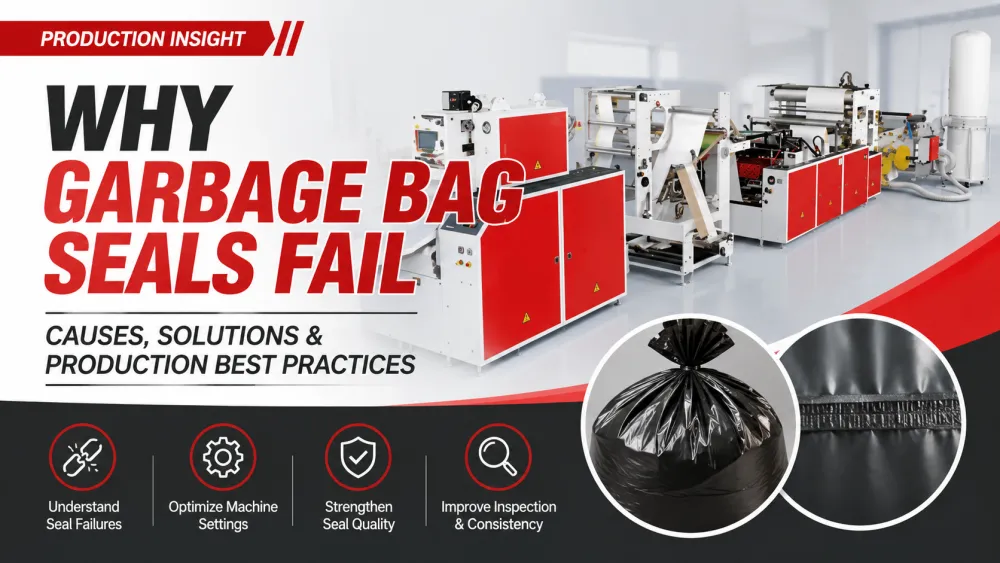
Why Garbage Bag Seals Fail: Causes, Solutions & Production Best Practices
Why Sealing Strength Is One of the Most Important Quality Indicators
For garbage bag manufacturers, sealing quality is often a more critical performance indicator than production speed. A bag with poor sealing may look acceptable immediately after production but fail during transportation, storage, or actual use.
Consumers usually notice seal failures only when the bag is already carrying waste. A bottom seal that suddenly opens or a side seal that tears under load not only causes inconvenience but also damages brand reputation and increases customer complaints.
From a manufacturer's perspective, seal failures also lead to higher scrap rates, additional quality inspections, production downtime, and increased material waste.
Improving sealing strength is therefore not simply about increasing sealing temperature. It requires understanding how materials, machine settings, production speed, and process control work together throughout the manufacturing process.
What Makes a Strong Garbage Bag Seal?
A strong seal should do much more than simply hold two film layers together. It must remain reliable throughout filling, transportation, storage, and daily use without tearing or leaking.
An ideal garbage bag seal should provide:
- Uniform sealing width across the entire bag.
- Consistent sealing strength from edge to edge.
- No burnt areas or overheated film.
- No wrinkles or trapped air inside the seal.
- Good resistance to stretching, impact, and heavy loads.
- Stable performance under different environmental conditions.
Achieving these characteristics depends on the balance between material properties and production parameters rather than any single machine setting.
Common Types of Garbage Bag Seal Failures
Different sealing defects often indicate different production problems. Identifying the failure pattern is usually the fastest way to locate the root cause.
| Failure Type | Typical Appearance | Production Impact |
|---|---|---|
| Bottom Seal Split | Seal opens under load | Bag failure during use |
| Weak Seal | Seal tears easily by hand | Reduced carrying strength |
| Burnt Seal | Film becomes brittle or discolored | Lower mechanical strength |
| Wrinkled Seal | Uneven sealing surface | Poor appearance and inconsistent sealing |
| Incomplete Seal | Small gaps along the sealing line | Leakage and product rejection |
| Seal Delamination | Film layers separate after sealing | Unstable sealing performance |
Although these defects may look similar, they often originate from completely different causes. Correct diagnosis is essential before adjusting machine settings.
Root Cause Analysis: Why Garbage Bag Seals Fail
Seal failures rarely result from a single issue. In most cases, they are caused by several factors acting together during production.
| Production Factor | Possible Effect on Seal Quality |
|---|---|
| Incorrect sealing temperature | Weak or burnt seals |
| Insufficient sealing pressure | Poor bonding between film layers |
| Excessive machine speed | Short sealing time and inconsistent strength |
| Uneven web tension | Wrinkles and seal distortion |
| Contaminated sealing area | Incomplete sealing |
| Film thickness variation | Inconsistent sealing performance |
Instead of changing several machine settings at once, experienced operators usually identify the most likely cause first and make adjustments one parameter at a time. This approach makes troubleshooting faster and prevents new production problems from being introduced.
How Film Materials Influence Sealing Performance
Machine settings alone cannot compensate for unsuitable film materials. Different polyethylene formulations behave differently during heat sealing, and selecting the wrong material may result in unstable production even when machine parameters appear correct.
| Material | Typical Sealing Performance | Common Applications |
|---|---|---|
| HDPE | Higher stiffness, narrower sealing window | Lightweight garbage bags |
| LDPE | Excellent sealing flexibility | Heavy-duty trash bags |
| LLDPE | High impact resistance and strong seals | Premium garbage bags |
| Recycled PE | Performance depends on material consistency | Cost-sensitive production |
| Biodegradable Film | Requires dedicated sealing parameters | Eco-friendly waste bags |
Material consistency is just as important as material type. Variations in thickness, resin composition, or recycled content can significantly affect sealing quality and production stability.
Machine Settings Are Only Part of the Solution
When seal failures occur, many operators immediately increase sealing temperature. Although temperature is important, it is only one variable within a much larger production system.
Reliable sealing depends on the balance between several process parameters, including:
- Heat sealing temperature.
- Sealing pressure.
- Dwell time.
- Cooling efficiency.
- Machine speed.
- Film tension control.
Changing one parameter without evaluating the others may temporarily solve one defect while creating new quality problems elsewhere in the production process.
Explore equipment designed for stable trash bag production: Garbage Bag Making Machines
Seal Failure Diagnosis Matrix
When seal failures occur, changing machine settings without identifying the actual cause often creates new production problems. A systematic diagnosis helps operators locate the root cause more efficiently and minimizes unnecessary adjustments.
| What You Observe | Most Likely Cause | First Item to Check |
|---|---|---|
| Bottom seal opens when lifting a full bag | Insufficient sealing temperature or pressure | Verify sealing bar temperature and pressure consistency |
| Seal looks complete but tears easily | Short sealing dwell time | Check sealing time and production speed |
| Seal appears burnt or brittle | Excessive sealing temperature | Reduce temperature and inspect film condition |
| Wrinkles appear inside the seal | Uneven web tension | Inspect tension control and film alignment |
| Only one side of the seal fails | Uneven sealing bar pressure | Check sealing bar parallelism |
| Random seal failures throughout production | Film thickness variation or material inconsistency | Inspect incoming raw material quality |
| Seal contains small holes | Dust, oil or contamination | Clean sealing area and inspect production environment |
Machine Parameters That Affect Sealing Quality
Reliable sealing is achieved by balancing several production parameters rather than maximizing a single setting.
| Production Parameter | If Too Low | If Too High |
|---|---|---|
| Sealing Temperature | Weak bonding | Film deformation and burnt seals |
| Sealing Pressure | Incomplete fusion | Film distortion and excessive compression |
| Dwell Time | Insufficient bonding | Reduced production efficiency |
| Machine Speed | Lower productivity | Insufficient sealing time |
| Cooling Efficiency | Seal deformation | Usually minimal impact, but unnecessary energy consumption |
| Film Tension | Wrinkles and unstable feeding | Film stretching and registration issues |
Production engineers typically adjust only one parameter at a time while monitoring seal performance. Making multiple adjustments simultaneously makes troubleshooting more difficult and increases the risk of introducing new defects.

Quality Inspection Methods Used by Professional Manufacturers
High-quality garbage bag manufacturers do not rely solely on visual inspection. Mechanical performance testing is equally important for ensuring consistent product quality.
| Inspection Method | Purpose |
|---|---|
| Visual Inspection | Check sealing appearance and uniformity |
| Manual Peel Test | Evaluate initial seal bonding strength |
| Tensile Test | Measure seal strength under load |
| Drop Test | Verify seal durability during handling |
| Leak Test | Detect incomplete sealing |
| Production Sampling | Monitor consistency during continuous production |
Rather than testing only the first production batch, experienced manufacturers perform regular sampling throughout production to detect gradual process variations before they become significant quality issues.
Production Best Practices for Stronger Garbage Bag Seals
Consistent sealing quality is achieved through standardized production management rather than occasional parameter adjustments.
- Maintain stable raw material quality and thickness.
- Verify sealing temperature at regular intervals.
- Inspect sealing bars for wear and contamination.
- Monitor web tension continuously during production.
- Reduce unnecessary machine speed fluctuations.
- Perform routine seal strength testing throughout each production shift.
- Record parameter changes to simplify future troubleshooting.
These practices improve production stability, reduce scrap rates, and help manufacturers deliver more consistent product quality.
Daily Quality Control Checklist
Before each production shift, operators can use the following checklist to reduce the likelihood of sealing defects.
| Inspection Item | Status |
|---|---|
| Raw material specification verified | □ |
| Film thickness within tolerance | □ |
| Sealing bars clean and aligned | □ |
| Temperature controllers calibrated | □ |
| Web tension operating normally | □ |
| Trial seal strength approved | □ |
| Random production samples inspected | □ |
Using a standardized inspection routine before and during production helps prevent many common sealing failures before they affect finished products.
For a broader equipment evaluation framework, see our Bag Making Machine Manufacturer: Complete Buyer Guide .
Conclusion
Strong garbage bag seals are the result of a well-controlled production process rather than a single machine setting. Material consistency, machine parameters, equipment condition, and routine quality inspections all contribute to sealing performance.
Manufacturers that establish standardized operating procedures and quality control systems are better positioned to reduce defects, improve customer satisfaction, and achieve more stable long-term production.
Frequently Asked Questions
What is the most common cause of garbage bag seal failure?
Seal failures are usually caused by a combination of unsuitable sealing parameters, inconsistent film quality, uneven pressure, excessive production speed, or poor process control rather than a single factor.
Can increasing sealing temperature always improve seal strength?
No. Excessive temperature may weaken the film, cause deformation, or create brittle seals. Sealing quality depends on balancing temperature, pressure, dwell time, cooling, and material characteristics.
How should manufacturers inspect sealing quality during production?
In addition to visual inspection, manufacturers should perform routine peel tests, tensile testing, leak testing, and regular production sampling to ensure consistent sealing performance throughout each production run.
Why do sealing problems sometimes appear only after production?
Some defects become noticeable only when bags are filled, transported, or subjected to load. This is why production-line inspections should be complemented by performance testing under real operating conditions.