





Drying Tunnel Design for High-Speed Gravure Printing
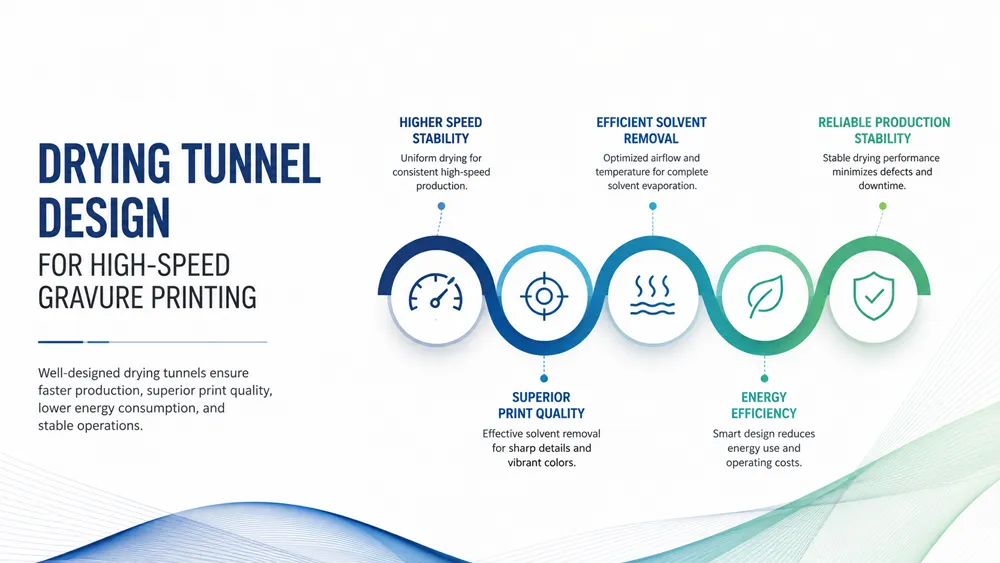
In high-speed rotogravure printing, drying performance is just as important as printing quality. Even the most advanced gravure press cannot achieve stable production if the drying tunnel fails to remove solvents efficiently.
As production speeds increase, drying tunnel design becomes a critical engineering factor that directly influences print quality, registration stability, energy consumption, and overall production efficiency.
For flexible packaging manufacturers, understanding how drying tunnels are designed helps explain why some gravure printing systems can operate reliably at high speed while others struggle with defects, waste, or production limitations.
Why Drying Tunnel Design Matters in Gravure Printing
Gravure printing uses liquid inks that must be dried after each printing station before the substrate enters the next color unit.
If drying is insufficient, manufacturers may experience:
- Ink smearing
- Color contamination
- Poor adhesion
- Registration instability
- Reduced production speed
A properly designed drying tunnel allows the machine to maintain consistent print quality while supporting stable high-speed production.
What Is a Drying Tunnel in a Rotogravure Printing Machine?
A drying tunnel is the section located between printing stations where heated air removes solvents or moisture from the printed substrate.
Its primary objective is to ensure that the printed ink is sufficiently dried before the web reaches the next printing unit.
Modern drying tunnels are engineered to balance:
- Drying efficiency
- Material stability
- Energy consumption
- Production speed
- Operational safety
Key Components of a Gravure Drying Tunnel
A high-performance drying tunnel consists of multiple systems working together.
Heating System
The heating system generates the thermal energy required for solvent evaporation.
Depending on machine configuration, heating may use:
- Electric heaters
- Gas heating systems
- Thermal oil systems
Air Distribution System
Airflow design determines how effectively heat reaches the printed surface.
Uniform airflow helps ensure consistent drying across the entire web width.
Exhaust System
As solvents evaporate, they must be removed from the drying chamber efficiently.
Proper exhaust design improves drying performance and contributes to production safety.
Insulation Structure
High-quality insulation reduces heat loss and improves overall energy efficiency.
How Drying Tunnel Length Affects Production Speed
Drying tunnel length directly affects how much drying time is available during production.
As machine speed increases, the substrate spends less time inside the tunnel.
To maintain effective drying at higher speeds, manufacturers often:
- Increase tunnel length
- Improve airflow efficiency
- Optimize temperature control
- Enhance solvent extraction
Insufficient drying tunnel length may limit maximum production speed even when the printing units themselves are capable of operating faster.
Why Airflow Design Is Critical
Temperature alone does not determine drying performance.
Airflow distribution plays an equally important role in solvent removal.
Well-designed airflow systems help:
- Increase evaporation efficiency
- Improve drying consistency
- Reduce temperature variation
- Support high-speed operation
Poor airflow distribution may create uneven drying and increase the risk of print defects.
Multi-Zone Temperature Control in Modern Drying Tunnels
High-speed gravure presses increasingly use multiple temperature control zones.
Rather than applying the same temperature throughout the tunnel, different sections can be adjusted independently.
Benefits include:
- Better drying consistency
- Improved material protection
- Higher production flexibility
- Reduced energy waste
Multi-zone control becomes particularly important when printing temperature-sensitive flexible films.
Drying Tunnel Design and Web Tension Stability
Heat affects material behavior during printing.
Excessive or uneven heating may cause:
- Film stretching
- Dimensional changes
- Registration drift
- Wrinkles
This is why drying tunnel design must work closely with web handling and tension control systems.
Stable web tension helps maintain print registration and material stability throughout the drying process. Learn more in our guide to Tension Control Systems in Rotogravure Printing Machines .
Solvent Removal and Production Safety
Solvent-based gravure inks generate evaporated vapors during drying.
Effective drying tunnel design must safely manage:
- Solvent concentration
- Air circulation
- Ventilation efficiency
- Explosion prevention requirements
Proper exhaust systems help maintain safe operating conditions while improving drying performance.
Energy Recovery Systems in Modern Gravure Printing
Energy consumption is a major operating cost in gravure printing.
Modern drying tunnels increasingly incorporate:
- Heat recovery systems
- Air recirculation technology
- Improved insulation materials
- Intelligent temperature management
These technologies help reduce energy consumption without compromising production efficiency.
Drying Tunnel Requirements for Different Packaging Materials
Different substrates respond differently to heat and drying conditions.
| Material | Drying Tunnel Consideration |
|---|---|
| BOPP Film | Requires stable temperature and airflow control |
| PET Film | Supports higher drying temperatures |
| PE Film | Sensitive to excessive heat and stretching |
| Aluminum Foil Laminates | Requires balanced drying and web stability |
| Multi-Layer Structures | May require customized drying profiles |
Matching drying tunnel design to substrate requirements helps improve print quality and production stability.
What Buyers Should Evaluate Before Purchasing a Gravure Printing Machine
When comparing gravure printing equipment, buyers often focus on printing speed and color quantity.
However, drying tunnel design is equally important.
Important questions include:
- How long is the drying tunnel?
- How is airflow distributed?
- Does the machine use multi-zone temperature control?
- How are solvents extracted?
- Is heat recovery included?
- Can the system support future speed upgrades?
These factors significantly influence long-term production efficiency and operating cost.
How Modern Rotogravure Printing Machines Improve Drying Performance
Modern Rotogravure Printing Machines increasingly integrate intelligent drying systems, optimized airflow management, energy-saving technology, and advanced web handling controls.
These improvements help manufacturers achieve higher speeds, better print quality, and lower production costs.
To understand how drying performance affects overall machine efficiency, you can also read our article on How Drying Systems Affect Rotogravure Printing Efficiency .
Conclusion
Drying tunnel design is a critical engineering component in high-speed gravure printing. It influences drying efficiency, print quality, web stability, solvent removal, energy consumption, and overall production performance.
As flexible packaging production continues to demand higher speeds and better efficiency, advanced drying tunnel design becomes an increasingly important factor when selecting a gravure printing machine.
Buyers who evaluate drying systems carefully often achieve stronger long-term productivity and lower operating costs.
Looking for a High-Efficiency Gravure Printing Solution?
Share your packaging materials, production speed targets, and application requirements. Our engineering team can help recommend the right gravure printing configuration for your production goals.
FAQ: Drying Tunnel Design for High-Speed Gravure Printing
What is a drying tunnel in a gravure printing machine?
A drying tunnel is the section between printing stations where heated air removes solvents or moisture from printed ink before the substrate enters the next color unit.
Why is drying tunnel design important in high-speed gravure printing?
Drying tunnel design affects print quality, production speed, solvent removal, web stability, and energy consumption. Poor drying performance can limit machine efficiency and create print defects.
How does drying tunnel length affect production speed?
Longer drying tunnels provide more drying time, allowing higher production speeds while maintaining sufficient solvent evaporation and print quality.
Why is airflow design important in a drying tunnel?
Airflow helps distribute heat evenly and remove evaporated solvents efficiently. Proper airflow improves drying consistency and reduces the risk of uneven print quality.
What is multi-zone temperature control?
Multi-zone temperature control allows different sections of the drying tunnel to operate at different temperatures, improving drying efficiency and protecting heat-sensitive materials.
Can drying tunnels affect print registration?
Yes. Excessive heat may cause film stretching or dimensional changes, which can contribute to registration drift if tension control and drying conditions are not properly balanced.
Do modern drying tunnels help reduce energy consumption?
Yes. Many modern systems include heat recovery technology, air recirculation, improved insulation, and intelligent temperature control to improve energy efficiency.
What should buyers evaluate when comparing drying tunnel designs?
Buyers should review tunnel length, airflow design, temperature control zones, solvent extraction efficiency, heat recovery capability, and compatibility with planned production materials.