





HDPE vs LDPE for T-Shirt Bag Production: How to Choose?
Why Material Selection Matters in T-Shirt Bag Production
Choosing the right plastic material directly affects bag strength, appearance, production efficiency, sealing quality, and manufacturing cost.
For T-shirt shopping bags used in supermarkets, grocery stores, retail packaging, and takeaway applications, manufacturers commonly compare HDPE (High-Density Polyethylene) and LDPE (Low-Density Polyethylene).
Although both materials are widely used in shopping bag production, they behave very differently in terms of flexibility, thickness, sealing performance, durability, and machine compatibility.
In this guide, we compare HDPE vs LDPE for T-shirt bag production and explain how to choose the best material based on your product goals and market requirements.
What Is HDPE?
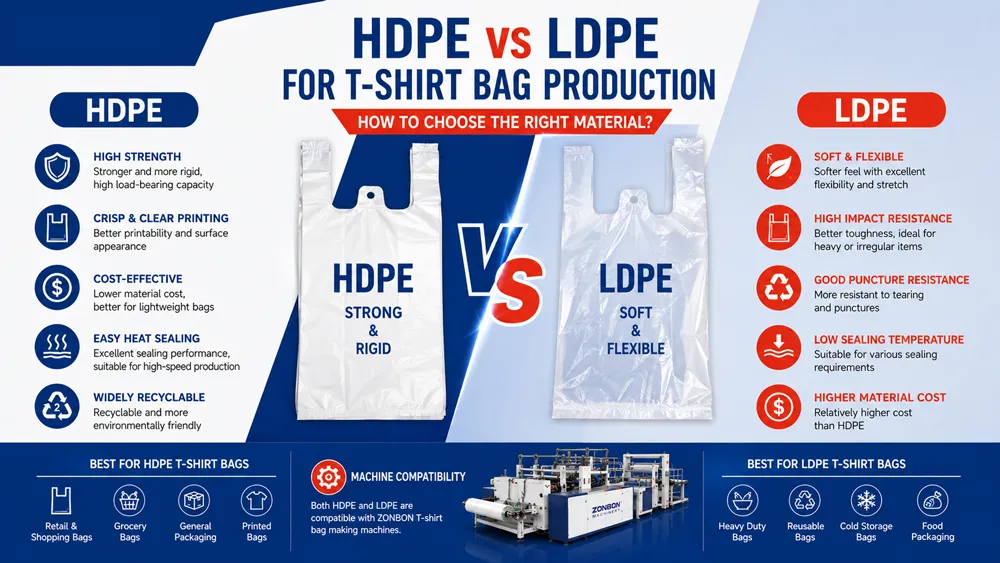
HDPE (High-Density Polyethylene) is one of the most common materials used for supermarket shopping bags and grocery bags.
Compared with LDPE, HDPE provides stronger rigidity and higher tensile strength while using thinner film thickness.
Typical characteristics of HDPE include:
- Higher strength-to-thickness ratio
- Lower material cost
- Lightweight structure
- Matte or less transparent appearance
- Slightly noisier bag texture
HDPE is commonly used for:
- Supermarket shopping bags
- Grocery carry bags
- Promotional retail bags
- High-volume low-cost shopping bags
What Is LDPE?
LDPE (Low-Density Polyethylene) is softer, more flexible, and more transparent than HDPE.
Because of its premium appearance and stronger flexibility, LDPE is often used for retail carry bags, fashion packaging, and heavier shopping applications.
Typical LDPE characteristics:
- Softer texture
- Higher flexibility
- Better transparency
- Higher puncture resistance
- Premium bag appearance
LDPE is commonly used for:
- Retail shopping bags
- Premium store packaging
- Takeaway bags
- Heavy-duty shopping bags
HDPE vs LDPE: Key Differences
Although both materials are used for T-shirt bags, their performance characteristics differ significantly.
| Factor | HDPE | LDPE |
|---|---|---|
| Strength | Higher rigidity | Higher flexibility |
| Flexibility | Lower | Higher |
| Transparency | Lower | Better clarity |
| Surface Feel | Crisp texture | Softer texture |
| Material Cost | Usually lower | Usually higher |
| Bag Appearance | Standard retail | Premium retail |
| Film Thickness | Can be thinner | Usually thicker |
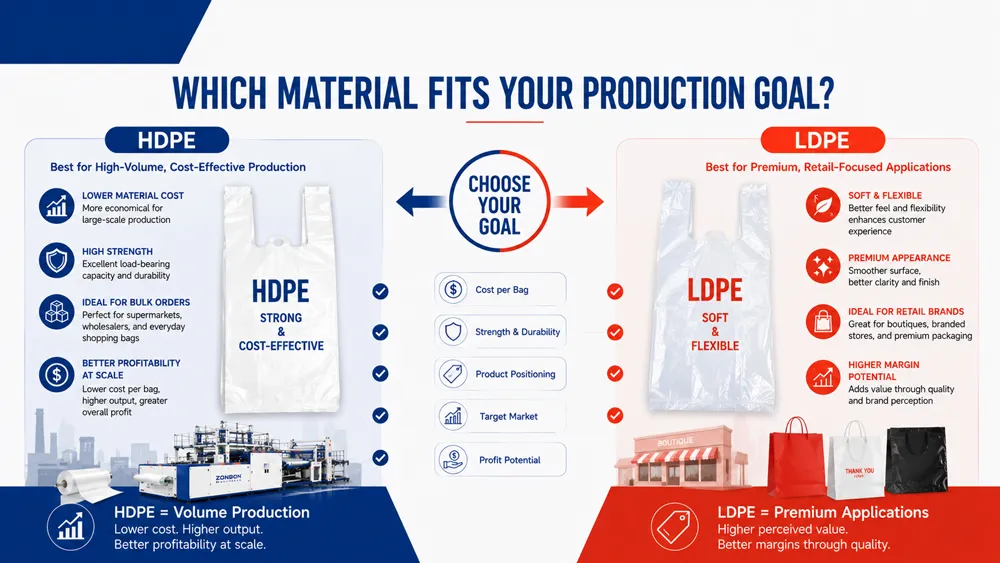
In general, HDPE is preferred for cost-sensitive high-volume production, while LDPE is often selected for stronger or more premium shopping bags.
Which Material Is Better for T-Shirt Bags?
The answer depends on your product positioning and target market.
| Production Goal | Recommended Material |
|---|---|
| Low-cost supermarket bags | HDPE |
| Premium retail bags | LDPE |
| Heavy grocery bags | LDPE |
| High-volume production | HDPE |
| Higher transparency needs | LDPE |
| Cost-sensitive production | HDPE |
If your business mainly supplies supermarkets or grocery chains, HDPE is often the more economical option.
For branded retail packaging requiring stronger aesthetics and flexibility, LDPE may offer better value.
Machine Compatibility: HDPE vs LDPE
Material selection also affects machine setup, sealing temperature, punching quality, and production speed.
| Factor | HDPE | LDPE |
|---|---|---|
| Sealing Difficulty | Medium | Easier |
| Punching Stability | Very Good | Good |
| Production Speed | Usually higher | Depends on thickness |
| Machine Compatibility | Very Common | Very Common |
Modern T-Shirt Bag Making Machines usually support both HDPE and LDPE materials, but sealing settings and film thickness must be adjusted correctly.
For buyers comparing equipment, machine compatibility with multiple material types can improve future flexibility.
You may also read: T-Shirt Bag Making Machine Guide for Shopping & Retail Bags
Cost & ROI Comparison
Material cost directly affects long-term profitability.
| Factor | HDPE | LDPE |
|---|---|---|
| Material Cost | Lower | Higher |
| Material Usage | Less film needed | Usually thicker film |
| Bag Selling Price | Lower | Higher |
| Profit Potential | High volume | Premium pricing |
HDPE may improve profitability through volume production, while LDPE may support higher margins through premium retail applications.
Common Buyer Mistakes
- Choosing material only based on price
- Ignoring sealing compatibility
- Using HDPE for premium retail applications
- Using LDPE for highly cost-sensitive supermarket production
- Not testing film compatibility before mass production
Small material mistakes may lead to higher waste, unstable sealing, lower customer satisfaction, or unnecessary cost increases.
Conclusion
Both HDPE and LDPE are suitable for T-shirt bag production, but the best choice depends on your target market, packaging requirements, production goals, and budget.
HDPE is often preferred for cost-efficient high-volume supermarket bags, while LDPE offers stronger flexibility and premium appearance for retail packaging.
Before choosing material, manufacturers should evaluate machine compatibility, sealing requirements, product positioning, and long-term ROI.
For a complete machine buying framework, read: Bag Making Machine Manufacturer Buyer Guide
FAQ About HDPE vs LDPE for T-Shirt Bags
Which is better for T-shirt bags, HDPE or LDPE?
HDPE is better for cost-efficient supermarket bags, while LDPE is preferred for premium shopping bags requiring flexibility and stronger appearance.
Why do supermarkets commonly use HDPE bags?
HDPE offers strong performance with thinner film thickness, helping reduce material cost in high-volume production.
Is LDPE stronger than HDPE?
LDPE is generally more flexible and puncture-resistant, while HDPE provides stronger rigidity and structure.
Can one T-shirt bag making machine process both materials?
Yes. Most modern machines support both HDPE and LDPE, but sealing temperature and machine settings should be adjusted accordingly.