





What Packaging Bag Is This? Practical Bag Identification Guide for Buyers
Why Packaging Bag Identification Matters Before Choosing Equipment
Many packaging equipment inquiries begin with a simple message:
"Can you produce this bag?"
Sometimes the customer sends only a photo. Sometimes they provide a physical sample. In many cases, there is no technical drawing, no material specification, and no explanation of how the bag is manufactured.
For purchasing managers, distributors, and trading companies, identifying the bag correctly is often the first and most difficult step. If the bag type is misunderstood, the recommended production equipment, production process, and even the quotation may all be incorrect.
Instead of starting with machine models, experienced packaging manufacturers always begin by identifying the finished bag.
This guide explains how to recognize common packaging bag structures, understand their materials, identify the manufacturing process, and determine the production equipment typically used to make them.
Start by Looking at the Bag Structure, Not the Material
Many buyers immediately ask what material a bag is made from. While material is important, the bag structure usually provides the fastest clue to how the package is manufactured.
Before discussing machinery, examine the following features:
- How many sealed edges does the bag have?
- Does it stand upright by itself?
- Is there a zipper?
- Is there a bottom gusset?
- Does it have side gussets?
- Is there a spout or valve?
- Does it include a handle?
- Is it supplied individually or on a roll?
Answering these questions often allows experienced engineers to identify the bag type within seconds.
Common Flexible Packaging Bag Types
| Bag Type | Typical Products | Main Feature | Typical Production Equipment |
|---|---|---|---|
| Three-Side Seal Bag | Snacks, spices, cosmetics | Three sealed edges | Three-Side Seal Bag Making Machine |
| Center Seal Bag | Coffee, frozen food | Single back seal | Center Seal Bag Making Machine |
| Stand-Up Pouch | Pet food, coffee, beverages | Bottom gusset | Stand-Up Pouch Machine |
| Zipper Pouch | Frozen food, snacks | Resealable zipper | Ziplock Bag Making Machine |
| Courier Bag | E-commerce shipping | Permanent adhesive strip | Express Bag Making Machine |
| Vacuum Bag | Meat, seafood | High barrier film | Vacuum Bag Making Machine |
| Retort Pouch | Ready meals | High-temperature resistant | Retort Pouch Machine |
| Woven Sack | Rice, fertilizer, cement | PP woven fabric | Woven Bag Making Machine |
A Quick Packaging Bag Identification Checklist
If you are unsure what type of bag you are looking at, use the checklist below.
| Question | If YES |
|---|---|
| Does the bag have a zipper? | It is likely a zipper pouch. |
| Does it stand by itself? | It is probably a stand-up pouch. |
| Does it have side gussets? | It may be a side gusset bag. |
| Does it have a bottom gusset? | It is likely designed for higher filling volume. |
| Does it include a valve? | Usually used for cement or powder packaging. |
| Is it supplied on a roll? | Roll bag production equipment is required. |
| Is the handle heat-sealed onto the bag? | It is typically a soft loop handle bag. |
| Is the bag made from woven fabric? | It is usually a PP woven sack. |
Material Structure Helps Confirm the Manufacturing Process
Once the bag structure has been identified, the next step is understanding the material.
| Material Structure | Typical Applications |
|---|---|
| PET / PE | Food packaging |
| BOPP / CPP | Snack packaging |
| PET / VMPET / PE | Coffee and high-barrier packaging |
| NY / PE | Vacuum packaging |
| PET / AL / PE | Retort pouches |
| Paper / PE | Paper-based packaging |
The material structure influences sealing temperature, machine configuration, production speed, and overall packaging performance.
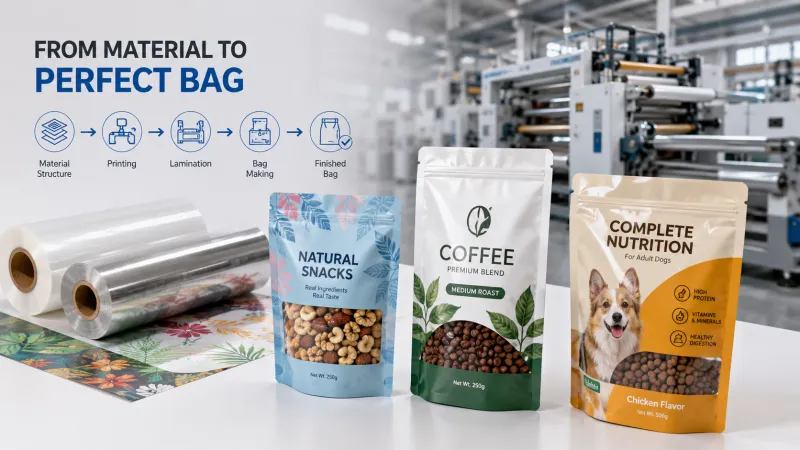
Typical Flexible Packaging Production Workflow
After identifying the bag structure and material, the complete production process becomes much easier to understand.
- Film Printing
- Lamination (if required)
- Slitting & Rewinding
- Bag Making
- Inspection
- Packing
Each production stage requires different equipment, and selecting compatible machinery helps ensure stable quality and efficient manufacturing.
Matching Bag Types to Production Equipment
| Bag Product | Recommended Machine |
|---|---|
| Food Packaging Bags | Food Packaging Bag Making Machine |
| Stand-Up Pouches | Stand-Up Pouch Machine |
| Courier Bags | Express Bag Making Machine |
| Garbage Bags | Garbage Bag Making Machine |
| Shopping Bags | T-Shirt or Soft Loop Handle Bag Making Machine |
| PP Woven Sacks | Woven Bag Making Machine |
Explore our complete equipment range: Bag Making Machines
Common Mistakes When Identifying Packaging Bags
- Confusing three-side seal bags with center-seal bags.
- Judging the bag only by its printed design instead of its structure.
- Ignoring the material composition when selecting machinery.
- Assuming all zipper bags require the same production process.
- Selecting equipment before confirming future product expansion plans.
Correct bag identification reduces equipment selection errors, shortens quotation time, and improves communication between buyers, distributors, and machine manufacturers.
Still Not Sure What Bag You Have?
If you only have a product photo or a physical sample, don't worry. Professional engineers can usually identify the bag structure and recommend a suitable production solution after reviewing a few key details.
To receive a more accurate recommendation, prepare the following information:
- Clear photos of the front, back, and bottom of the bag
- Bag dimensions (if available)
- Material specification or sample (if known)
- Product packed inside the bag
- Expected production volume
Based on this information, it is possible to determine the bag structure, likely material composition, recommended manufacturing process, and the most suitable production equipment.
For a complete equipment evaluation framework, read our Bag Making Machine Manufacturer: Complete Buyer Guide.
Conclusion
Successful packaging production begins with understanding the product rather than selecting a machine. By correctly identifying the bag structure, material, and manufacturing process first, buyers can make better investment decisions, avoid costly equipment mistakes, and communicate more effectively with suppliers.
Whether you are sourcing equipment for food packaging, courier bags, zipper pouches, shopping bags, or industrial sacks, the first step is always the same: identify the bag correctly before choosing the production line.
Frequently Asked Questions
Can a bag photo be enough to identify the required machine?
In many cases, yes. A clear photo showing the front, back, side, and bottom of the bag can reveal its structure and help engineers determine the most suitable production equipment.
Why is bag structure more important than bag appearance?
Different bag structures require different sealing methods, machine configurations, and production processes. Two bags with similar printing may require completely different equipment.
Can one bag making machine produce multiple bag types?
Some machines offer modular configurations and can manufacture several bag styles, while others are designed for a specific bag structure. The suitability depends on the machine design and production requirements.
What information should I provide when requesting a machine recommendation?
Providing bag photos, dimensions, material information, the packaged product, and expected production capacity allows engineers to recommend a more accurate and cost-effective production solution.