





What Questions Should You Ask Before Buying a Slitting Machine?
Why Asking the Right Questions Matters
Purchasing a slitting machine is a significant investment that can affect production efficiency, material waste, product quality, and long-term operating costs. Many buyers focus heavily on machine price and speed specifications but overlook critical factors that determine whether the equipment will actually meet production requirements.
A slitting machine that performs well for one material may not be suitable for another. Likewise, two machines with similar specifications may deliver very different results in real production environments.
Before requesting quotations or comparing suppliers, buyers should prepare a list of key questions that help identify the most suitable machine configuration and reduce investment risks.
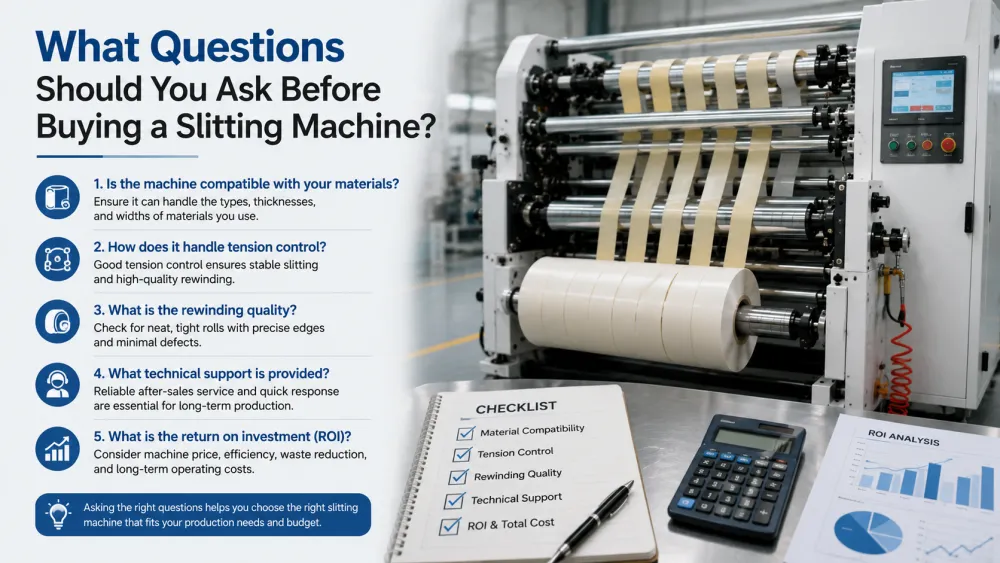
Question 1: What Materials Will the Machine Process?
The first and most important question concerns material compatibility.
Different materials require different slitting technologies, tension control systems, and rewinding structures.
- BOPP film
- PET film
- PE film
- CPP film
- Paper rolls
- Thermal paper
- Aluminum foil
- Self-adhesive labels
- Adhesive tapes
Providing accurate material information allows suppliers to recommend the most suitable machine configuration.
Question 2: What Material Thickness Range Can the Machine Handle?
Material thickness directly affects slitting performance.
Machines designed for thin flexible films may not perform well when processing thicker laminates or paper materials. Buyers should verify both minimum and maximum material thickness capabilities.
It is also important to consider future production plans rather than only current requirements.
Question 3: What Slitting Method Is Recommended?
Different materials may require different cutting methods.
Razor Slitting
Often used for lightweight films and simple applications.
Shear Slitting
Commonly preferred for PET films, foil laminates, labels, and applications requiring clean edges.
Crush Slitting
Frequently used for paper, tape, and selected industrial materials.
Buyers should ask suppliers why a specific slitting method is recommended for their application.
For a detailed comparison, see Razor Slitting vs Shear Slitting vs Crush Slitting.
Question 4: How Is Web Tension Controlled?
Tension control is one of the most important factors affecting slitting quality.
Poor tension control may create:
- Wrinkles
- Telescoping rolls
- Material stretching
- Uneven rewinding
- Production waste
Ask suppliers how tension is controlled during unwinding, slitting, and rewinding.
Modern slitter rewinders often use automatic tension control systems that improve production consistency.
Learn more in our guide to Web Tension Control in Slitter Rewinder Machines.
Question 5: What Slit Width Accuracy Can Be Achieved?
For many industries, slit width accuracy directly affects downstream production quality.
This is especially important for:
- Label converting
- Thermal paper production
- Medical packaging materials
- Flexible packaging laminates
Ask suppliers for realistic production tolerances rather than theoretical specifications.
Question 6: How Is Rewinding Quality Controlled?
Finished roll quality depends heavily on rewinding performance.
Ask suppliers:
- How roll hardness is controlled
- How telescoping is prevented
- How wrinkles are minimized
- How winding tension is adjusted
Request sample rolls or production videos whenever possible.
Question 7: What Is the Real Production Speed?
Machine catalogs often show maximum speed, but actual production speed depends on material type, roll width, slit width, and product quality requirements.
Buyers should ask:
- What speed is typically achieved in normal production?
- What materials were used during testing?
- How does speed affect rewinding quality?
Consistent production is often more valuable than the highest possible speed.
Question 8: What Automation Features Are Included?
Automation can improve productivity and reduce operator workload.
Common features include:
- Automatic tension control
- EPC web guiding
- Automatic knife positioning
- Touchscreen controls
- Production data monitoring
- Automatic unloading systems
Buyers should evaluate which automation features provide meaningful value for their operation.
Question 9: What Technical Support Is Available After Installation?
After-sales support is often overlooked during supplier evaluation.
Ask suppliers:
- Is installation support available?
- Is operator training included?
- How quickly can technical assistance be provided?
- Are spare parts readily available?
- Is remote troubleshooting supported?
Reliable support can significantly reduce downtime and operating risk.
Question 10: What Is the Expected ROI?
A lower machine price does not always result in lower operating costs.
Buyers should evaluate:
- Material waste reduction
- Production efficiency improvements
- Labor savings
- Maintenance requirements
- Machine lifespan
Long-term ROI often provides a more accurate comparison than initial purchase cost alone.
Information Buyers Should Prepare Before Requesting a Quotation
To receive accurate recommendations and quotations, buyers should prepare:
- Material type
- Material thickness range
- Jumbo roll width
- Finished roll widths
- Unwind diameter
- Rewind diameter
- Target production speed
- Annual production volume
Providing complete information helps suppliers recommend more suitable machine configurations and avoid unnecessary costs.
Choosing the Right Supplier Is as Important as Choosing the Right Machine
A successful slitting project depends on both equipment quality and supplier expertise.
Manufacturers that understand your materials, production goals, and future growth plans are often better positioned to recommend practical solutions and provide long-term support.
Buyers evaluating different options can explore available slitting machines and compare machine configurations based on actual production requirements rather than specifications alone.
FAQ: Questions Before Buying a Slitting Machine
What is the most important question to ask before buying a slitting machine?
Material compatibility is usually the most important consideration because it determines the required slitting method, tension control system, and rewinding configuration.
Should I focus on machine speed when comparing suppliers?
Not necessarily. Production stability, rewinding quality, and material compatibility are often more important than maximum speed specifications.
Why is tension control important?
Stable tension helps reduce wrinkles, telescoping rolls, material stretching, and production waste.
What information should I provide when requesting a quotation?
Material type, thickness, roll width, finished slit width, unwind and rewind diameters, and production speed requirements are usually essential.
How can I compare slitting machine suppliers effectively?
Evaluate machine quality, application experience, technical support, customization capability, spare parts availability, and long-term service rather than comparing price alone.