





What Questions Should You Ask Before Buying a Gravure Press?
Buying a gravure press is a major investment for any packaging manufacturer. Unlike standard industrial equipment, gravure printing machines are highly customized based on production requirements, substrate type, automation level, and long-term output goals.
Many buyers focus only on machine price or color count. However, choosing the wrong configuration can lead to lower efficiency, unstable print quality, higher maintenance costs, or limited production flexibility.
Asking the right questions before purchasing helps reduce risk and ensures the machine aligns with both current production demands and future business growth.
Why Asking Questions Before Buying a Gravure Press Matters
Gravure printing machines are designed for long-term production use. Once installed, the equipment becomes a core part of your manufacturing workflow.
A poor purchasing decision may result in:
- Production bottlenecks
- Registration instability
- Excessive energy consumption
- Higher setup waste
- Limited future scalability
Before comparing suppliers or requesting quotations, it is important to understand what technical and operational questions should be clarified.
1. What Materials Will You Print?
Material type is one of the first factors that determines machine configuration.
Gravure printing can support many substrates, but different materials require different tension control, drying systems, and cylinder performance.
Common materials include:
- BOPP film
- PET film
- PE film
- Aluminum foil
- Laminated packaging structures
- Decorative films
Thin flexible films require stable tension and high registration precision, while thicker substrates may need stronger web handling capability.
2. What Production Speed Do You Require?
Not all gravure presses operate at the same production speed.
Before purchasing, define your realistic output target.
- Entry-level machines may support moderate-speed production
- High-speed packaging lines often exceed 250–400 m/min
- Production speed influences drying design and motor requirements
Buying a machine with insufficient speed can limit long-term production capacity.
3. How Many Colors Are Required?
Color quantity directly affects both machine complexity and investment level.
Flexible packaging commonly uses:
- 4-color configuration for simple packaging
- 6-color systems for general consumer packaging
- 8–10 color presses for premium graphics
Selecting the correct color configuration avoids underinvestment or unnecessary overspending.
4. What Printing Width Is Needed?
Web width influences productivity and material flexibility.
Questions to consider include:
- What packaging sizes do you currently produce?
- Will future product formats require larger width?
- Do you need narrow-web or wide-web production?
Machine width impacts overall line size, power requirements, and factory layout.
5. Which Drive System Is More Suitable?
Modern gravure presses typically use either mechanical line shaft or electronic line shaft synchronization.
Electronic systems provide better flexibility and automation, while mechanical systems often reduce initial investment.
Understanding the difference between both architectures is essential when comparing long-term performance.
If you want a deeper technical comparison, you can read our guide on Electronic Line Shaft vs Mechanical Shaft in Gravure Printing .
6. What Registration Accuracy Can the Machine Achieve?
Registration accuracy determines how precisely colors align during printing.
This becomes critical in packaging with fine text, gradients, and multi-color graphics.
Ask the supplier:
- What registration tolerance is guaranteed?
- How does the system maintain alignment during speed changes?
- Is automatic correction included?
Stable registration improves print quality while reducing waste during startup.
7. What Drying System Is Included?
Drying efficiency directly affects production speed and ink performance.
Questions to ask include:
- Does the machine use standard or energy-saving drying?
- How is airflow distributed?
- Is heat recovery available?
- Can the drying system support high-speed printing?
In flexible packaging production, poor drying performance can become a major bottleneck.
8. What Automation Features Are Available?
Automation increasingly influences gravure press efficiency.
Advanced systems may include:
- Automatic registration control
- Servo synchronization
- Recipe memory for repeat jobs
- Automatic tension adjustment
- Remote diagnostics
Higher automation can reduce labor dependence and improve repeatability.
9. How Easy Is Maintenance and Spare Parts Support?
Long-term maintenance affects operational cost just as much as purchase price.
Before buying, ask:
- Are spare parts readily available?
- What is the typical replacement cycle?
- Can parts be sourced internationally?
- Is remote support provided?
Reliable after-sales service becomes especially important for high-output factories.
10. Does the Machine Match Future Production Growth?
Purchasing decisions should consider future demand, not just current production.
Ask yourself:
- Will order volume increase?
- Will additional packaging formats be introduced?
- Will automation become more important later?
Choosing scalable equipment reduces the need for premature replacement.
11. What Is the Real Total Cost of Ownership?
Machine price is only one part of the investment.
Buyers should also evaluate:
- Installation cost
- Operator training
- Energy consumption
- Cylinder engraving cost
- Maintenance expense
Understanding ownership cost helps create a more realistic ROI calculation.
To better understand pricing structures, you can explore our detailed guide on Rotogravure Printing Machine Cost in 2026 .
12. Does the Supplier Provide Engineering Support?
A gravure press supplier should offer more than machine manufacturing.
Strong suppliers often provide:
- Layout planning
- Installation guidance
- Operator training
- Production optimization advice
- Technical troubleshooting
Engineering support becomes especially valuable during commissioning and production ramp-up.
What Makes a Reliable Gravure Press Supplier?
Beyond specifications, supplier experience plays a major role in equipment performance.
Reliable manufacturers typically provide:
- Customization capability
- Stable machine engineering
- Clear technical communication
- Global installation support
- Long-term spare parts availability
Modern Rotogravure Printing Machines often include advanced automation, intelligent tension control, and high-efficiency drying systems designed for flexible packaging production.
Before You Buy: Build a Gravure Press Evaluation Checklist
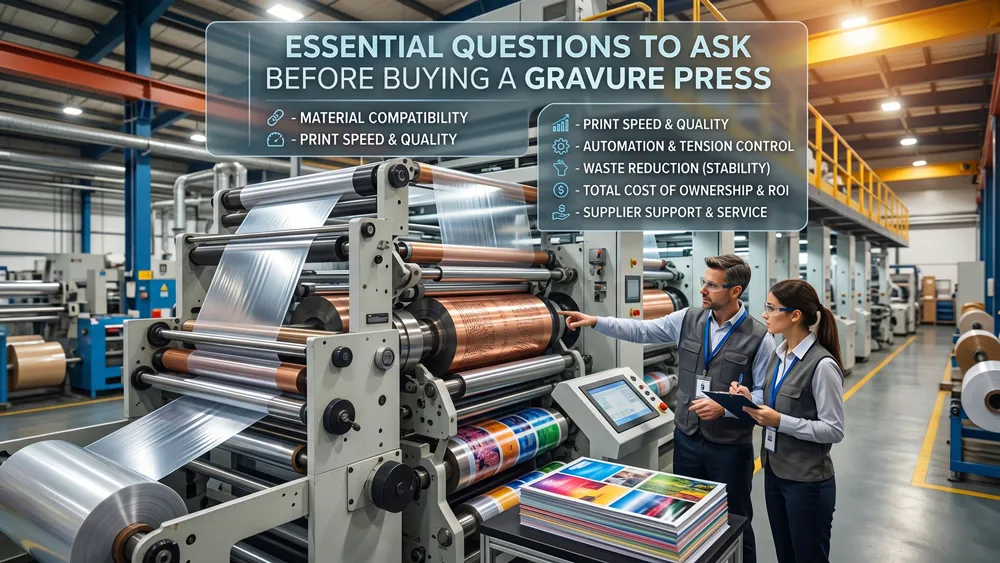
Before requesting quotations, create a clear evaluation checklist based on your production goals.
This checklist should include:
- Material compatibility
- Speed target
- Automation level
- Maintenance support
- Long-term scalability
- Supplier engineering capability
The more precise your requirements, the easier it becomes to compare suppliers objectively.
Conclusion
Buying a gravure press is not simply about choosing a machine—it is about building a production system that supports efficiency, quality, and long-term business growth.
Asking the right questions before purchasing helps reduce investment risk and ensures that machine performance aligns with your packaging workflow.
From material compatibility and drying performance to automation and supplier support, each factor contributes to the overall success of your production line.