





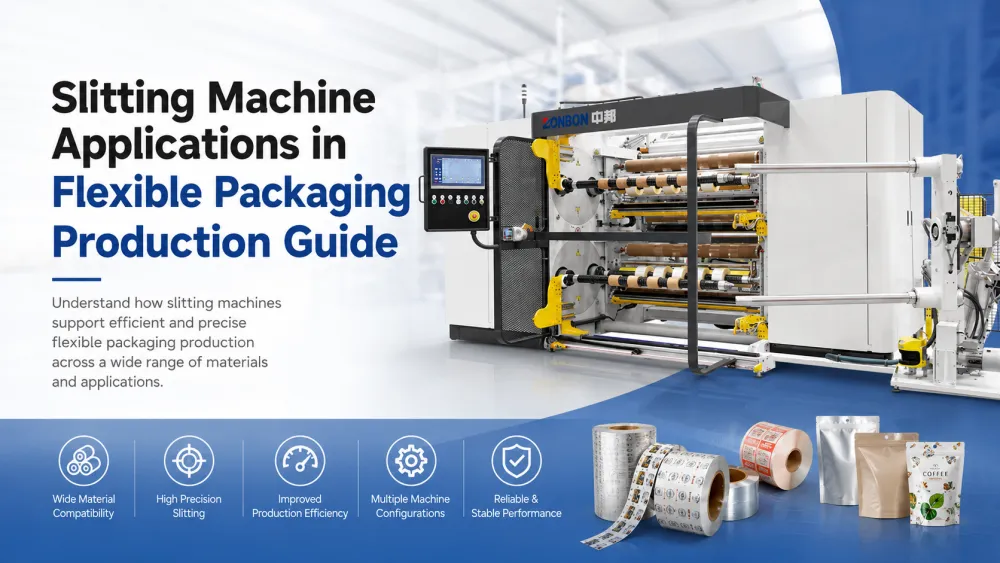
Slitting Machine Applications in Flexible Packaging Production Guide
Why Slitting Is a Critical Process in Flexible Packaging Production
Flexible packaging has become one of the fastest-growing sectors in the packaging industry due to its lightweight design, excellent barrier performance, lower transportation costs, and attractive printing quality. Products ranging from snack foods and frozen meals to coffee, pharmaceuticals, personal care items, and pet food all rely on flexible packaging materials.
However, high-quality printing and lamination alone cannot guarantee excellent finished packaging. Before rolls can enter pouch making, bag making, or automatic packaging lines, they must be slit into precise widths with consistent roll quality. This is where the slitting machine becomes an essential part of the flexible packaging converting process.
A well-configured slitting machine ensures accurate slit widths, stable winding tension, smooth roll edges, and consistent roll hardness, helping downstream equipment operate efficiently while reducing waste and production interruptions.
This guide explains where slitting fits within flexible packaging production, which materials require different configurations, common production challenges, and how manufacturers can improve converting efficiency through proper machine selection.
Where Slitting Fits in the Flexible Packaging Production Process
Flexible packaging production involves multiple converting processes before the finished packaging reaches the customer.
| Production Stage | Main Purpose |
|---|---|
| Film Extrusion | Produce plastic substrate films |
| Printing | Apply graphics, branding, and product information |
| Lamination | Combine multiple material layers for barrier performance |
| Curing | Stabilize adhesive bonding after lamination |
| Slitting & Rewinding | Convert jumbo rolls into finished production rolls |
| Pouch or Bag Making | Produce finished packaging products |
Although slitting is often considered a secondary converting process, it directly influences the performance of every downstream operation. Poor slit quality can create wrinkles, telescoping rolls, uneven feeding, registration problems, and sealing defects during bag making.
Why Slitting Quality Directly Affects Finished Packaging
Many packaging manufacturers focus heavily on printing quality and lamination performance while underestimating the importance of slitting. In reality, even perfectly laminated materials can create production problems if they are slit incorrectly.
Poor slitting quality may lead to:
- Uneven roll hardness that affects unwinding performance.
- Wrinkled films during pouch making.
- Telescoping rolls that complicate storage and transportation.
- Irregular slit widths causing registration deviations.
- Edge defects that reduce sealing quality.
- Increased material waste and lower production efficiency.
A properly configured slitting machine helps maintain the quality established during earlier converting processes while preparing rolls for high-speed downstream production.
Common Flexible Packaging Materials Processed by Slitting Machines
Modern slitting machines are designed to process a wide variety of flexible packaging materials with different thicknesses, structures, and mechanical properties.
| Material | Typical Applications | Key Slitting Considerations |
|---|---|---|
| BOPP Film | Snack food, bakery, confectionery | Clean edges and stable rewinding |
| PET Film | Coffee, premium food packaging | High tension stability |
| CPP Film | Retort pouches and food packaging | Scratch prevention and smooth winding |
| PE Film | Frozen food and heavy-duty bags | Prevent stretching during rewinding |
| BOPA (Nylon) | Vacuum packaging and meat packaging | Stable web tension throughout production |
| PET/AL/PE Laminates | Coffee bags and pharmaceutical packaging | High rewinding precision with consistent roll hardness |
Different material structures require different knife systems, tension control strategies, and rewinding configurations to maintain consistent product quality.
Flexible Packaging Products That Depend on Precision Slitting
Slitting machines support nearly every flexible packaging market by preparing rolls for downstream converting equipment.
| Packaging Product | Typical Material Structure | Production Priority |
|---|---|---|
| Snack Food Packaging | BOPP / CPP | High-speed production and clean slit edges |
| Coffee Bags | PET / AL / PE | Stable rewinding and dimensional accuracy |
| Frozen Food Packaging | BOPA / PE | Consistent web tension and roll stability |
| Stand-up Pouches | PET / PE | Excellent edge quality for pouch making |
| Pet Food Packaging | PET / PE | Uniform roll hardness for long production runs |
| Medical Packaging | PET / AL / PE | Precision slitting with minimal material defects |
Although these packaging products differ in appearance and material structure, they all require accurately slit rolls to achieve reliable downstream processing and consistent finished product quality.
Recommended Machine Features for Flexible Packaging Converters
Choosing a slitting machine for flexible packaging production involves more than comparing maximum operating speed. Manufacturers should evaluate machine configurations according to material characteristics, production volume, and downstream processing requirements.
Important features include:
- Automatic web guiding for accurate material tracking.
- Closed-loop tension control throughout unwinding and rewinding.
- Differential rewind shafts for consistent roll hardness.
- Precision shear slitting systems for laminated films.
- Automatic roll unloading to improve production efficiency.
- Servo-driven control systems for improved accuracy and repeatability.
For most laminated flexible packaging materials, maintaining stable tension throughout the converting process is just as important as achieving precise slit widths.
To better understand how stable web control influences slit quality, read our guide on Web Tension Control in Slitter Rewinder Machines.
Common Slitting Challenges in Flexible Packaging Production
Even when printing and lamination are performed correctly, poor slitting can create quality issues that affect every downstream process. Understanding these challenges helps manufacturers identify whether production problems originate from the slitting stage rather than earlier converting operations.
| Production Issue | Possible Cause | Recommended Solution |
|---|---|---|
| Wrinkled Finished Rolls | Unstable web tension or incorrect rewinding pressure | Optimize closed-loop tension control and rewinding parameters |
| Telescoping Rolls | Uneven winding hardness | Use differential rewind shafts and proper tension profiles |
| Rough or Frayed Edges | Incorrect knife selection or worn blades | Replace blades regularly and match the slitting method to the material |
| Uneven Roll Diameter | Inconsistent rewinding speed | Maintain synchronized servo control throughout production |
| Poor Bag Making Performance | Inconsistent slit width or winding quality | Improve slitting accuracy before downstream processing |
| Excessive Material Waste | Poor machine setup or unstable web guiding | Optimize machine calibration and operator procedures |
Many converters initially assume these issues originate from printing or lamination. In reality, slitting quality often determines whether finished rolls perform reliably during pouch making, filling, and sealing.
How Precision Slitting Improves Downstream Packaging Efficiency
The purpose of slitting is not simply to divide a jumbo roll into narrower widths. It prepares material for high-speed downstream production while maintaining dimensional accuracy and roll consistency.
When slit rolls meet quality requirements, manufacturers benefit from:
- Smoother unwinding on pouch-making machines.
- Improved registration stability during automatic packaging.
- More consistent sealing performance.
- Reduced machine stoppages caused by poor roll quality.
- Lower scrap rates and reduced material consumption.
- Higher production efficiency across the entire converting line.
Because slitting directly influences every subsequent converting process, investing in stable slitting performance often delivers measurable improvements throughout the production workflow rather than only within the slitting department itself.
Choosing the Right Slitting Configuration for Different Packaging Applications
Different flexible packaging products require different machine configurations. Rather than selecting equipment based solely on maximum speed, manufacturers should evaluate the material structure, production volume, and downstream converting requirements.
| Packaging Application | Typical Material | Recommended Machine Features |
|---|---|---|
| Snack Packaging | BOPP / CPP | High-speed shear slitting with automatic tension control |
| Coffee Packaging | PET / AL / PE | Precision rewinding with stable roll hardness |
| Frozen Food Packaging | BOPA / PE | Closed-loop tension control for stretch-sensitive films |
| Stand-up Pouches | PET / PE | Differential rewind shafts and accurate web guiding |
| Pet Food Packaging | PET / PE | Heavy-duty rewinding for long production runs |
| Medical Packaging | Multi-layer Laminates | High-precision slitting with excellent edge quality |
Selecting machine configurations according to the finished packaging application helps improve product quality while reducing long-term operating costs.
Flexible Packaging Material Selection Matrix
Different flexible packaging materials have unique mechanical properties, laminate structures, and processing requirements. Selecting the appropriate slitting configuration helps maintain slit quality, improve rewinding consistency, and reduce production waste throughout the converting process.
The following matrix provides a practical reference for matching common flexible packaging materials with recommended slitting solutions.
| Material Structure | Typical Packaging Application | Recommended Slitting Method | Key Machine Features | Buyer Recommendation |
|---|---|---|---|---|
| BOPP / CPP | Snack Food, Bakery, Confectionery | Shear Slitting | Automatic tension control, high-speed rewinding | Ideal for high-volume production requiring clean edges and stable roll quality. |
| PET / PE | Stand-up Pouches, Liquid Packaging | Shear Slitting | Closed-loop tension control, differential rewind shafts | Recommended for converters requiring consistent roll hardness and reliable pouch-making performance. |
| PET / AL / PE | Coffee Bags, Pharmaceutical Packaging | Precision Shear Slitting | Servo synchronization, precision rewinding, EPC web guiding | Suitable for high-barrier laminated structures where dimensional accuracy is critical. |
| BOPA / PE | Frozen Food, Vacuum Packaging | Shear Slitting | Constant tension control and stable rewinding pressure | Helps prevent film stretching and maintains roll stability during long production runs. |
| PET / VMPET / PE | Coffee, Pet Food, Premium Packaging | Precision Shear Slitting | High-precision web guiding and servo-driven rewinding | Recommended for metallized laminates requiring smooth edges and consistent winding. |
| Paper / PE Laminates | Food Packaging, Paper-Based Flexible Packaging | Shear Slitting | Stable web tension with dust control | Minimizes paper dust while maintaining clean slit edges for downstream converting. |
| Medical Multi-layer Laminates | Medical Pouches and Sterile Packaging | Precision Shear Slitting | Servo control, EPC system, high-accuracy tension regulation | Designed for applications requiring excellent dimensional consistency and minimal material defects. |
Although many flexible packaging materials appear similar, differences in film stiffness, laminate construction, thickness, surface characteristics, and barrier layers often require different slitting strategies. Matching the machine configuration to the material structure helps improve production efficiency, reduce waste, and ensure consistent performance during downstream pouch making and packaging operations.
What Buyers Should Evaluate Before Purchasing a Slitting Machine
For converters entering or expanding flexible packaging production, selecting the right slitting machine should be based on long-term production objectives rather than only current output requirements.
Before requesting quotations, buyers should evaluate:
- Types of flexible packaging materials to be processed.
- Material thickness range and laminate structures.
- Maximum jumbo roll diameter and finished roll size.
- Required slit width accuracy.
- Expected production speed under normal operating conditions.
- Automation level and operator requirements.
- Future expansion plans for new packaging products.
- Availability of technical support, spare parts, and training.
A machine that supports multiple material structures and future production growth generally provides better long-term value than selecting equipment based solely on the initial purchase price.
Future Trends in Flexible Packaging Slitting
As flexible packaging continues to evolve, converters are processing increasingly complex laminated materials while facing higher expectations for quality, productivity, and sustainability.
Modern slitting technology is therefore moving toward:
- Fully servo-driven control systems.
- Automatic tension optimization.
- Intelligent defect monitoring.
- Higher precision for thinner packaging films.
- Faster job changeovers with reduced downtime.
- Digital production data collection for quality management.
Manufacturers investing in advanced slitting technology today are better positioned to meet future packaging requirements while improving production efficiency and reducing operating costs.
Conclusion
Slitting is one of the most important converting processes in flexible packaging production. It bridges printing, lamination, and pouch making by transforming jumbo rolls into finished production rolls with the precision required for reliable downstream processing.
Whether manufacturing snack packaging, coffee bags, medical pouches, frozen food packaging, or pet food packaging, consistent slit quality, stable tension control, and reliable rewinding directly influence finished product quality and production efficiency.
When evaluating film slitting machines, manufacturers should focus on material compatibility, rewinding performance, automation, precision, and long-term service support to ensure the equipment matches both current production needs and future business growth.
FAQ: Slitting Machine Applications in Flexible Packaging Production
Why is slitting important in flexible packaging production?
Slitting converts jumbo rolls into production-ready rolls with accurate widths, consistent winding quality, and stable tension, ensuring smooth downstream pouch making and packaging operations.
Which flexible packaging materials can be processed by a slitting machine?
Modern slitting machines commonly process BOPP, PET, PE, CPP, BOPA, aluminum foil laminates, and various multi-layer flexible packaging structures.
How does slitting affect pouch-making quality?
Poor slit width accuracy, uneven roll hardness, or unstable tension can cause wrinkles, feeding problems, registration errors, and sealing defects during pouch production.
What machine features are most important for laminated films?
Converters should prioritize automatic tension control, precision shear slitting, differential rewind shafts, accurate web guiding, and servo-driven synchronization for laminated flexible packaging materials.
How can manufacturers improve slitting efficiency?
Efficiency can be improved by selecting the correct machine configuration, maintaining stable web tension, replacing knives regularly, optimizing rewinding parameters, and providing proper operator training and preventive maintenance.