





Common Solventless Lamination Problems: Causes, Solutions and Prevention
What Are the Most Common Solventless Lamination Problems?
Solventless lamination has become one of the most widely adopted technologies in modern flexible packaging production because of its high efficiency, lower energy consumption, compact machine design, and reduced solvent emissions. It is commonly used for food packaging, snack pouches, coffee bags, pet food packaging, personal care products, and many other laminated flexible packaging structures.
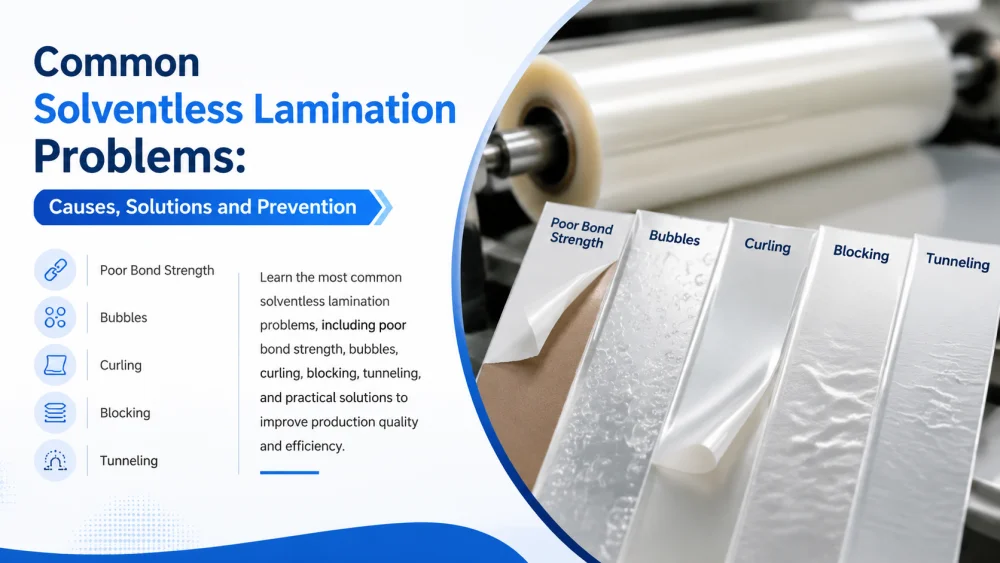
However, like any converting process, solventless lamination is not completely free from production challenges. Poor bond strength, bubbles, curling, blocking, tunneling, wrinkles, and uneven adhesive coating are among the most frequently encountered quality issues. These defects can reduce production efficiency, increase waste, delay deliveries, and ultimately affect customer satisfaction.
Fortunately, most solventless lamination problems are not caused by a single factor. They usually result from a combination of material properties, adhesive selection, machine settings, web tension, curing conditions, and operator adjustments. By understanding the root causes and following a structured troubleshooting process, manufacturers can significantly improve product quality and production stability.
This guide explains the most common solventless lamination problems, their symptoms, possible causes, practical solutions, and preventive measures to help converters optimize their production process.
Poor Bond Strength
Poor bond strength is one of the earliest indicators that something is wrong during solventless lamination. Although laminated rolls may initially appear normal, weak bonding often becomes evident during curing, slitting, pouch making, transportation, or customer use.
Unlike visible defects such as wrinkles or bubbles, poor bond strength may remain hidden until the finished package experiences stress. For food packaging manufacturers, this can result in product returns, leakage, shortened shelf life, and costly quality claims.
Typical Symptoms
- Laminated layers separate easily during peel testing.
- Bond strength decreases after pouch conversion.
- Edges begin separating during slitting.
- Pouches open unexpectedly during filling or transportation.
- Seal integrity remains good, but laminate layers separate.
Possible Causes
| Possible Cause | Description |
|---|---|
| Incorrect adhesive selection | The adhesive does not match the substrate or packaging application. |
| Low adhesive coating weight | Insufficient adhesive creates incomplete bonding. |
| Poor film surface treatment | Low corona level prevents proper wetting. |
| Incorrect adhesive mixing ratio | Two-component adhesive cannot fully react. |
| Insufficient curing | The adhesive has not reached its designed bond strength. |
| Material contamination | Oil, dust, silicone, or moisture reduce adhesion. |
Recommended Solutions
- Verify the adhesive is suitable for the packaging structure.
- Measure film surface tension before production.
- Check adhesive coating weight regularly.
- Maintain accurate adhesive mixing ratios.
- Allow sufficient curing time before slitting and bag making.
- Inspect incoming materials for contamination.
If poor bond strength occurs repeatedly across multiple jobs, manufacturers should review both adhesive compatibility and process parameters rather than adjusting only machine pressure or coating weight.
Bubbles and Air Entrapment
Bubbles are another common solventless lamination problem. They appear as small or large air pockets trapped between laminated layers and can reduce package appearance, barrier performance, and overall product quality.
Bubble defects may appear immediately after lamination or gradually become more visible during curing.
Typical Symptoms
- Visible air pockets between substrates.
- Uneven laminate appearance.
- Localized bond failure around bubble areas.
- Poor optical clarity.
- Random transparent or white spots.
Possible Causes
| Possible Cause | Description |
|---|---|
| Air trapped during lamination | Insufficient contact between substrates. |
| Incorrect nip pressure | Pressure is too low for complete bonding. |
| Uneven adhesive coating | Creates localized bonding differences. |
| Poor web alignment | Substrates enter the laminating nip unevenly. |
| High production speed | Air cannot escape before lamination. |
| Film deformation | Uneven substrate flatness traps air. |
Recommended Solutions
- Optimize laminating nip pressure.
- Reduce production speed during troubleshooting.
- Improve web guiding accuracy.
- Maintain consistent adhesive coating.
- Inspect rollers for contamination or wear.
- Store materials correctly to reduce deformation.
When bubbles appear randomly across different production jobs, operators should inspect the entire laminating process rather than focusing only on adhesive performance.
Curling After Lamination
Curling occurs when the laminated web loses dimensional balance and begins bending toward one side. Curling may not seem serious immediately after lamination, but it can create significant problems during slitting, pouch making, and automatic filling operations.
In many cases, curling is caused by stress imbalance between substrates rather than adhesive performance alone.
Typical Symptoms
- The laminated web curls toward one material layer.
- Rolls become difficult to rewind evenly.
- Finished pouches fail to remain flat.
- Automatic packaging equipment experiences feeding instability.
Possible Causes
| Possible Cause | Description |
|---|---|
| Uneven web tension | Different tension between primary and secondary webs. |
| Material shrinkage differences | PET, PE, CPP, and other films react differently. |
| Excessive winding tension | Stress accumulates inside the laminated roll. |
| Uneven adhesive distribution | Creates localized internal stress. |
| Improper curing conditions | Adhesive stress develops unevenly. |
Recommended Solutions
- Balance web tension across all unwinding stations.
- Optimize winding tension during rewinding.
- Verify adhesive coating consistency.
- Allow complete curing before downstream converting.
- Select compatible material structures for the intended application.
Packaging structures such as PET/PE and PET/CPP respond differently to internal stress because each material has unique mechanical and thermal characteristics. Material selection should therefore be evaluated together with process control.
Blocking During Winding
Blocking occurs when adjacent layers inside a laminated roll stick together unintentionally during storage or curing. Operators often discover blocking only when attempting to unwind the roll during slitting or pouch conversion.
Blocking not only reduces productivity but may also damage printed graphics, distort laminated structures, and increase material waste.
Typical Symptoms
- The roll is difficult to unwind.
- Layers stick together after curing.
- Printed graphics are damaged during unwinding.
- Surface marks appear after separating layers.
- Material tears during slitting.
Possible Causes
| Possible Cause | Description |
|---|---|
| Excessive winding tension | Creates excessive roll pressure. |
| Insufficient curing | Adhesive remains active. |
| High storage temperature | Accelerates adhesive migration. |
| Excessive adhesive coating | Increases adhesive transfer. |
| Improper storage conditions | Temperature and humidity accelerate blocking. |
Recommended Solutions
- Reduce winding tension where appropriate.
- Follow adhesive supplier curing recommendations.
- Store laminated rolls in a controlled environment.
- Monitor adhesive coating weight carefully.
- Avoid stacking freshly laminated rolls before curing is complete.
Blocking is often associated with curing management rather than machine performance alone. Proper roll handling and storage procedures are equally important for preventing this problem.
Tunneling Between Laminated Layers
Tunneling is a lamination defect in which localized channels or tunnel-like gaps develop between laminated substrates after production. Unlike bubbles, which are often caused by trapped air, tunneling is usually the result of internal stress, incomplete bonding, or uneven stress distribution within the laminate.
This problem often becomes visible after curing or during storage rather than immediately after lamination. In severe cases, tunneling can reduce barrier performance, weaken package strength, and cause customer complaints.
Typical Symptoms
- Long, narrow separation channels inside the laminate.
- Localized bond failure after curing.
- Uneven laminate appearance under reflected light.
- Progressive separation during storage.
- Reduced peel strength in affected areas.
Possible Causes
| Possible Cause | Description |
|---|---|
| Uneven adhesive coating | Creates localized weak bonding areas. |
| High internal stress | Stress is released after winding or curing. |
| Poor adhesive compatibility | The adhesive cannot maintain long-term bonding. |
| Insufficient curing | The adhesive has not fully developed its final strength. |
| Excessive winding tension | Compresses the laminate and increases internal stress. |
| Different shrinkage rates | Substrates shrink at different speeds during curing. |
Recommended Solutions
- Maintain consistent adhesive coating weight.
- Reduce excessive winding tension.
- Verify adhesive compatibility with the selected substrate combination.
- Follow recommended curing conditions.
- Review material structure if tunneling appears repeatedly.
- Inspect coating rollers for wear or contamination.
Tunneling often develops gradually, making it difficult to identify during production. Regular bond strength testing after curing is one of the most effective methods for early detection.
Wrinkles and Web Tracking Problems
Wrinkles are among the most visible defects in solventless lamination. Even when bond strength meets specification, wrinkles reduce product appearance and create difficulties during slitting, pouch making, and automatic filling.
Because wrinkles usually originate from web handling rather than adhesive chemistry, solving them requires careful inspection of the entire web path.
Typical Symptoms
- Diagonal wrinkles across the web.
- Longitudinal wrinkles running in the machine direction.
- Material folds entering the laminating nip.
- Unstable web tracking during production.
- Edge wrinkles after rewinding.
Possible Causes
| Possible Cause | Description |
|---|---|
| Poor web alignment | The substrates do not enter the laminating nip evenly. |
| Unstable web tension | Creates uneven stretching across the web width. |
| Guide roller misalignment | Changes web direction unexpectedly. |
| Damaged rollers | Roller surface defects disturb web movement. |
| Uneven substrate thickness | Creates localized stress during lamination. |
| Improper rewinding tension | Produces wrinkles inside finished rolls. |
Recommended Solutions
- Calibrate web guide systems regularly.
- Maintain stable web tension throughout production.
- Inspect all guide rollers and laminating rollers.
- Check substrate flatness before production.
- Reduce speed temporarily while identifying the root cause.
- Verify roller parallelism after maintenance.
Operators should avoid adjusting multiple parameters simultaneously. Changing one variable at a time makes troubleshooting faster and more accurate.
Uneven Adhesive Coating
Uniform adhesive application is essential for achieving stable lamination quality. Even small variations in coating weight may create significant differences in bond strength across the web.
Uneven coating is often the root cause of several other defects, including bubbles, delamination, tunneling, blocking, and inconsistent peel strength.
Typical Symptoms
- Inconsistent peel strength.
- Localized delamination.
- Random bubbles.
- Visible coating streaks.
- Different laminate appearance across the web width.
Possible Causes
| Possible Cause | Description |
|---|---|
| Incorrect coating gap | Produces inconsistent adhesive thickness. |
| Roller contamination | Blocks adhesive transfer. |
| Adhesive viscosity changes | Alters coating performance. |
| Metering roller wear | Creates uneven adhesive distribution. |
| Improper machine setup | Causes unstable coating pressure. |
| Production speed fluctuations | Affects adhesive transfer consistency. |
Recommended Solutions
- Inspect coating rollers before every production shift.
- Maintain stable adhesive viscosity.
- Clean adhesive application systems regularly.
- Replace worn metering components when necessary.
- Monitor coating weight continuously.
- Record coating data for repeat production orders.
Consistent coating quality not only improves bond strength but also reduces adhesive consumption and production waste.
How to Troubleshoot Solventless Lamination Problems
When a defect appears, many operators immediately adjust machine settings. However, effective troubleshooting should follow a structured process to identify the true root cause rather than simply reducing visible symptoms.
Recommended Troubleshooting Workflow
| Inspection Step | Questions to Ask | Typical Action |
|---|---|---|
| Material Inspection | Are the films clean and properly treated? | Measure surface tension and inspect incoming materials. |
| Adhesive Inspection | Is the adhesive suitable and correctly mixed? | Verify viscosity, mixing ratio, and pot life. |
| Coating Inspection | Is coating weight uniform? | Measure coating weight across the web. |
| Machine Inspection | Are rollers, nip pressure, and alignment correct? | Inspect mechanical condition and settings. |
| Tension Inspection | Is web tension balanced? | Review tension profiles from unwinding to rewinding. |
| Curing Inspection | Has sufficient curing time been allowed? | Delay downstream converting if necessary. |
Following a consistent troubleshooting workflow helps reduce unnecessary machine adjustments and minimizes production downtime.
Root Cause Diagnosis Guide
Many solventless lamination defects share similar symptoms. The following table provides a quick reference for identifying possible root causes.
| Problem | Most Likely Cause | First Area to Inspect |
|---|---|---|
| Poor Bond Strength | Adhesive, curing, surface treatment | Adhesive selection and curing conditions |
| Bubbles | Nip pressure, air entrapment | Web alignment and laminating pressure |
| Curling | Tension imbalance | Unwinding and rewinding tension |
| Blocking | Incomplete curing | Curing time and storage conditions |
| Tunneling | Internal stress | Material compatibility and winding tension |
| Wrinkles | Web guiding | Guide rollers and alignment system |
| Uneven Coating | Coating system | Coating rollers and adhesive viscosity |
When the Problem Is the Machine Instead of the Process
Not every solventless lamination problem is caused by adhesive formulation or operator settings. In some cases, recurring quality issues indicate limitations in machine performance or equipment condition.
Manufacturers should consider evaluating their laminating equipment if they experience:
- Repeated tension instability despite correct settings.
- Inconsistent adhesive coating across the web width.
- Frequent web wandering or tracking problems.
- Difficulty maintaining stable nip pressure.
- High defect rates across multiple material structures.
- Excessive downtime caused by mechanical adjustments.
Modern Solventless Laminating Machines provide improved tension control, precision coating systems, servo-driven automation, and more stable production performance, helping converters reduce defect rates while improving productivity.
Successful solventless lamination depends on a combination of high-quality equipment, suitable materials, accurate adhesive management, and disciplined operating procedures.
Experienced converters typically follow these best practices:
- Inspect incoming materials before every production run.
- Verify corona treatment and substrate cleanliness.
- Monitor adhesive viscosity and mixing accuracy continuously.
- Maintain stable web tension throughout the production line.
- Keep coating rollers clean and properly calibrated.
- Allow sufficient curing time before slitting or pouch making.
- Record machine parameters for repeat production jobs.
- Perform routine preventive maintenance according to machine recommendations.
Rather than reacting to defects after they appear, preventive process control helps manufacturers achieve more consistent quality, reduce waste, and improve production efficiency.
Preventive Maintenance Checklist for Solventless Lamination
Most solventless lamination problems can be prevented long before they affect production. Instead of waiting for defects to appear, successful converters establish standardized preventive maintenance and quality inspection procedures throughout the entire production process.
The following checklist can help production managers, maintenance engineers, and operators improve process stability while reducing waste and unexpected downtime.
| Inspection Item | Recommended Frequency | Purpose |
|---|---|---|
| Check film surface treatment (Dyne level) | Before each production job | Ensure proper adhesive wetting and bond strength. |
| Verify adhesive mixing ratio | Every batch | Maintain consistent adhesive performance. |
| Inspect adhesive viscosity | During production | Prevent coating inconsistencies. |
| Measure adhesive coating weight | Each production run | Maintain uniform bonding. |
| Clean coating rollers | Daily | Prevent streaks and uneven coating. |
| Inspect laminating rollers | Weekly | Maintain stable nip pressure. |
| Verify web tension settings | Every job | Reduce curling and wrinkles. |
| Inspect web guide system | Weekly | Maintain accurate web alignment. |
| Review curing conditions | Every production batch | Achieve full adhesive strength. |
| Record production parameters | Every order | Improve repeatability and troubleshooting. |
Operator Best Practices for Solventless Lamination
Experienced operators know that solventless lamination quality depends on consistent process control rather than frequent machine adjustments. Small changes in adhesive management, web handling, or curing conditions can significantly influence final package performance.
To improve production consistency, operators should follow these practical guidelines:
- Inspect all incoming materials before loading the machine.
- Confirm adhesive batch numbers and mixing ratios before production.
- Avoid changing multiple machine parameters simultaneously during troubleshooting.
- Monitor web tension continuously from unwinding to rewinding.
- Check coating quality regularly during long production runs.
- Follow recommended curing times before slitting or pouch conversion.
- Document process settings for repeat production orders.
- Train new operators using standardized troubleshooting procedures.
Factories that follow standardized operating procedures generally experience lower defect rates, shorter setup times, and more stable production quality.
How Solventless Lamination Problems Affect Production Costs
Many manufacturers focus only on visible quality defects, but the financial impact of solventless lamination problems often extends much further than the defective rolls themselves.
| Problem | Potential Business Impact |
|---|---|
| Poor Bond Strength | Customer complaints, rejected products, package failure |
| Bubbles | Reduced visual quality, increased scrap rate |
| Curling | Difficulty during slitting and pouch making |
| Blocking | Production delays and material damage |
| Tunneling | Reduced barrier performance and shorter shelf life |
| Wrinkles | Printing registration issues and converting instability |
| Uneven Adhesive Coating | Higher adhesive consumption and inconsistent quality |
By reducing these defects, manufacturers can lower material waste, improve delivery performance, reduce customer claims, and increase overall production profitability.
When Should You Review Your Lamination Equipment?
Many production issues can be corrected through process optimization, but recurring defects across different materials and production jobs may indicate equipment limitations rather than operator error.
It may be time to evaluate your laminating system if:
- The same defects appear across multiple production orders.
- Stable bond strength cannot be achieved despite correct adhesive selection.
- Web tension fluctuates frequently during normal production.
- Coating consistency varies across the machine width.
- Production speed must be reduced significantly to maintain acceptable quality.
- Maintenance requirements continue increasing each year.
Modern Laminating Machines equipped with precision coating systems, servo-controlled tension management, and automated process monitoring can significantly improve production consistency while reducing operator workload.
Related Technical Resources
Understanding solventless lamination problems is only one part of building a reliable flexible packaging production process. The following technical resources provide additional guidance for improving lamination quality and selecting suitable production technologies.
- What Is Flexible Packaging Lamination? — Learn the complete lamination workflow and production process.
- Solventless vs Dry Lamination — Compare process differences, costs, applications, and equipment selection.
- How to Choose an Adhesive for Flexible Packaging Lamination — Understand adhesive selection for different packaging structures.
- Why Delamination Happens in Flexible Packaging — Explore one of the most common quality issues in greater depth.
Conclusion
Solventless lamination has become one of the preferred technologies for modern flexible packaging production because it offers excellent production efficiency, lower energy consumption, and environmentally friendly operation. However, achieving consistent quality requires much more than selecting the right adhesive or purchasing a high-performance machine.
Problems such as poor bond strength, bubbles, curling, blocking, tunneling, wrinkles, and uneven adhesive coating are usually the result of multiple process variables working together. Material selection, adhesive management, web tension, coating consistency, curing conditions, and equipment stability all contribute to final package quality.
Instead of solving individual defects one by one, manufacturers should establish standardized operating procedures, preventive maintenance programs, and data-driven quality control systems. This approach helps reduce production waste, improve delivery reliability, and increase long-term manufacturing efficiency.
Whether you are operating an existing flexible packaging plant or planning a new production line, understanding the root causes of solventless lamination problems is one of the most effective ways to improve product quality and strengthen your competitive advantage.
FAQ: Common Solventless Lamination Problems
What is the most common problem in solventless lamination?
Poor bond strength is one of the most common solventless lamination problems. It is often related to incorrect adhesive selection, insufficient coating weight, poor surface treatment, inaccurate adhesive mixing, or inadequate curing conditions.
Why do bubbles appear during solventless lamination?
Bubbles are usually caused by trapped air, uneven adhesive coating, insufficient nip pressure, poor web alignment, excessive production speed, or substrate deformation before lamination.
Why does curling occur after solventless lamination?
Curling is commonly caused by tension imbalance, differences in material shrinkage, excessive winding tension, uneven adhesive distribution, or incomplete curing.
What causes blocking in laminated rolls?
Blocking often results from insufficient curing, excessive winding pressure, high storage temperatures, or excessive adhesive coating weight, causing adjacent layers to stick together.
How can uneven adhesive coating be prevented?
Regular roller cleaning, stable adhesive viscosity, accurate coating gap adjustment, routine equipment maintenance, and continuous coating weight monitoring all help maintain consistent adhesive application.
Is solventless lamination more difficult to control than dry lamination?
Both processes require careful process control. Solventless lamination eliminates solvent drying but places greater emphasis on adhesive mixing accuracy, coating consistency, curing conditions, and tension control.
Can operator experience affect lamination quality?
Yes. Well-trained operators who follow standardized procedures are better able to identify abnormal conditions early, maintain stable machine settings, and prevent quality defects before they become serious production problems.
How can manufacturers reduce solventless lamination defects?
The most effective approach combines proper material selection, suitable adhesive systems, accurate process control, preventive maintenance, operator training, and stable laminating equipment. Monitoring production data and following standardized troubleshooting procedures also helps improve long-term production consistency.