





Common Problems in Ziplock Bag Production and How to Fix Them
Why Ziplock Bag Production Quality Matters
Ziplock bags are widely used in food packaging, cosmetics, pharmaceuticals, electronics, and retail applications because of their resealable convenience and protective performance.
However, compared with standard plastic bags, ziplock bag production is more technically demanding. Small production issues such as zipper misalignment or weak sealing can quickly lead to leakage, customer complaints, increased waste, and unstable production efficiency.
For manufacturers, improving ziplock bag consistency requires stable material handling, accurate zipper positioning, strong sealing performance, and reliable machine configuration.
In this guide, we explain the most common problems in ziplock bag production and practical ways to fix them.

Common Ziplock Bag Problems and Solutions
Ziplock bag defects are often caused by material inconsistency, zipper positioning problems, sealing instability, or machine setup errors.
| Problem | Possible Cause | Recommended Solution |
|---|---|---|
| Zipper Misalignment | Unstable tracking or registration | Improve web guiding and tension control |
| Weak Sealing | Incorrect temperature or pressure | Adjust sealing parameters |
| Poor Zipper Closure | Zipper positioning inconsistency | Calibrate zipper feeding system |
| Bag Length Variation | Servo or tension instability | Improve feeding consistency |
| Wrinkles or Curling | Material tension imbalance | Adjust web tension settings |
| High Scrap Rate | Multiple production inconsistencies | Improve process control |
1. Zipper Misalignment
Zipper misalignment is one of the most common issues in ziplock bag production. When the zipper does not align correctly with the bag opening, users may struggle to close or reseal the bag properly.
Common causes:
- Web guiding instability
- Incorrect zipper tracking
- Material feeding inconsistency
- Poor tension control
How to fix it:
- Improve web guiding precision
- Stabilize material feeding
- Adjust zipper alignment system
- Monitor registration accuracy
For high-speed production, servo control systems can improve zipper positioning stability.
2. Weak Sealing Strength
Weak sealing can result in leakage, poor freshness protection, and product failure during shipping.
This problem becomes especially critical in food packaging and liquid packaging applications.
Typical causes:
- Low sealing temperature
- Insufficient sealing pressure
- Material incompatibility
- Contaminated sealing area
Solutions:
- Optimize heat sealing temperature
- Adjust sealing pressure
- Test material compatibility
- Maintain sealing cleanliness
Different film structures may require different sealing conditions.
You may also read: What Materials Are Used for Food Packaging Bag Making?
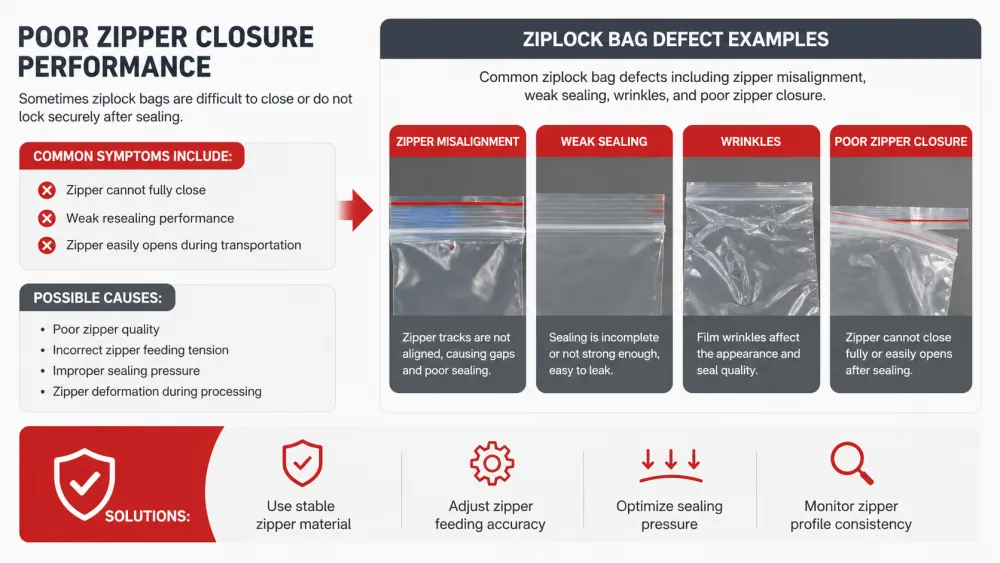
3. Poor Zipper Closure Performance
Sometimes ziplock bags are difficult to close or do not lock securely after sealing.
Common symptoms include:
- Zipper cannot fully close
- Weak resealing performance
- Zipper easily opens during transportation
Possible causes:
- Poor zipper quality
- Incorrect zipper feeding tension
- Improper sealing pressure
- Zipper deformation during processing
Solutions:
- Use stable zipper material
- Adjust zipper feeding accuracy
- Optimize sealing pressure
- Monitor zipper profile consistency
4. Bag Length Inconsistency
Inconsistent bag length affects product appearance and packaging efficiency.
This issue often becomes noticeable during high-speed production.
Common causes:
- Servo control instability
- Web feeding inconsistency
- Material slippage
- Tension fluctuation
Recommended fixes:
- Improve tension control
- Calibrate servo settings
- Use stable film materials
- Monitor feeding consistency
5. Wrinkles and Curling
Wrinkles and edge curling can negatively affect zipper alignment, sealing quality, and final bag appearance.
Common causes:
- Uneven material tension
- Improper roller settings
- Film thickness inconsistency
- Temperature imbalance
Solutions:
- Adjust web tension
- Optimize roller pressure
- Use higher consistency film
- Improve machine stability
6. High Scrap Rate
High production waste often happens when multiple minor defects accumulate during production.
Common reasons include:
- Unstable zipper feeding
- Weak sealing consistency
- Poor operator settings
- Material quality variation
Reducing scrap usually requires improving overall production stability rather than solving only one defect.
How Materials Affect Ziplock Bag Quality
Different materials may affect sealing, zipper performance, and bag stability.
| Material | Potential Risk | Production Consideration |
|---|---|---|
| PE Film | Lower stiffness | Requires stable sealing |
| Laminated Film | Sealing complexity | Higher temperature control |
| Thicker Films | Poor zipper fit | Requires stronger pressure |
| Thin Films | Wrinkling risk | Better tension control needed |
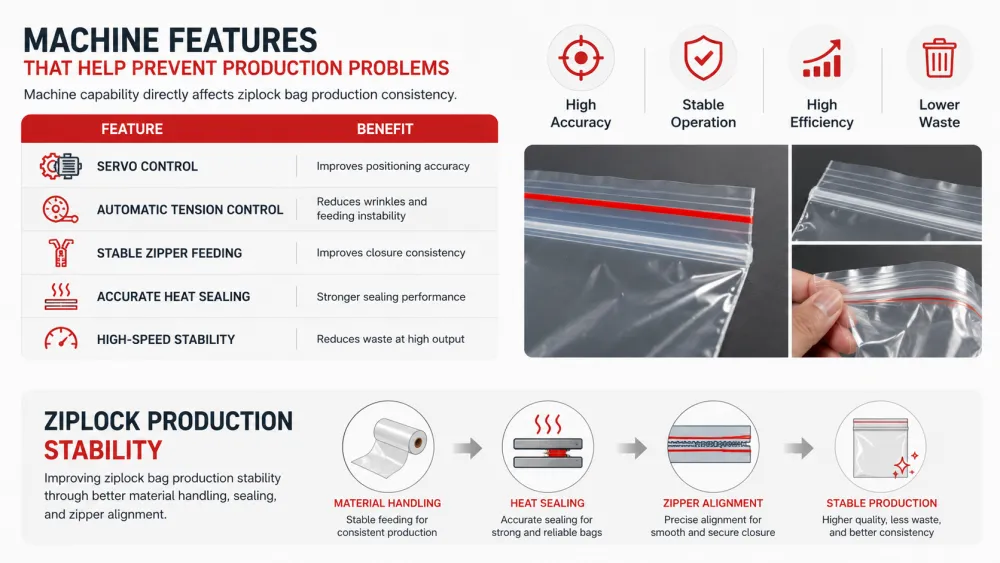
Machine Features That Help Prevent Production Problems
Machine capability directly affects ziplock bag production consistency.
| Feature | Benefit |
|---|---|
| Servo Control | Improves positioning accuracy |
| Automatic Tension Control | Reduces wrinkles and feeding instability |
| Stable Zipper Feeding | Improves closure consistency |
| Accurate Heat Sealing | Stronger sealing performance |
| High-Speed Stability | Reduces waste at high output |
Explore suitable equipment: Ziplock Bag Making Machines
Conclusion
Ziplock bag production requires stable zipper positioning, reliable sealing, accurate feeding, and material consistency.
Common problems such as zipper misalignment, weak sealing, wrinkles, and bag inconsistency can significantly reduce product quality and increase waste.
By improving material compatibility, machine settings, and production stability, manufacturers can reduce defects and improve long-term efficiency.
For a complete machine buying framework, read: Bag Making Machine Manufacturer Buyer Guide
FAQ About Ziplock Bag Production Problems
Why does zipper misalignment happen in ziplock bags?
Zipper misalignment is often caused by unstable web guiding, poor tension control, or inaccurate zipper feeding systems.
What causes weak sealing in ziplock bag production?
Weak sealing usually results from incorrect sealing temperature, insufficient pressure, or incompatible materials.
Why do ziplock bags wrinkle during production?
Wrinkles are commonly caused by uneven web tension, poor roller settings, or inconsistent film thickness.
How can manufacturers reduce ziplock bag waste?
Improving machine stability, material consistency, zipper alignment, and sealing control can significantly reduce scrap rates.