





Flexo Printing for Frozen Food Packaging: Materials & High-Barrier Guide
Frozen Food Packaging Requires More Than Just Good Printing
Frozen food packaging is one of the most demanding applications in the flexible packaging industry. Unlike standard food packaging, frozen products must withstand low temperatures, moisture, transportation, long storage periods, and repeated handling while maintaining package integrity and attractive shelf appearance.
For packaging converters and distributors, selecting the right printing technology is only one part of the solution. Packaging performance depends on choosing the correct material structure, barrier properties, printing inks, lamination process, and machine configuration.
Understanding how these elements work together helps manufacturers produce reliable frozen food packaging while reducing production waste and improving long-term product quality.
Why Frozen Food Packaging Is Different from Standard Food Packaging
Frozen food packaging operates under much harsher conditions than ordinary food packaging.
Packages may be exposed to:
- Sub-zero storage temperatures.
- Condensation during transportation.
- High humidity.
- Sharp product edges.
- Long storage periods.
- Frequent temperature fluctuations.
These conditions require packaging that not only looks attractive but also protects the product throughout its entire supply chain.
As a result, frozen food packaging generally requires stronger material structures and more demanding production processes than many other flexible packaging applications.
What Is High-Barrier Packaging?
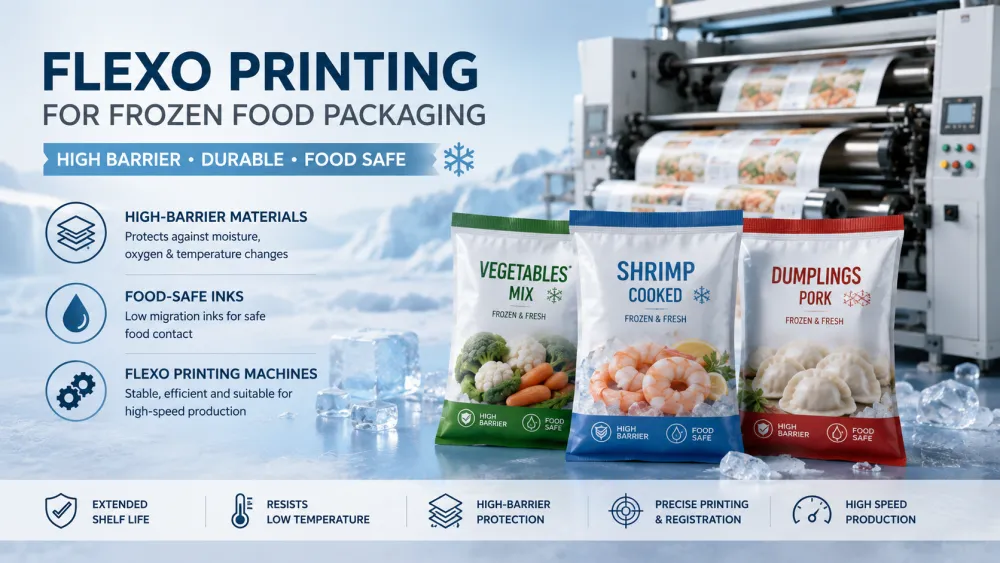
High-barrier packaging is designed to protect food from external factors that reduce shelf life or affect product quality.
A high-barrier package helps prevent:
- Oxygen penetration.
- Moisture migration.
- Loss of aroma.
- Grease penetration.
- External contamination.
- Light exposure for sensitive products.
For frozen food, barrier performance is particularly important because moisture and oxygen can affect both product freshness and package durability during long-term frozen storage.
Common High-Barrier Material Structures for Frozen Food Packaging
Frozen food packaging rarely consists of a single film. Instead, multiple materials are laminated together to combine printability, strength, sealing performance, and barrier protection.
| Packaging Application | Typical Structure | Main Advantages |
|---|---|---|
| Frozen Vegetables | PET / PE | Moisture resistance and sealing |
| Frozen Seafood | PET / NY / PE | Puncture resistance and durability |
| Frozen Meat | PET / AL / PE | Excellent oxygen and moisture barrier |
| Dumplings | BOPP / CPP | Cost-effective with good printability |
| Ice Cream Packaging | PET / PE | Stable printing and sealing performance |
The choice of material structure depends on the product, storage conditions, transportation requirements, and expected shelf life.
Printing Challenges for Frozen Food Packaging
Frozen food packaging presents several printing challenges that require careful process control.
Excellent Registration Accuracy
Retail frozen food products often feature colorful graphics and high-resolution branding. Maintaining stable registration during multi-color printing is essential for professional package appearance.
Strong Ink Adhesion
Printed graphics must remain stable after lamination, sealing, transportation, and long-term frozen storage.
Lamination Compatibility
Since many frozen food packages use laminated structures, the printed surface must be compatible with adhesives and downstream converting processes.
Consistent Drying Performance
Proper drying helps ensure stable ink adhesion and reduces the risk of production defects during lamination.
Why CI Flexo Printing Machines Are Widely Used for Frozen Food Packaging
Most frozen food packaging is produced on lightweight flexible films such as PET, BOPP, and laminated structures.
These materials require stable web handling and accurate multi-color registration throughout production.
For this reason, many converters choose CI Flexo Printing Machines because they provide:
- Stable web tension for thin films.
- Accurate multi-color registration.
- Efficient high-speed production.
- Lower setup waste.
- Excellent performance on laminated packaging films.
For premium frozen food packaging with demanding print quality requirements, advanced servo-controlled CI flexo systems can further improve production consistency and changeover efficiency.
How Packaging Structure Influences Machine Selection
Different frozen food products often require different packaging structures, and these structures influence machine selection.
| Packaging Type | Barrier Requirement | Typical Printing Solution |
|---|---|---|
| Frozen Vegetables | Medium | CI Flexo |
| Frozen Seafood | High | CI Flexo |
| Frozen Meat | Very High | CI Flexo / Rotogravure |
| Frozen Dumplings | Medium | CI Flexo |
| Ice Cream Packaging | Medium | CI Flexo |
Rather than selecting a printing machine first, experienced manufacturers evaluate the packaging structure, barrier requirements, and production objectives before determining the most suitable printing solution.
Questions Buyers Should Ask Before Investing in Frozen Food Packaging Production
- What products will the package contain?
- How long is the required shelf life?
- What barrier performance is required?
- Will the package be laminated after printing?
- Which film structure will be used?
- How many packaging designs will be produced?
- What production speed is required?
- Will future products require higher barrier structures?
Answering these questions before comparing machines helps avoid selecting equipment that may limit future production capabilities.
How ZONBON Machinery Helps Buyers Select Frozen Food Packaging Solutions
Many distributors and packaging buyers understand the frozen food products their customers manufacture but are less familiar with packaging structures, barrier materials, and printing technologies.
At ZONBON Machinery, we begin by understanding the complete production process—including packaging application, material structure, barrier requirements, printing technology, and future expansion plans—before recommending equipment.
Instead of simply supplying a machine, we help distributors, converters, and factory owners bridge the gap between customer requirements and the most appropriate production solution.
Related Reading
If you are planning a flexible food packaging production line, you may also find these guides helpful:
- Flexo Printing for Food Packaging: Materials, Ink & Machine Guide
- How to Choose the Best Flexo Printing Machine for Flexible Packaging Film
FAQ About Frozen Food Packaging Printing
Why does frozen food packaging require high-barrier materials?
High-barrier materials help protect frozen food from oxygen, moisture, and external contamination, extending shelf life and maintaining product quality.
What materials are commonly used for frozen food packaging?
Common structures include PET/PE, PET/NY/PE, PET/AL/PE, and BOPP/CPP, depending on the product and barrier requirements.
Why are CI flexo printing machines widely used for frozen food packaging?
CI flexo machines provide stable web handling, accurate registration, and efficient production for thin flexible films commonly used in frozen food packaging.
Can flexographic printing produce high-quality frozen food packaging?
Yes. Modern CI flexographic printing technology can achieve excellent print quality while supporting efficient production on a wide range of flexible packaging materials.
What should buyers consider before investing in frozen food packaging production?
Buyers should evaluate packaging structure, barrier requirements, substrate type, production volume, lamination process, print quality expectations, and future product expansion before selecting printing equipment.