





Thermal Paper Slitting Machine: Buyer Guide
Why Thermal Paper Slitting Quality Matters
Thermal paper is widely used for POS receipts, ATM rolls, lottery tickets, logistics labels, parking tickets, medical receipts, and various transaction records. Before reaching end users, large jumbo rolls must be converted into smaller finished rolls through a slitting and rewinding process.
Unlike ordinary paper, thermal paper contains a heat-sensitive coating that can be affected by excessive pressure, poor rewinding, dust contamination, or improper slitting conditions. Poor slitting quality may lead to uneven rolls, edge defects, paper dust, telescoping rolls, and printing problems during use.
Choosing the right thermal paper slitting machine helps manufacturers improve roll consistency, reduce waste, and maintain stable production quality.
Common Thermal Paper Products
Thermal paper converting covers a wide range of applications. Understanding product requirements helps buyers select suitable machine configurations.
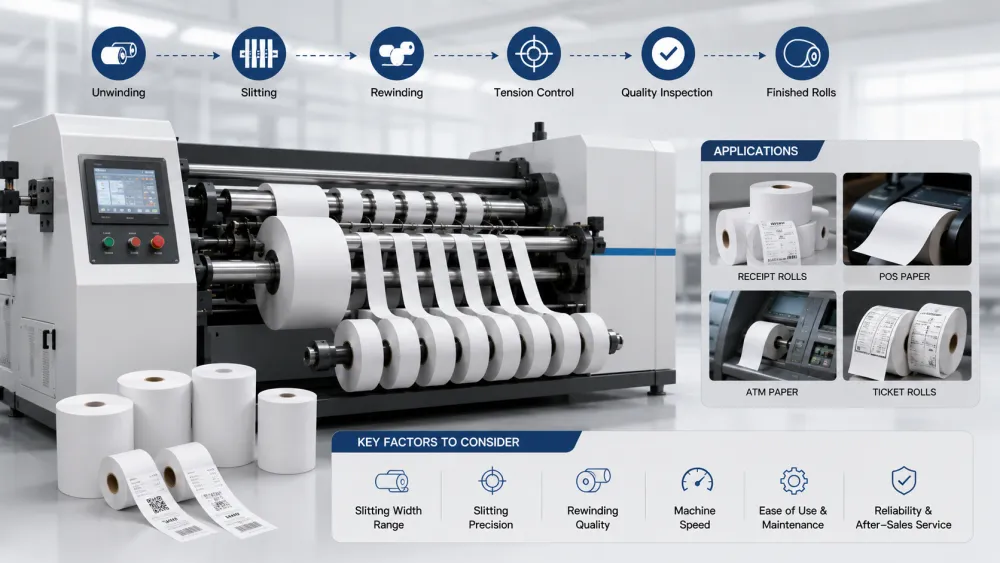
POS Receipt Rolls
POS receipt rolls are one of the most common thermal paper products. Roll diameter consistency, clean edges, and stable rewinding are critical for smooth operation in retail environments.
ATM Rolls
ATM rolls typically require strict width tolerance and stable roll hardness because machine feeding systems are highly sensitive to roll quality.
Lottery and Ticket Rolls
Lottery tickets, cinema tickets, parking tickets, and transportation tickets often require precise roll dimensions and reliable slitting accuracy.
Logistics Label Materials
Thermal label materials often require accurate width control because poor slit quality can affect label printing and die-cutting performance.
What Is a Thermal Paper Slitting Machine?
A thermal paper slitting machine is specialized converting equipment used to slit large thermal paper jumbo rolls into smaller finished rolls while maintaining consistent roll quality and protecting the thermal coating.
A typical production process includes:
- Unwinding: Feeding jumbo thermal paper rolls.
- Web Guiding: Maintaining paper alignment.
- Slitting: Cutting paper into required widths.
- Rewinding: Producing finished rolls with consistent hardness.
- Finished Roll Collection: Preparing rolls for packaging.
Modern thermal paper slitting machines are designed to minimize dust, maintain slit accuracy, and improve rewinding stability.
Key Challenges in Thermal Paper Slitting
Paper Dust Generation
Excessive paper dust is one of the most common problems in thermal paper converting. Dust can contaminate machine components and negatively affect print quality.
Roll Hardness Consistency
Uneven rewinding may create rolls that are too loose or too tight. This can cause feeding issues in POS printers and ATM machines.
Edge Quality
Rough or damaged edges may lead to paper jams and reduce customer satisfaction.
Width Accuracy
Many receipt and ticket applications require strict width tolerances. Even small variations may create compatibility problems with automatic printing equipment.
How to Choose a Thermal Paper Slitting Machine
Slitting Accuracy
High slit width accuracy is essential for receipt rolls, ATM rolls, and ticket applications. Buyers should verify machine tolerance specifications before purchasing.
Tension Control System
Stable tension helps maintain roll consistency and prevents wrinkles or uneven winding.
Understanding web tension control in slitter rewinder machines can help buyers evaluate machine performance more effectively.
Knife System
The knife system directly affects edge quality and dust generation.
Depending on paper type and production requirements, manufacturers may use different cutting methods. This comparison of razor slitting vs shear slitting vs crush slitting explains the advantages of each approach.
Rewinding Quality
Stable rewinding is critical because finished rolls must perform reliably in automatic receipt printers and ticket machines.
Production Speed
Buyers should balance production speed with roll quality. High speed is valuable only when consistent slitting quality can be maintained.
Common Thermal Paper Slitting Problems
Loose Rolls
Usually caused by insufficient rewind tension or poor winding control.
Telescoping Rolls
Often caused by uneven winding pressure or unstable tension.
Excessive Dust
Typically caused by dull knives or unsuitable slitting conditions.
Uneven Widths
May result from incorrect knife positioning or unstable web guiding.
Wrinkles
Often caused by improper tension settings during slitting and rewinding.
Features to Look for in a Thermal Paper Slitting Machine
- Automatic tension control
- Accurate slit width adjustment
- Stable rewinding system
- Dust reduction design
- EPC web guiding system
- Easy knife adjustment
- Production data monitoring
These features help improve roll consistency and reduce downtime in high-volume thermal paper production.
Choosing the Right Machine Configuration
Machine configuration should be selected based on jumbo roll width, finished roll size, production volume, paper thickness, and downstream application requirements.
For manufacturers producing POS rolls, ATM paper, and ticket rolls, consistent rewinding quality and slitting accuracy often have a greater impact on customer satisfaction than maximum machine speed.
Buyers evaluating paper slitting machines should focus on long-term production stability, maintenance requirements, and roll quality consistency.
FAQ: Thermal Paper Slitting Machine
What is a thermal paper slitting machine used for?
It is used to convert jumbo thermal paper rolls into finished POS rolls, ATM rolls, ticket rolls, and other thermal paper products.
Why is rewinding quality important for thermal paper?
Poor rewinding may cause feeding problems in printers, POS systems, and ATM machines.
How can paper dust be reduced during slitting?
Using sharp knives, proper slitting methods, and regular machine maintenance helps reduce dust generation.
Why is slit width accuracy important?
Accurate widths ensure compatibility with receipt printers, ticket machines, and automatic dispensing equipment.
What should buyers focus on when choosing a thermal paper slitting machine?
Buyers should evaluate slitting accuracy, rewinding quality, tension control, production speed, dust control, and machine stability.